 By
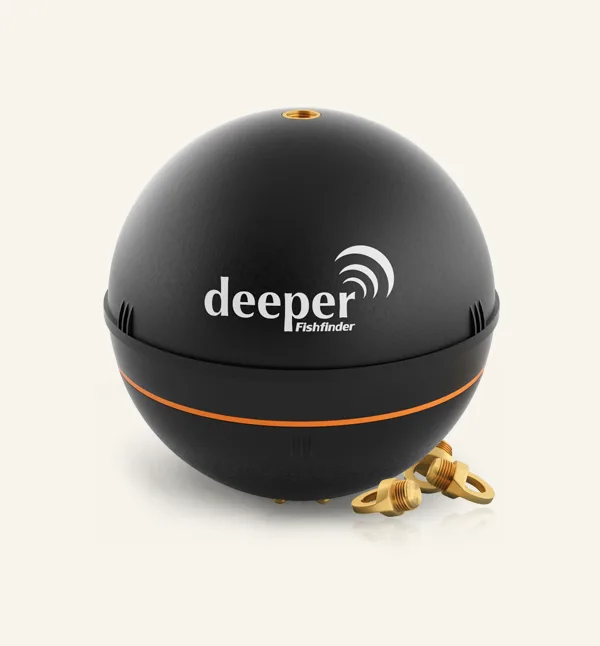
A portable fish finder comes down to one choice: a castable sonar ball for about $160–280, or a real fish finder in a carry case for about $150–550. From the bank, a pier or a dock, get the castable. You tie it to your line and read it on your phone. A bare-bones one like the Deeper START is $89.99. If you move between a rental boat, a borrowed kayak and the ice, get the kit. It has its own battery and a suction-cup transducer.
On paper, my first pick on the bank is the Deeper PRO+ 2 because its map teaches you the water you fish. The Garmin Striker Cast GPS is the easy second. In a rental boat, the Garmin Striker 4 Portable Bundle is the kit to get: the budget kit that still has GPS. The figures are the makers’ specs and fall 2026 retailer prices, plus one reviewers’ round-up for the kits. I haven’t put any of them on the water for this page.
The Deeper MAX sends you sonar from about 400 ft (120 m) out, and it runs up to 15 hours a charge with GPS off.
Castable or carry kit?
Go by where you stand. On solid ground, use a castable. In a boat you don’t own, use a kit. Both work on the ice.
| Kind | What it is | Power | Best for | Limits |
|---|---|---|---|---|
| Castable | A floating sonar ball on the line that streams to a phone app | Built-in battery, 6–15 h a charge | Bank, pier, dock, pond, ice hole | Sees only a strip along your retrieve, and your phone is the screen |
| Carry kit | A screen unit, transducer and battery, usually in a case, sold as one | A 12 V battery or AAA cells, all day | Rental boats, kayaks, canoes, ice | You set it up every trip, and the transducer mount is the weak point |
Only ever fish from your own kayak? Skip both and bolt a kayak fish finder to it. It won’t move from boat to boat, but it’s the better buy there.
Which one is for you?
Find the way you fish, and that’s your pick.
| Situation | Pick |
|---|---|
| Bank fishing a pond or lake, want to learn the bottom | Deeper PRO+ 2 |
| Night catfishing or wide water from the bank | Deeper MAX |
| Bank or pier, want depth and fish, simply | Garmin Striker Cast GPS |
| Tight budget | From the bank, the Deeper START ($89.99, 165 ft range and depth, 6 h, no GPS). In a canoe or small boat, the HawkEye FishTrax 1C |
| Rental boats, canoes, occasional ice | Garmin Striker 4 Portable Bundle |
| Older eyes, kayak or boat | Humminbird HELIX 5 G3 Portable |
| Your own kayak | A unit mounted on that kayak, not a portable kit |
Free PDF · Water temperature chart Which fish are biting at today's water temperature?
One reading, and the 16-page chart shows which of 26 fish are spawning, feeding hard or slowing down; for bass, crappie, bluegill and walleye, where they sit and what to throw. Every number sourced.
No card, nothing to buy, and the PDF is yours to keep. Confirm with one click and it's on its way. Then a few short emails and one a week on what's biting. Unsubscribe anytime. Privacy.
How do the six compare?
| Unit | Sonar | Max depth | Runtime | Price |
|---|---|---|---|---|
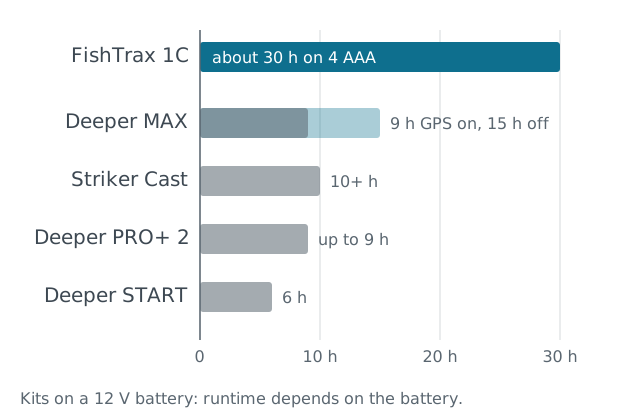
| Deeper PRO+ 2 (castable) | Three beams: 675, 240, 100 kHz | 330 ft (100 m) | Up to 9 h | $159.99 sale, $179.99 regular |
| Deeper MAX (castable) | Three beams, same frequencies | 330 ft (100 m) | 9 h GPS on, 15 h off | $249 sale, $279.99 regular |
| Garmin Striker Cast GPS (castable) | 260/455 kHz | 150 ft (45 m) | 10+ h | $199.99 |
| Garmin Striker 4 Portable Bundle (kit) | CHIRP, 77/200 kHz transducer | 1,600 ft (488 m) fresh | 0.23 A draw, as long as the battery lasts | $249.99 |
| Humminbird HELIX 5 CHIRP GPS G3 Portable (kit) | Dual Spectrum CHIRP | 1,200 ft (366 m) | As long as the battery lasts | About $550 |
| HawkEye FishTrax 1C (kit) | 200/83 kHz | 240 ft (75 m) | About 30 h on 4 AAA | $149.99 sale, $184.99 regular |
Go easy on the depth column. A kit’s 1,600 ft is a best-case number for water you’ll never fish. A castable’s 150–330 ft covers almost every pond and every lake you can reach from the bank. On a castable, look at runtime. On a kit, look at screen size.
Deeper or Striker Cast?
Buy the Deeper for the map and the Striker Cast for less fuss. Both are floating balls that send sonar to your phone. They differ in what they do with it.
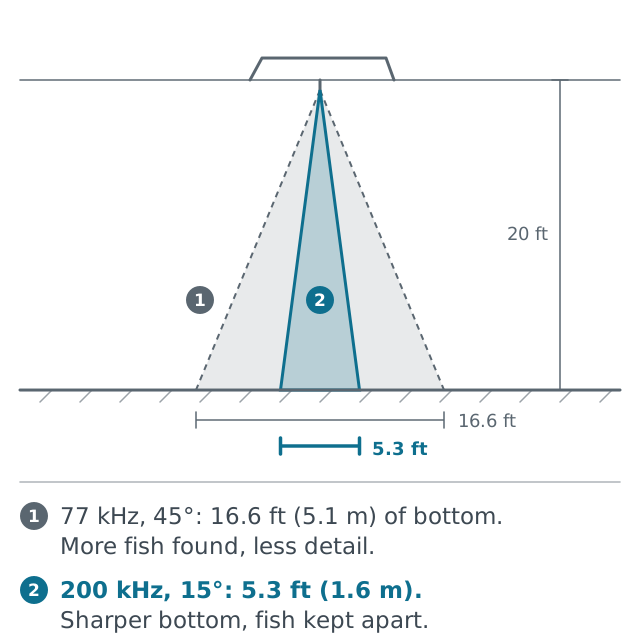
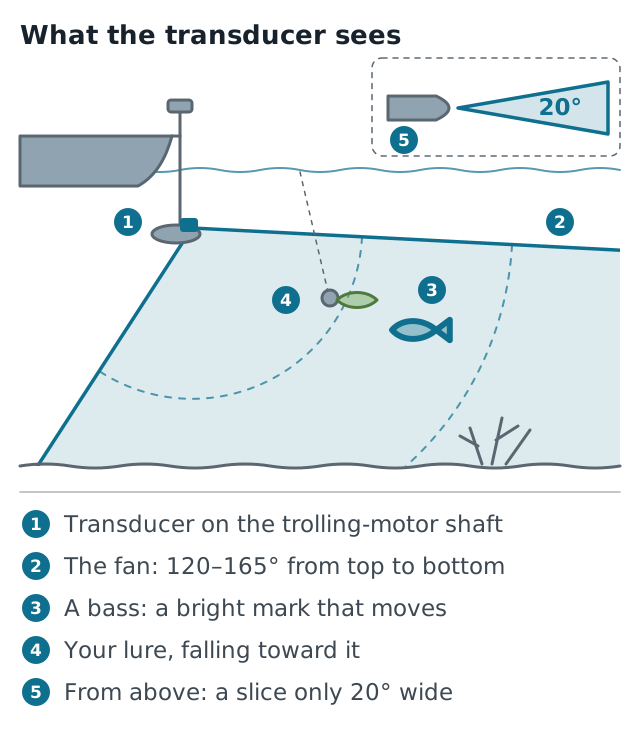
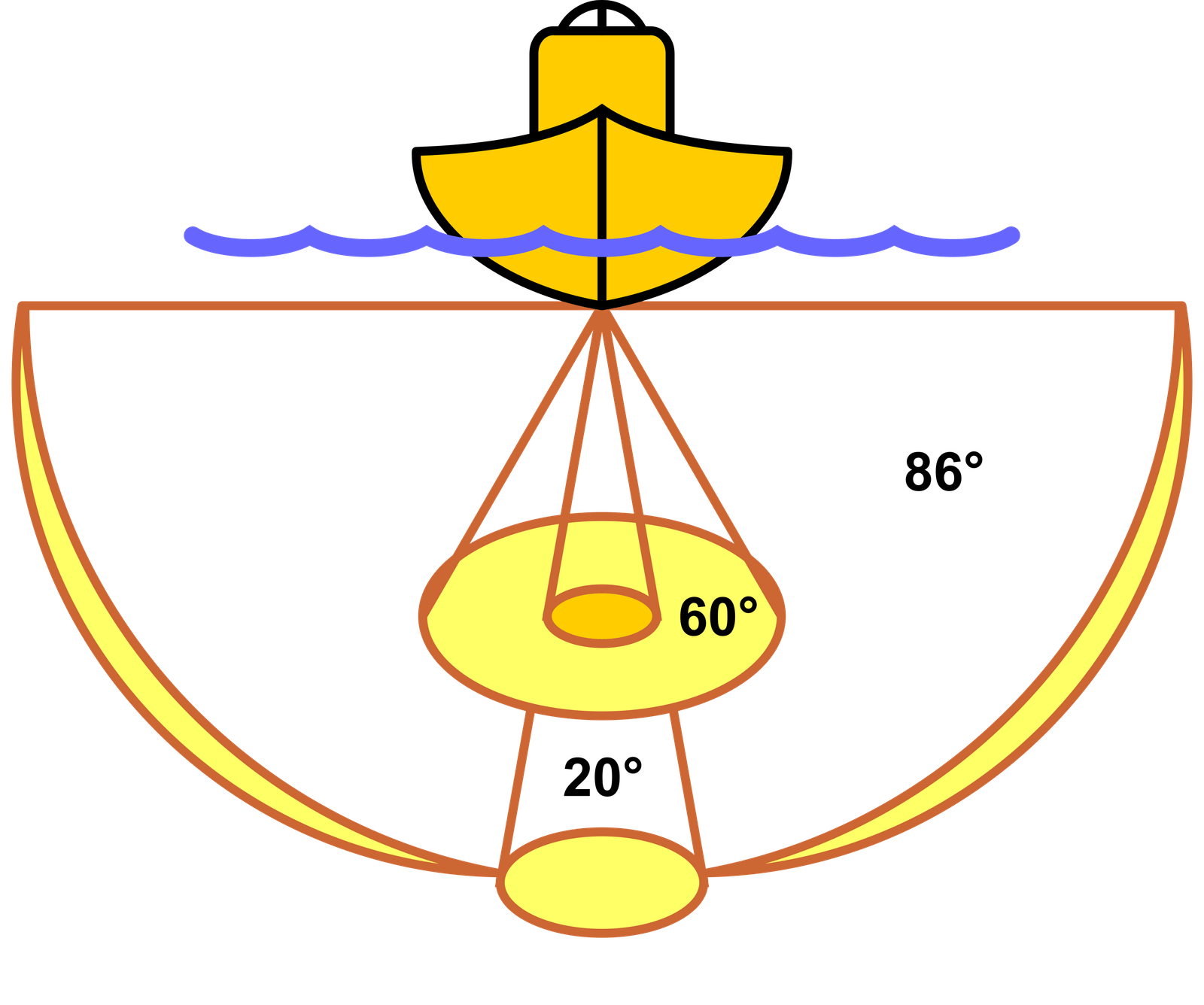
Deeper runs three beams at once. The narrow one, a 7° cone at 675 kHz, shows you the detail, down to two targets 1 cm (0.4 in) apart. The wide one, a 47° cone at 100 kHz, finds things. A 20° cone at 240 kHz sits in the middle. The ball makes its own Wi-Fi network, so you don’t need a phone signal. That link holds to 100 m (330 ft) on the PRO+ 2 and about 400 ft (120 m) on the MAX, Deeper says.
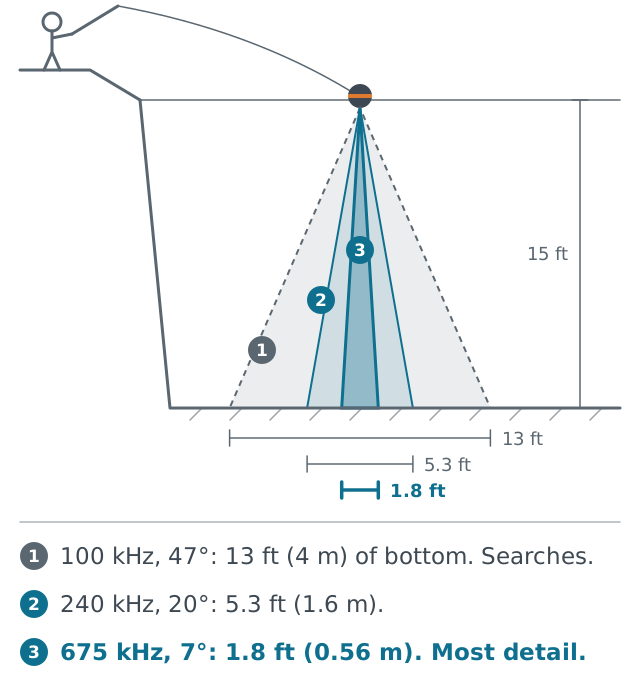
At 15 ft (4.6 m) the wide beam sweeps a 13 ft (4 m) circle of bottom. That’s why a slow retrieve finds the edge of a drop-off. The narrow beam covers less than 2 ft of it and shows you the detail.
The map is the real reason to buy one. GPS logs every cast, and the app turns them into a depth chart of the water in front of you, a bathymetric map. Forget to charge it and the PRO+ 2 fast-charges to 80% in 45 minutes.
Garmin’s Striker Cast is simpler, with two frequencies, 260 and 455 kHz, a 200 ft casting range and more than 10 hours a charge. The GPS model records Quickdraw Contours, Garmin’s own maps with 1 ft contours. For the ice it has a flasher mode. A 16.4 ft (5 m) tether comes with it for dropping it off a dock or down a hole. Use 20 lb line or heavier, Garmin says.
Fish the same pond or reservoir bank again and again, and the Deeper’s map is worth it. The MAX’s 15 hours with GPS off cover a whole night of catfishing, though with the map running it’s 9 hours, the same as the PRO+ 2. For depth, bottom and fish with the least fuss, take the Striker Cast.
How do you use a castable from the bank?
Cast it far, reel it back slowly and watch the bottom draw on your phone.
- Rig it like a heavy lure. Tie the ball to 20 lb mono or 30 lb braid on a medium-heavy rod with a palomar knot. Light line on a light rod is the usual way a ball gets lost.
- Cast to the far edge of what you can reach and let it settle. Open the app and the depth reads at once.
- Reel back slowly, about a turn a second, and watch the profile draw. You’ll see the drop-off off the bank, the hump, the channel, weed as a fuzz above the bottom, fish as arches or icons.
- Fan-cast your spot at four or five angles. On a Deeper or a Striker Cast GPS, each cast adds to the map. After a dozen casts, the shape of the bottom is on your screen.
- Mark the features and fish them. The cast where the bottom fell from 4 ft to 12 ft is the cast to repeat with a bait.
- Use the other modes. Deeper has shore, kayak, boat and ice modes. Troll the PRO+ 2 behind a boat at a slow 3 km/h (about 2 mph). On the ice, the Striker Cast has a flasher mode for reading down the hole. The PRO+ 2 has an A-Scope vertical flasher, plus an ice mode that remembers where each hole was.
What does a carry kit give you?
A kit is a real fish finder made to travel. Open Garmin’s Striker 4 Portable Bundle and you get the 3.5 in unit, a carry case and a sealed rechargeable battery with its charger. Also in the box: a suction-cup transducer mount, a kayak in-hull transducer mount, a foam float and cable storage. For the ice, Garmin also sells the same Striker 4 as an Ice bundle, the portable kit plus an ice fishing transducer. Humminbird’s HELIX 5 G3 Portable puts the same idea on a shuttle frame in a soft case, with a suction-cup transducer, battery and charger. HawkEye’s FishTrax skips the 12 V battery and runs on four AAA cells.
Kits differ most in the battery. That Garmin bundle’s weak spot is its sealed lead-acid battery, Wired2Fish says. It’s heavier than the lithium batteries kayak anglers carry now. But a small unit needs very little power. The Striker 4 draws 0.23 A in normal use, Garmin says, so a ten-hour day uses about 2.3 amp-hours. Even a small 12 V battery of a few amp-hours gets you through more than one day like that on a charge. Cold cuts what any battery gives, so on the ice don’t count on the second day.
| Striker 4 at its typical 0.23 A draw | Battery used |
|---|---|
| A 4-hour evening on a rental boat | About 0.9 Ah |
| A 10-hour day on the ice | About 2.3 Ah |
| Two 10-hour days | About 4.6 Ah |
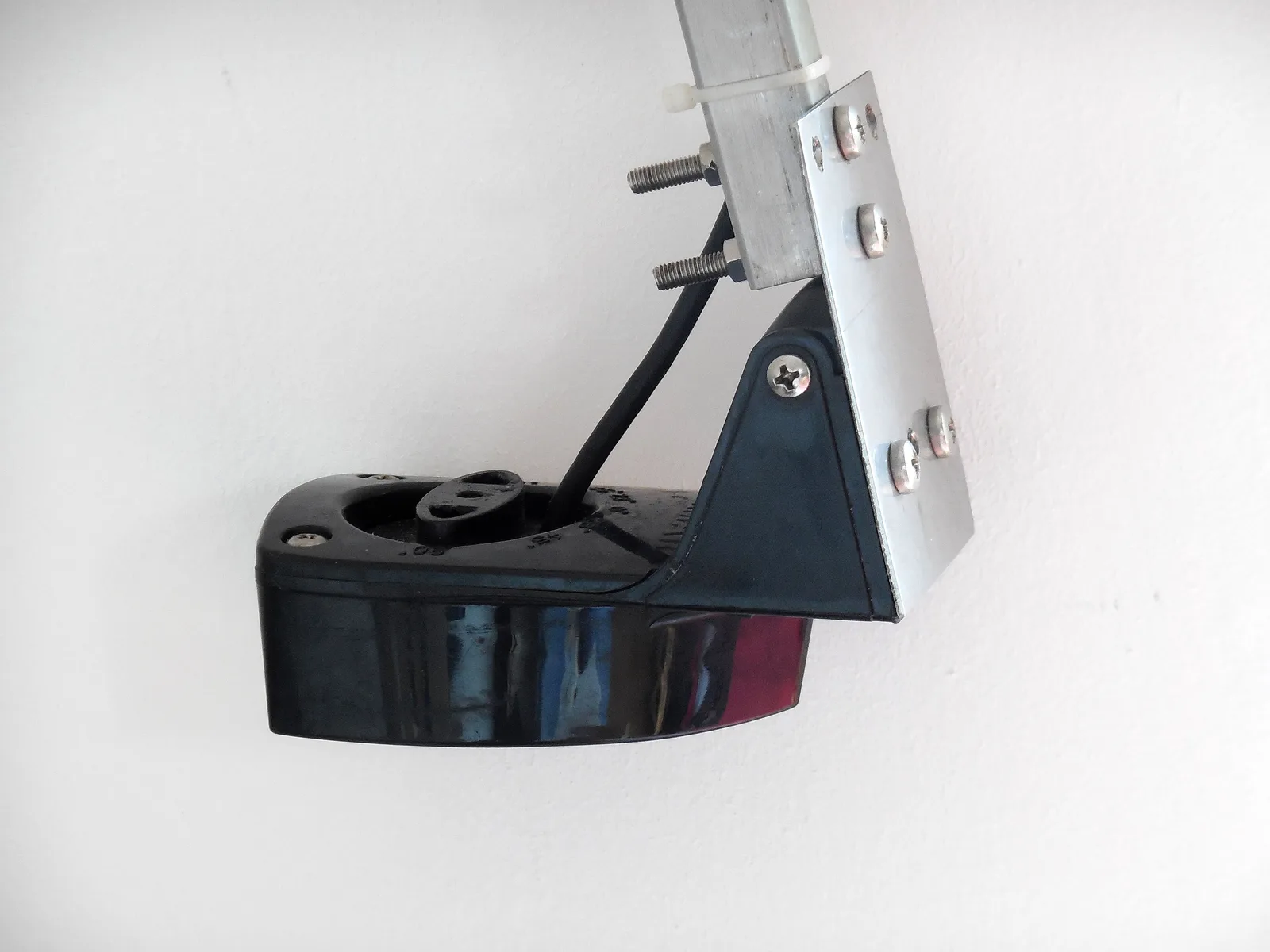
Watch the suction cup, because that’s the weak point. It holds on a clean, smooth hull, a canoe or the transom of a rental jon boat. It lets go on a dirty or textured one. Wet the cup, press it on below the waterline and tie a lanyard to the transducer cable. On the ice, drop the transducer down the hole. The Striker 4’s flasher view shows your jig and the fish coming to it.
For down imaging, a picture of what’s under you, the next unit up is Garmin’s Striker Vivid 4cv. It lists at $199.99 with its transducer, less than the bundle, but you get no portable kit: no case and no battery. The best fish finder page walks every price step above it.
What else matters before you buy?
Frequency and cone. Lower frequencies reach deeper and spread wider. Higher ones show more detail in a narrower cone. The fish finders hub has the table.
Wi-Fi range is not the casting limit. A Deeper’s own Wi-Fi reaches 330–400 ft, farther than most of us can cast a 3.3 oz (94 g) MAX. So your rod, not the radio, decides how far out you can read.
Can I use my phone as a fish finder? Only with a castable. Your phone has no transducer, so on its own it can’t see under the water. The castable is the sonar and your phone is its screen. It’s hard to read in bright sun, and its battery runs down with the app open. Turn the brightness up, carry a power bank and keep the phone in a dry pocket between casts.
GPS is what makes a map. Without it you see the bottom once. With it, you can save the drop-off and find it next weekend. Of the six compared, only the HawkEye lacks GPS. The Deeper START in the budget row has none either.
Does any fish finder show actual fish? None of the six here draws a picture of a fish. You see arches, icons or blobs and the bottom. The how to read a fish finder page explains them. A flasher shows a fish rising toward your jig as a moving band. Only forward-facing sonar shows fish as moving shapes out in front of you, and it costs far more than any unit here.
Who is each one for?
Deeper PRO+ 2
This one teaches you the water you fish. Three beams, 330 ft depth and the map make it my pick when you fish the same banks all season for carp, catfish or bass. Deeper’s own US store listed it sold out when we checked in October 2026, so check stock before you count on it. Nine hours a charge is a long day, so charge it the night before.
Deeper MAX
It’s the PRO+ 2’s sonar with a bigger battery, longer Wi-Fi reach and USB-C. Buy it for night fishing, or for wide water where 400 ft of reach matters. It costs about $90 more on sale, $100 at full price. On a small pond by day, the PRO+ 2 does the same job.
Garmin Striker Cast GPS
Buy this one when you want an answer, not a project. It gives you depth, bottom, fish, a flasher on the ice and simple contours. Its 150 ft depth limit is no limit from a bank.
Garmin Striker 4 Portable Bundle
This is Garmin’s entry kit, with CHIRP (sonar that sweeps a band of frequencies instead of one, for cleaner arches), GPS waypoints and a flasher mode in one case. The 3.5 in screen is small. If you need reading glasses, look at the HELIX.
Humminbird HELIX 5 CHIRP GPS G3 Portable
You’re paying for the screen. A 5 in, 800 × 480 display is much easier to read in a moving kayak or a bright boat. It costs about twice the Striker bundle. The Humminbird fish finder page explains what the rest of the HELIX ladder adds.
HawkEye FishTrax 1C
It runs thirty hours on four AAA batteries, and there’s no 12 V battery to carry. The display is small, 2 × 1.6 in (50 × 40 mm). There’s no GPS, so it shows you depth and fish but can’t take you back to a spot.
How were the picks chosen?
We gave each of the six one job: be the clearest answer for one kind of angler. That’s the bank angler who wants a map, the one who wants it simple and the night angler. Then come the rental-boat angler who also walks on the ice, the one who needs a bigger screen in a kayak or boat, and the angler on a tight budget.
Every figure on depth, frequency and runtime comes from the maker’s own product or support page, or from a retailer reprinting the maker’s spec sheet. Prices are the list or sale prices we saw on the makers’ and retailers’ sites in October 2026. They move weekly, so check before you buy. The Deeper PRO+ 2 and MAX were listed as sold out on Deeper’s US store when we wrote this. Wired2Fish’s guide (Ric Burnley, June 2024) gave us the reviewers’ picks for kits. It leaves castables out entirely, and they’re half of what “portable” means.
Once the bottom is on your screen, the bass hub tells you what bass hold on by season, so you know where to cast. The Garmin fish finder page shows where the Striker family goes after the portable bundle.

Free PDF · 16 pages
Stop guessing. Know what's biting before your first cast
A whole Saturday on the water with nothing to show for it. One reading tells you who's feeding.
The Water Temperature Fishing Chart. Take one water temperature reading, find it on the chart, and see which of 26 freshwater fish are spawning, feeding hard or slowing down.
- Where bass, crappie, bluegill and walleye sit, and what to throw. Trout: the reading where you stop.
- Why a 3 ft drop beats a cold front, and what to throw each day of the front
- The three thermometer mistakes that make a reading lie
The chart's numbers come from state fish and wildlife agencies and fisheries research: 61 sources, each listed on the site.
No card, nothing to buy. Confirm with one click and the PDF is on its way, one version for your phone and one to print, yours to keep. Then a few short emails and one a week on what's biting, with an unsubscribe link in every one. Privacy.
Related
Section guide
Fish Finders: How Sonar Works, the Types, and Which Unit to BuyA fish finder is a sonar: how it works, what 2D, CHIRP, side imaging and live sonar show, what each costs, and the three brand ladders from $120 up.
 Lowrance Fish Finder: Eagle, Eagle Eye, HOOK Reveal, Elite FS and HDS PRO
Lowrance fish finders from the $123 Eagle 4x to HDS PRO, with the $999 Eagle Eye 9 Live as the cheapest live sonar and the pick for each boat.
 Garmin Striker 4: What It Does, What It Lacks, Which Striker to Buy
Garmin fish finder Striker 4: CHIRP sonar and GPS for $159.99, no maps or imaging. The specs, the 4 vs Plus 4 vs Vivid 4cv, and how to read the screen.
 Depth Finder for a Boat: Which Unit, and Where the Transducer Goes
The best boat depth fish finder is a $120–200 sonar, not a dash gauge. The picks by boat, and the makers' rules for where the transducer goes.
 Forward Facing Sonar: How It Works, What It Costs, and the 2026 Rules
Forward facing sonar shows fish and your lure ahead of the boat, live. LiveScope 2, MEGA Live 2, ActiveTarget 2 compared, from $999, plus the rules.
 Garmin Fish Finder: Striker vs ECHOMAP vs GPSMAP, and Which to Buy
Garmin fish finders as a ladder: Striker (sonar only), ECHOMAP (charts, LiveScope 2), GPSMAP. Current prices, the model-number decoder, the pick by boat.
 Humminbird Fish Finder: PiranhaMAX, HELIX, SOLIX, XPLORE and APEX
Humminbird fish finder picks: PiranhaMAX 4 for a jon boat, HELIX 5 or 7 for a kayak, XPLORE 9 for a bass boat that may add MEGA Live 2. No HELIX runs it.
Sources (12)
- Deeper, PRO+ 2 product page and specifications
- Deeper support, Deeper MAX technical specifications and key features
- Deeper, Deeper MAX product page (price and modes)
- Deeper, compare Deeper fish finders (depth, casting range, beams, battery, A-Scope flasher)
- Deeper, Deeper START product page (price)
Show all 12 sourcesShow fewer sources
- Tackle Warehouse, Garmin Striker Cast GPS castable sonar
- Garmin, STRIKER 4 and STRIKER 4 Portable Bundle
- GPS Central, Garmin Striker 4 Portable Bundle specifications
- Mealey Marine, Humminbird HELIX 5 CHIRP GPS G3 Portable (411680-1)
- HawkEye Electronics, FishTrax 1C small boat fish finder
- Wired2Fish (Ric Burnley), best portable fish finders
- Tackle Warehouse, Garmin Striker Vivid series: models and prices