 By
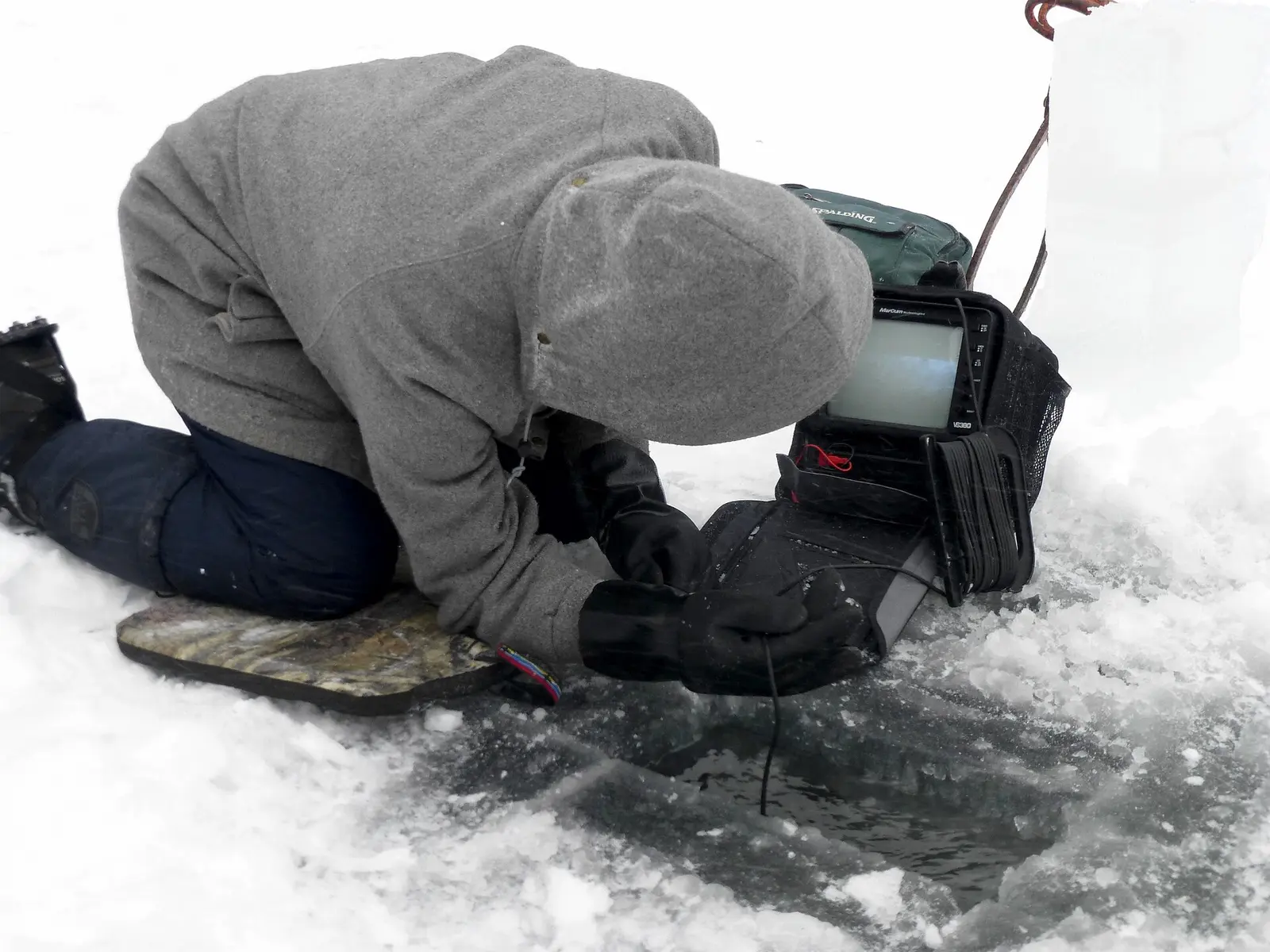
An ice fishing camera is a small waterproof camera on a cable. You drop it down a hole and watch the fish live on a screen on the ice. New, the makers’ own kits start at $229.99 for Aqua-Vu’s Micro Stealth 4.3 and run to $699.99 for MarCum’s Quest HD L. For a first camera, get MarCum’s Pursuit SD Plus at $319.99. The picks rest on the makers’ pages and manuals, read on November 22, 2026, and their prices, re-read on November 25. None was run on the ice for this page.
In muddy water a camera may see only a few inches. In clear water it sees many feet, MarCum says. Know your lake before you spend $300.
What does an underwater camera show that a flasher can’t?
It shows you what the fish is. A flasher is a sonar. It shows a mark, a band of color on a dial, for anything the sound bounces off. A camera shows the thing itself.
MarCum puts it plainly in its VS485C manual. A color camera lets you “see how fish, bait, lures and weeds really look.” You see whether that mark is a crappie, a perch or a pike. You see whether it’s eating your jig or just looking. And you learn “how to interpret signals on your sonar”, the same manual says. That’s the quiet bonus: watch both for a few days and the flasher starts to make more sense.
Minnesota DNR names both tools in the same breath. Anglers with an underwater camera or sonar “clearly have an advantage” in finding where crappie are or aren’t, it says. For walleye it calls sonar particularly helpful, and cameras good for seeing what the bottom looks like and how much bait is around.
| Ice fishing camera | Flasher | |
|---|---|---|
| What you see | The fish, the bottom, your jig, in picture | Marks on a dial, live |
| Which way it looks | Sideways, 90° to 110° wide | Straight down, in a cone |
| How far | Many feet in clear water, inches in muddy | Down to the bottom: a 19° cone covers 6.7 ft (2 m) of it at 20 ft (6 m) |
| Best at | Telling what a fish is and how it acts | Depth, bottom and fish under the hole |
| Maker price | $229.99 to $699.99 | $259.99 on sale (list $369.99) to $699.99 |
Field of view from MarCum’s camera specs, cone coverage from Vexilar’s manual. Prices from the makers’ own stores on November 15 (flashers) and November 25, 2026 (cameras).
The catch is the water. A camera needs light and clear water to see, MarCum says. A flasher reads by sound, not light. If you fish a stained or muddy lake, buy the flasher first.
Which ice fishing camera should you buy?
Here’s the pick for each kind of ice angler. All prices are the makers’ own, read on November 25, 2026.
Your first camera: MarCum Pursuit SD Plus, $319.99
Of the three makers here, it was the cheapest new camera in stock on November 25, and MarCum had it on sale at $199.99 that day. You get a 5 in screen, 50 ft of cable and up to 6 hours of runtime on a built-in lithium battery. It shows camera depth, water temperature and direction on screen, and records to a micro SD card. Skip it if you want full HD. Its screen is 800 x 480.
The cheapest new one from a camera maker: Aqua-Vu Micro Stealth 4.3, $229.99
A 4.3 in screen the size of a phone and 50 ft of depth-marked cable on a built-in spool. It runs up to 6 hours on its lithium battery. Its infrared lights come on by themselves in low light. It was on pre-order on November 25, expected to ship December 14. Skip it if you want depth and temperature on the screen. Aqua-Vu’s page doesn’t list them.
Tip: All four new Aqua-Vu cameras were on pre-order on November 25, to ship December 14. Want it for first ice? Buy one that’s in stock.
In stock that day instead: Vexilar’s reconditioned Fish Scout Predator at $319.99. Aqua-Vu’s certified refurbished Micro Stealth 4.3, $149.99, was sold out.
The HD step up: MarCum Pursuit HD L, $499.99
A 1080p camera feeds a 1280 x 720 screen of 5 in. The cable winds on a reel built into the unit. MarCum says the image is sharp enough to zoom in on weeds, fish and jigs. Runtime is the same as the SD Plus, up to 6 hours. Pay the extra $180 only if picture detail matters to you.
Fishing from a shelter: Aqua-Vu AV822HD, $599.99
An 8 in screen, a 1080p camera, 60 ft of cable and up to 9 hours of runtime. It records, and HDMI out lets you show the picture on a bigger screen in the ice fishing shelter. Also on pre-order, to ship December 14. Vexilar’s Fish Scout Base Camp, $349.99, has no screen of its own: it plugs its 1080p camera into any TV with an HDMI port. It was sold out on Vexilar’s store.
Already own a sonar screen: Aqua-Vu Micro Revolution HD, $199.99
It’s a camera on a built-in reel, with no screen. It plugs into select sonar units and outside monitors, Aqua-Vu says. Aqua-Vu’s page doesn’t name the units, so ask Aqua-Vu whether yours takes it before you order. Also on pre-order, to ship December 14. It’s $150 less than the Micro Revolution 5.0 HD, which comes with its own 5 in screen.
Free PDF · Water temperature chart Which fish are biting at today's water temperature?
One reading, and the 16-page chart shows which of 26 fish are spawning, feeding hard or slowing down; for bass, crappie, bluegill and walleye, where they sit and what to throw. Every number sourced.
No card, nothing to buy, and the PDF is yours to keep. It's in your inbox a minute later. Then a few short emails and one a week on what's biting. Unsubscribe anytime. Privacy.
Ice fishing cameras side by side
Here are the makers’ cameras on one ladder, cheapest first. Out of stock means the maker’s own store showed it sold out on November 25, 2026.
| Camera | Screen | Cable | Battery and runtime | Price |
|---|---|---|---|---|
| Aqua-Vu Micro Stealth 4.3 | 4.3 in | 50 ft (15 m) | Lithium, up to 6 h | $229.99 (pre-order) |
| MarCum Recon 5 | 5 in | 50 ft (15 m) | Lithium, up to 6 h | $299.99 (out of stock) |
| MarCum Pursuit SD Plus | 5 in | 50 ft (15 m) | Lithium, up to 6 h | $319.99 |
| Aqua-Vu Micro Revolution 5.0 HD | 5 in | 60 ft (18 m) | Lithium, runtime not given | $349.99 (pre-order) |
| MarCum VS485c | 7 in | 50 ft (15 m) | 12 V 7 Ah lead-acid | $379.99 (out of stock) |
| Vexilar Fish Scout Predator | 5 in | 50 ft (15 m) | Lithium polymer, runtime not given | $449.99 (out of stock) |
| MarCum Pursuit HD L | 5 in | 50 ft (15 m) | Lithium, up to 6 h | $499.99 |
| MarCum Explorer HD L | 7 in | 75 ft (23 m) | 12 V 10 Ah lithium, about 11 h | $549.99 (out of stock) |
| Aqua-Vu AV822HD | 8 in | 60 ft (18 m) | Lithium, up to 9 h | $599.99 (pre-order) |
| MarCum Quest HD L | 7 in | 75 ft (23 m) | 12 V 10 Ah lithium, about 11 h | $699.99 (out of stock) |
Specs and prices from each maker’s own product page. MarCum gives the 11 hours as an estimate “depending on conditions.”
Search the term in Google and the shopping boxes on top are full of no-name cameras from about $50. Some may work fine. The ones in those boxes on November 22 came from marketplace sellers, with no maker’s spec page or manual we could check. So they’re not on this list.
Looking at one anyway? Check four things on the listing. Cable as long as the water you fish is deep. Infrared lights, not just white ones. Battery hours, and what battery it is. And a cold rating. MarCum rates its Pursuit HD L down to 14 °F (-10 °C). A listing with no number tells you nothing.
What does more money buy?
Four things, and here’s what each does on the ice.
- Cable. Most kits carry 50 ft (15 m). MarCum’s Explorer HD L and Quest HD L carry 75 ft (23 m). Know the depth you fish for perch or walleye, and buy cable to match.
- Lights. Every camera in the table has lights for dark water. If you want one feature, look for infrared. Aqua-Vu says its invisible IR lighting improves low-light viewing “without spooking fish.” MarCum calls IR “a stealthy approach because infrared lights are not visible to the eye.”
- Screen size. A 4.3 or 5 in unit fits in your hand. MarCum’s Pursuit HD L weighs 2.7 lb, and its soft pack lets you wear it hands-free. That suits hole hopping, drilling and checking hole after hole. A 7 or 8 in screen is easier to share in a shelter, but MarCum’s 7 in kits weigh 10.2 to 13 lb.
- Extras. Depth on screen tells you how deep the camera hangs, and temperature reads the water, not the air. A DVR records what you saw. Nice, not needed.
Pixels matter least. How far any camera sees depends on the water’s clarity and the light, MarCum’s manual says. A sharper camera can’t see further in muddy water.
How do you set up an ice fishing camera?
Use two holes. Drill a second hole 3 or 4 ft from the one you fish, MarCum’s VS485C manual says. Set the screen on the ice and lower the camera down that second hole. Then send your bait down and find it on the screen. Now you’re fishing.
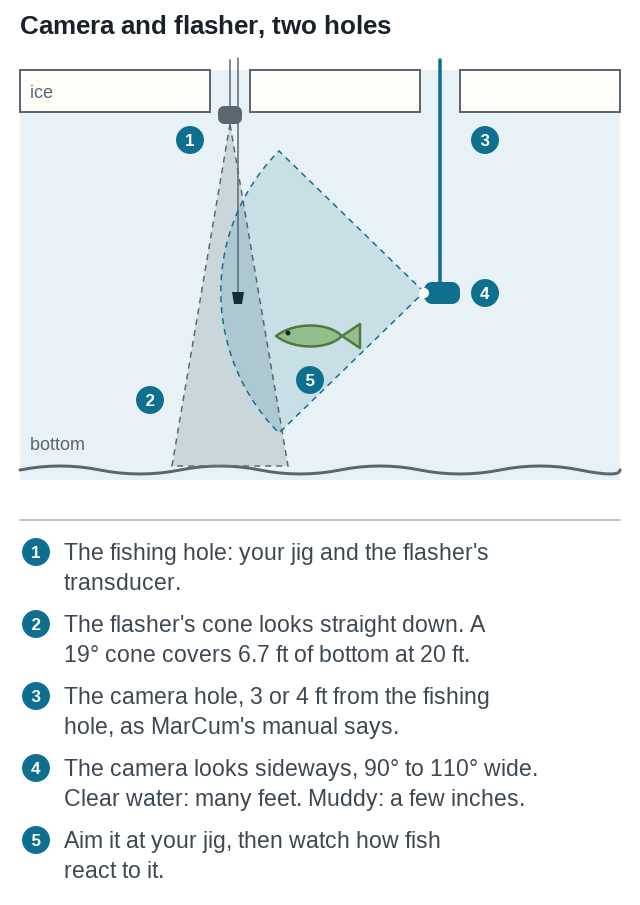
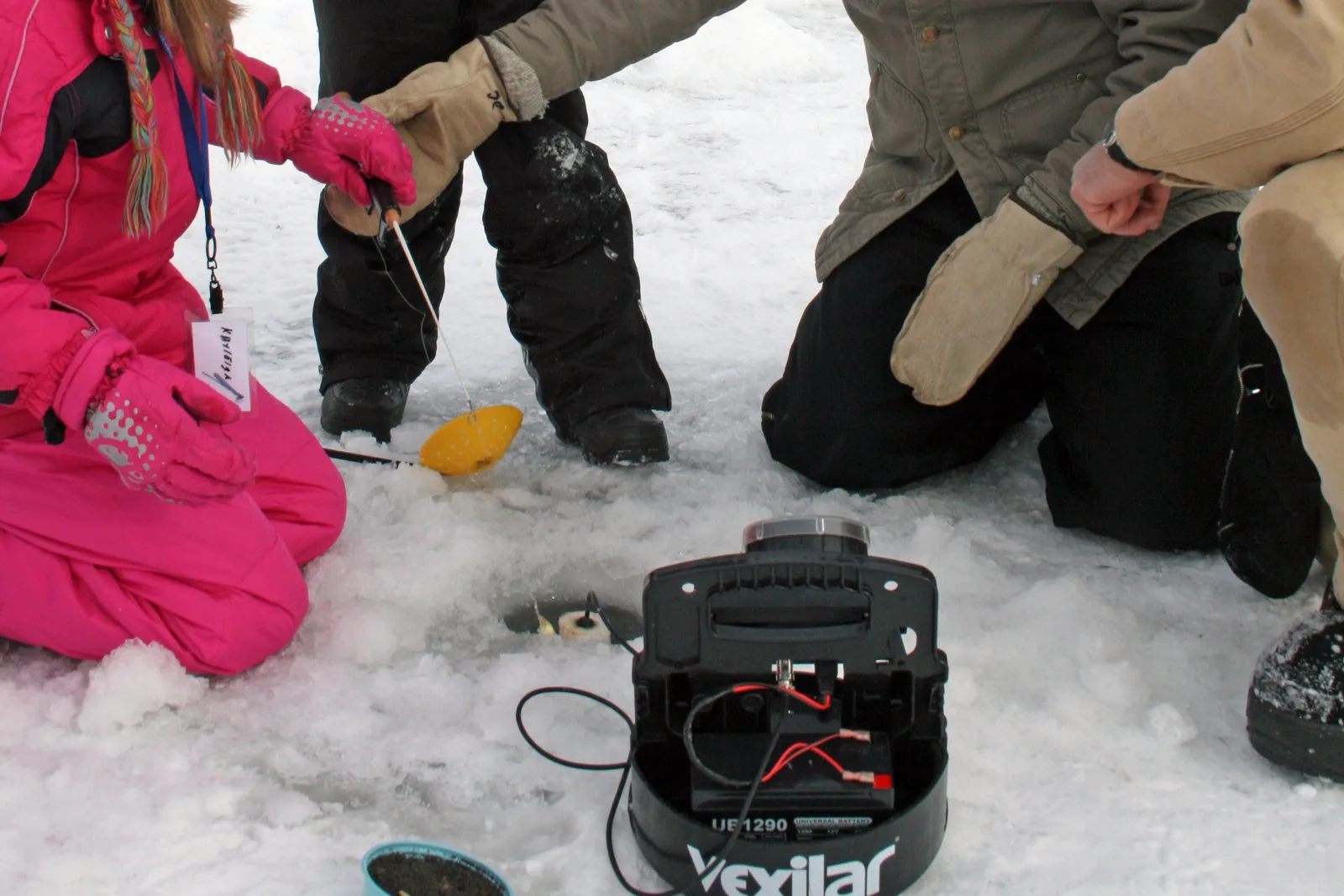
The two-hole setup from MarCum’s manual, with a flasher in the fishing hole. Drawing: fishing.info.
To search, drill a row of holes where you want to fish. Drop the camera down each one until you find the spot or the fish, MarCum says. A camera looks sideways by default. In very shallow water, point it down. The VS485C has a down-view fin for that, and Vexilar’s Predator tilts through five angles. Then it looks straight down your hole.
Then adjust for the light:
- Dawn and dusk. The camera needs light to see. Tilt it slightly up, MarCum says, to catch the light coming down through the ice.
- Bright days. Raise the camera and tilt it slightly down. You keep the bottom in view and see more water.
- Dark or stained water. Turn the lights up and switch to black and white, which MarCum calls best in low light, dirty water or after dark. The VS485C switches on its own in deep water or under thick, snowy ice.
- Glare on the screen. Turn the brightness up and turn the screen away from the sun.
If the picture is great above the water and goes blank below it, the lake is the problem, not the camera. That water is too murky for a camera that day, MarCum says.
How do you keep the battery going in the cold?
Keep a lithium camera warm until you use it. MarCum’s Pursuit HD L manual says the internal lithium battery “can become damaged if left in the cold.” Start with a full charge, and keep the unit insulated on the drive and the walk out. The same manual rates the unit at -10 to 40 °C (14 to 104 °F).
Tip: Carry a lithium camera inside your jacket or in the truck cab until you’re at the hole.
Never charge a frozen lithium battery. MarCum’s 10 Ah battery charges only from 0 °C (32 °F) up. Bring it inside first.
A lead-acid battery, like the one in the VS485c, wants a charge right after every trip. Leave it on overnight, 8 to 12 hours. If the picture turns cloudy or fuzzy, or the image starts to shrink, check the battery first. A slow, blurry screen at the start of a cold day can be normal. MarCum says it can take up to several minutes to warm up.
Do you need an ice fishing camera?
No. New York’s DEC says fish finders and underwater cameras “aren’t necessary for success.” They help with depth, structure and how fish move under the ice. Without one, start near the bottom and work up until you find fish or decide to move, as Minnesota DNR describes.
If you buy one electronic tool first, make it a flasher. It reads by sound, so it works in any water, day or night. Minnesota DNR agrees for walleye: sonar is “particularly helpful”, a camera “also beneficial”. Add the camera when you want to know what you’re marking, or you fish clear water where it can see. The rest of the ice fishing gear list and the ice fishing how-tos by species are where to start. Whatever you bring, check the ice thickness before you walk out. More screens for the ice and the boat sit on the fish finders page.
How we chose
Specs and prices come from Aqua-Vu’s, MarCum’s and Vexilar’s own stores. We read the specs on November 22, 2026, and the prices again on November 25. How to set a camera up and look after the battery comes from MarCum’s VS485C and Pursuit HD L manuals. No camera was tested on the ice for this page, and none of the links pays us. Cameras we couldn’t check against a maker’s spec page or manual are left out.

Free PDF · 16 pages
Stop guessing. Know what's biting before your first cast
A whole Saturday on the water with nothing to show for it. One reading tells you who's feeding.
The Water Temperature Fishing Chart. Take one water temperature reading, find it on the chart, and see which of 26 freshwater fish are spawning, feeding hard or slowing down.
- Where bass, crappie, bluegill and walleye sit, and what to throw. Trout: the reading where you stop.
- Why a 3 ft drop beats a cold front, and what to throw each day of the front
- The three thermometer mistakes that make a reading lie
The chart's numbers come from state fish and wildlife agencies and fisheries research: 64 sources, each listed on the site.
No card, nothing to buy. The PDF is in your inbox a minute later, one version for your phone and one to print, yours to keep. Then a few short emails and one a week on what's biting, with an unsubscribe link in every one. Privacy.
Related
Section guide
Fish Finders: How Sonar Works, the Types, and Which Unit to BuyA fish finder is a sonar: how it works, what 2D, CHIRP, side imaging and live sonar show, what each costs, and the three brand ladders from $120 up.
 Ice Fishing Flasher: How to Read the Dial, Cone Angles, and the Picks
What an ice fishing flasher shows, how to read the dial, how much bottom each cone angle sees, and six picks from a first flasher to live sonar.
 Portable Fish Finder: Castable Sonar vs Carry Kits, and Which to Buy
Portable fish finder: castable sonar ($160–280) for the bank or a carry kit ($150–550) for kayaks and ice. Six units compared on depth, runtime, price.
 Lowrance Fish Finder: Eagle, Eagle Eye, HOOK Reveal, Elite FS and HDS PRO
Lowrance fish finders from the $123 Eagle 4x to HDS PRO, with the $999 Eagle Eye 9 Live as the cheapest live sonar and the pick for each boat.
 Garmin Striker 4: What It Does, What It Lacks, Which Striker to Buy
Garmin fish finder Striker 4: CHIRP sonar and GPS for $159.99, no maps or imaging. The specs, the 4 vs Plus 4 vs Vivid 4cv, and how to read the screen.
 Depth Finder for a Boat: Which Unit, and Where the Transducer Goes
The best boat depth fish finder is a $120–200 sonar, not a dash gauge. The picks by boat, and the makers' rules for where the transducer goes.
 Forward Facing Sonar: How It Works, What It Costs, and the 2026 Rules
Forward facing sonar shows fish and your lure ahead of the boat, live. LiveScope 2, MEGA Live 2, ActiveTarget 2 compared, from $999, plus the rules.
Sources (20)
- Aqua-Vu, Micro Stealth 4.3 Underwater Camera
- Aqua-Vu, Micro Revolution 5.0 HD Underwater Camera
- Aqua-Vu, Micro Revolution HD Underwater Camera
- Aqua-Vu, AV822HD Underwater Camera
- MarCum, Pursuit SD Plus Underwater Viewing System
Show all 20 sourcesShow fewer sources
- MarCum, Pursuit HD L Underwater Viewing System
- MarCum, Explorer HD L Underwater Viewing System
- MarCum, Quest HD L Lithium Equipped Underwater Viewing System
- MarCum, Recon 5 Underwater Viewing System
- Aqua-Vu, Certified Refurbished Micro Stealth 4.3 Underwater Camera
- Vexilar, Reconditioned Fish Scout Predator
- MarCum, VS485c Underwater Viewing System
- MarCum, VS485C Under Water Viewing System user manual
- MarCum, Pursuit HD L Underwater Viewing System manual
- Vexilar, Fish Scout Predator
- Vexilar, Fish Scout Base Camp Underwater Camera
- Vexilar, FLX-12 flasher instruction manual (cone angle and coverage)
- Minnesota DNR, Ice fishing for crappie
- Minnesota DNR, Ice fishing for walleye
- New York State DEC, I FISH NY Guide to Ice Fishing