 By
The Garmin fish finder Striker 4 is CHIRP sonar, a flasher and GPS waypoints on a 3.5 in (8.9 cm) screen for $159.99, and nothing else. It draws no lake maps, has no down imaging and no side imaging. That is also its case. It is small, cheap, light on a battery, and the GPS lets you go back to the spot where you caught fish. The specs here are Garmin’s own and the verdicts are named reviewers’; no unit was run on the water for this page.
Garmin rates the Striker 4’s typical draw at 0.23 A. Outdoor Life’s reviewer ran his on a 4.4 Ah battery and got “about 19 hours”. Divide 4.4 by 0.23 and you get 19.1.
Is the Striker 4 a good fish finder?
For a kayak, a canoe or a small boat on water you fish often, a long-term owner and a kokanee site say yes. Daren Wendell of Outdoor Life has run one since 2020 and calls it “still my top recommendation for an entry-level fish finder, especially for small watercraft”. The kokanee site Chrome Catchers calls it “the best fish finder you can get for the money”, with the small display as its one con. On Amazon it held 4.6 of 5 stars from about 9,300 ratings on October 17, 2026, with 79 percent five-star.
The complaints repeat as well: both reviewers list the small screen, Wendell and one Amazon owner miss the maps, and another owner calls the power leads thin. Who should skip it: anyone who fishes cover and wants to see it, which needs down imaging, and anyone who wants a lake chart on the screen.
What is on the spec sheet?
Garmin’s page for part 010-01550-00, read in October 2026, lists:
- Screen: 3.5 in diagonal, 480 × 320 pixels, color, keyed; 3.6 × 5.9 × 1.6 in (9.1 × 15 × 4.1 cm) and 0.5 lb (230 g); waterproof to IPX7.
- Sonar: CHIRP at 77 and 200 kHz from the dual-beam transducer in the box, 200 W RMS. The unit can also drive a 50 kHz transducer. Bottom Lock, split-screen zoom, an A-scope, a flasher and a water-temperature sensor and log.
- GPS: 5,000 waypoints, 50,000 track points, 50 tracks and 100 routes, shareable with other Striker and echoMAP units.
- Power: 10 to 20 V DC, 0.23 A typical, 1.0 A maximum.
- In the box: the unit, the transducer with a 20 ft (6.1 m) cable, transom and trolling-motor mounts, a tilt and swivel mount and the power cable.
One row is missing: maximum depth. Retailers still list 1,600 ft (488 m) in fresh water and 750 ft (229 m) in salt, but Garmin’s current page gives no figure. For a lake or a bay it does not matter; the Striker 4 reads far deeper than most anglers fish.
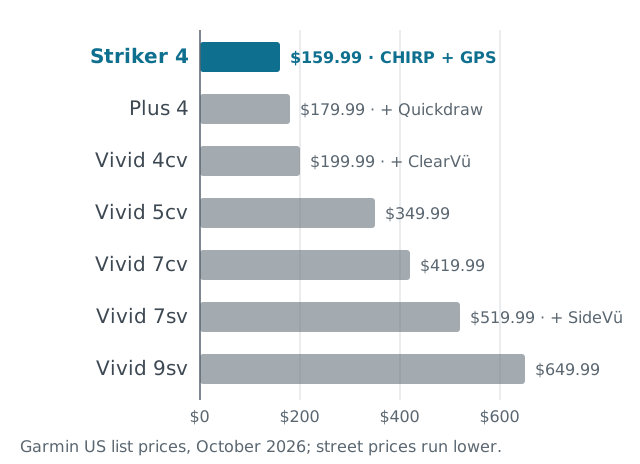
Price is the other moving number. Garmin lists $159.99 in October 2026. Wendell’s review in May 2026 gave $130, and $110 on sale at Bass Pro, so the street price runs well under list. On Garmin’s own ladder the Striker 4 is the bottom rung, and each step up buys one feature it lacks.

Free PDF · Water temperature chart Which fish are biting at today's water temperature?
One reading, and the 16-page chart shows which of 26 fish are spawning, feeding hard or slowing down; for bass, crappie, bluegill and walleye, where they sit and what to throw. Every number sourced.
It costs you one email address. No card, nothing to buy, and the PDF is yours to keep. Confirm with one click and it's on its way. Then a few short emails and one a week on what's biting. Unsubscribe anytime. Privacy.
What the Striker 4 does not do
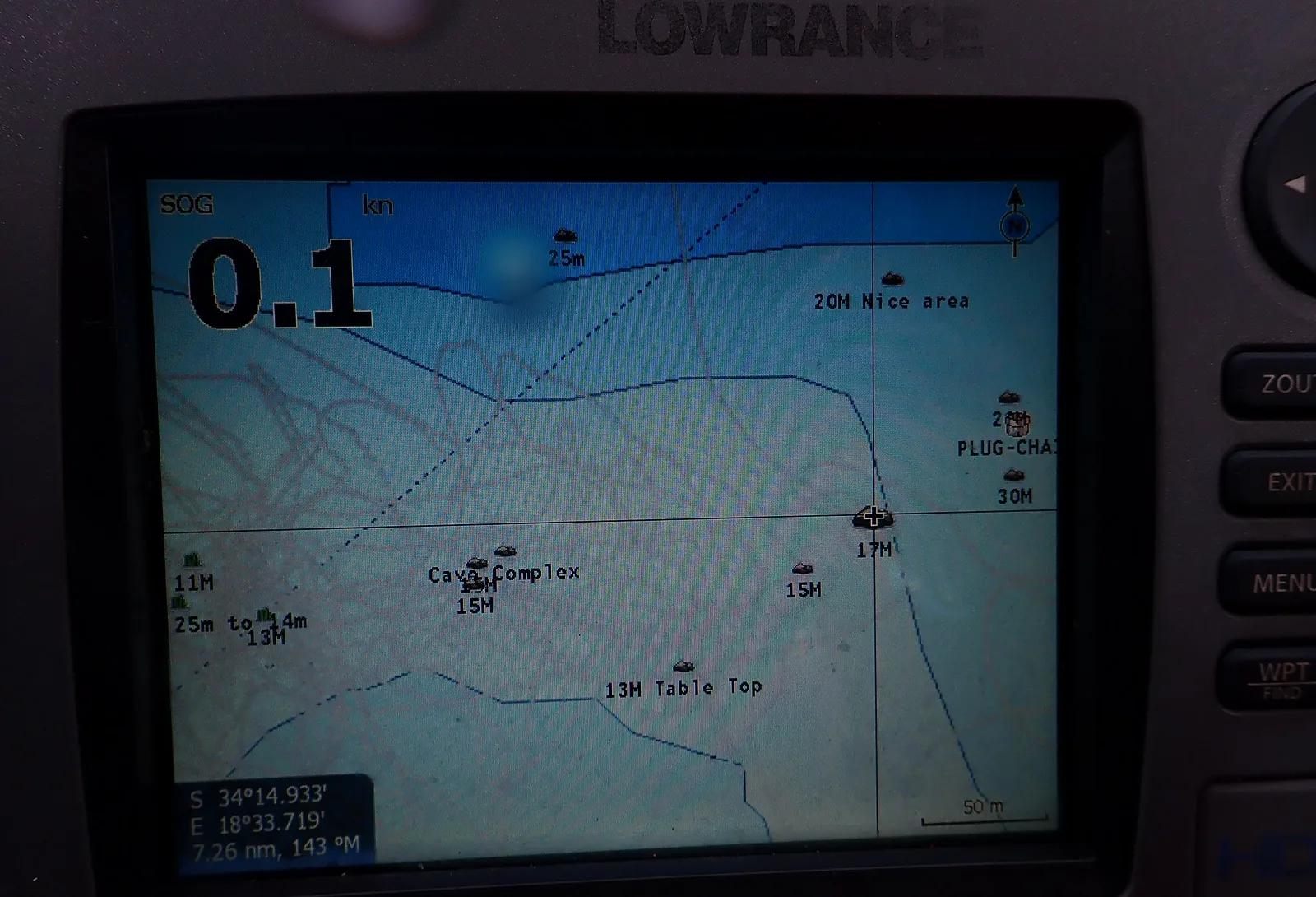
No charts and no card slot. Wendell puts it plainly: it “doesn’t offer detailed mapping, so you’re marking waypoints without much context”. One Amazon owner traces lake shorelines with the GPS track to make up for it.
No down or side imaging. A Reddit review of the unit credits it with “ClearVü Scanning Sonar”, and Amazon’s listing says the same: “Clear Vu scanning Sonar shows you more of what is in the water around your boat”. Garmin’s spec sheet lists traditional CHIRP only. ClearVü comes on the 4dv, the Plus 4cv and the Vivid 4cv.
No Quickdraw Contours, the feature that draws a 1 ft contour map from your own soundings. It starts at the Plus 4.
No wireless link. The Striker 4’s spec sheet lists none.
No live sonar. No Striker runs LiveScope, and the Garmin fish finder page explains why that makes the Striker-or-ECHOMAP choice a choice about the next two years.
Striker 4, Plus 4, 4dv or Vivid 4cv?
Five Strikers have carried a 4 in the name, and listings mix them up. This is what each one is, from Garmin’s own pages in October 2026.
| Model (part no.) | Screen | Sonar | Maps | Status and price |
|---|---|---|---|---|
| Striker 4 (010-01550-00) | 3.5 in, 480 × 320 | CHIRP 77/200 kHz, 200 W | Waypoints only | Current, $159.99 |
| Striker 4dv (010-01551-01) | 3.5 in, 480 × 320 | CHIRP 77/200 plus ClearVü 455/800 kHz | Waypoints only | Discontinued; Garmin Ireland still shows €249 |
| Striker Plus 4 (010-01870-00) | 4.3 in, 272 × 480 | CHIRP dual beam, 200 W | Quickdraw Contours | Current, $179.99 |
| Striker Plus 4cv (010-01871-00) | 4.3 in, 272 × 480 | CHIRP plus ClearVü (GT20 in the box), 300 W | Quickdraw Contours | Discontinued by Garmin |
| Striker Vivid 4cv (010-02550-00) | 4.3 in, 272 × 480 | CHIRP 77/200 plus ClearVü 455/800 kHz from the GT20-TM in the box (the unit also runs 260 kHz), 300 W | Quickdraw Contours | Current, $199.99 |
The Plus 4 against the plain 4 is a bigger screen with fewer pixels, the same sonar and a map you make yourself, for $20 more. The Vivid 4cv adds the picture under the boat, down imaging, for $40 over the Striker 4. If you fish brush, rock or weed, that is the $40 to spend.
There is no Striker 4sv. Side imaging starts at the Vivid 7sv, at $519.99 on the Garmin ladder. Above the 4 in models the line runs to the Vivid 5cv, 7cv, 7sv and 9sv, which the Garmin fish finder page prices.
The transducer, and the upgrade
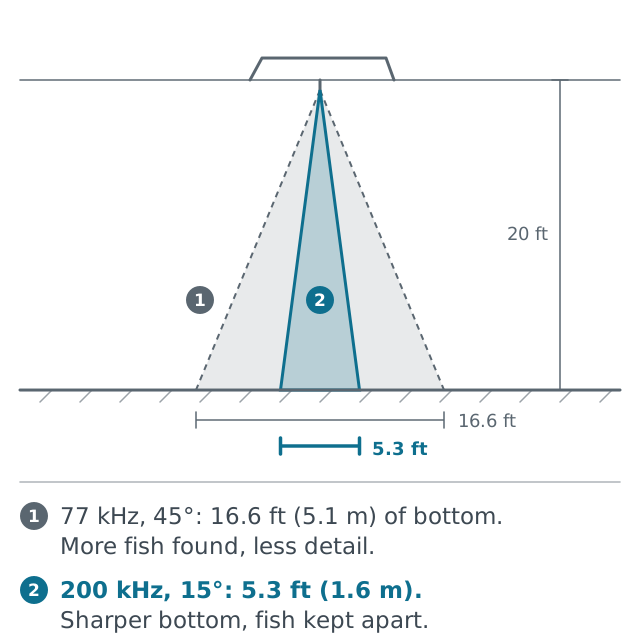
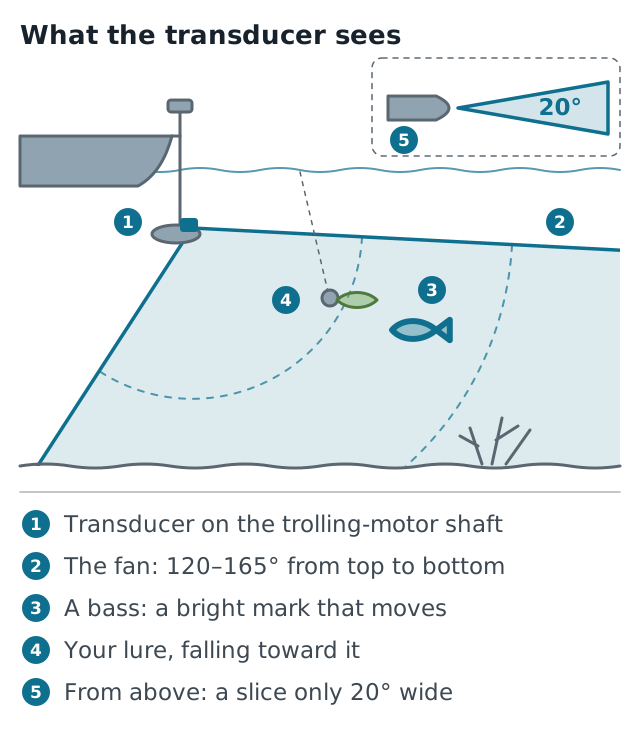
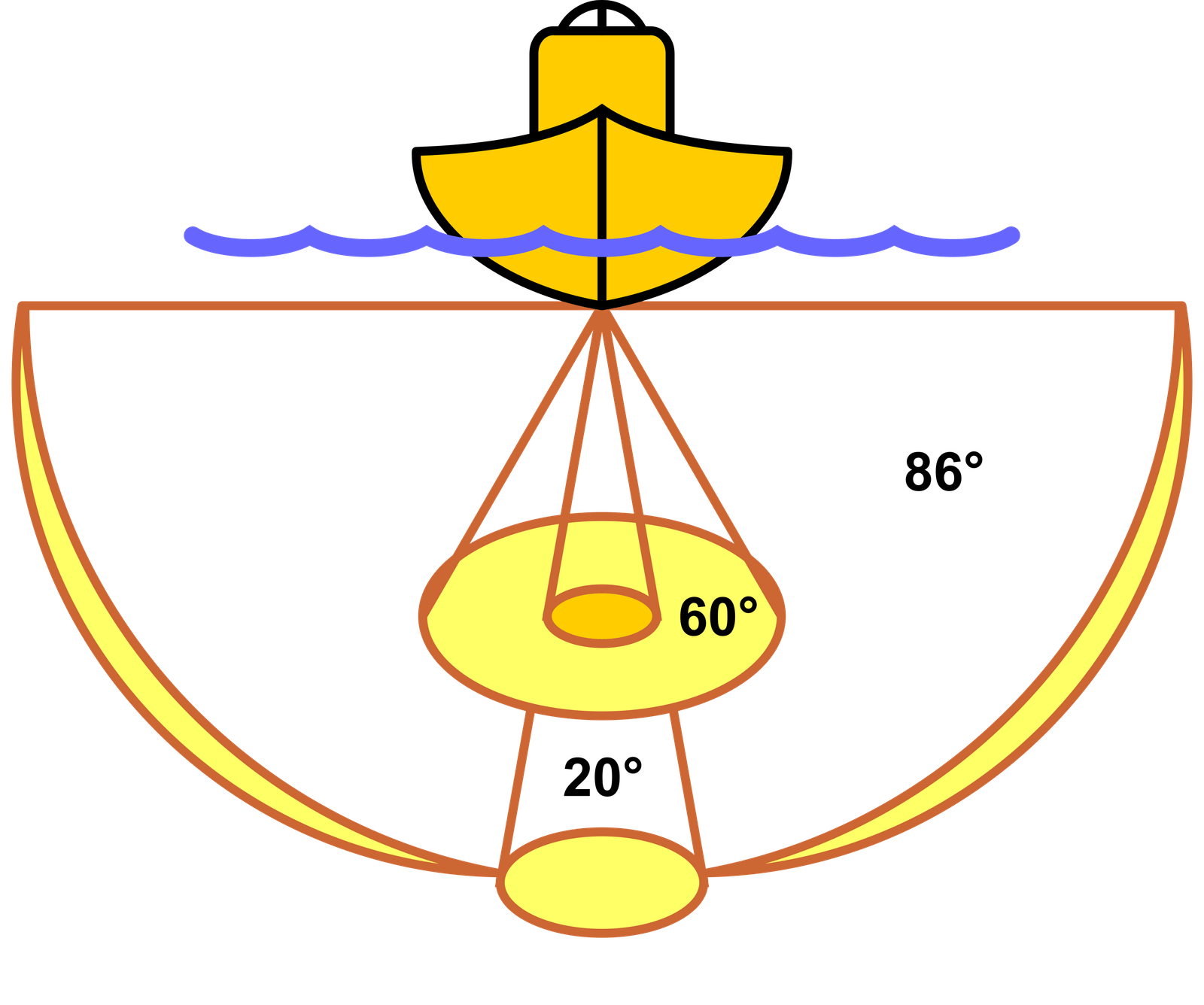
The dual-beam transducer in the box works at two frequencies, and the drawing at the top shows what each one covers. Garmin rates its 77/200 kHz dual-beam transducers at 45 degrees wide at 77 kHz and 15 degrees at 200 kHz. Chrome Catchers puts the difference in plain words: 200 kHz gives “a smaller but more accurate view”, 77 kHz “scans a bigger area but with less detail”. Split screen shows both at once, which is the simplest way to learn the difference.
For better CHIRP, Garmin’s page names the upgrade: “a GT8 or GT15 transducer (each sold separately)”. The Striker 4 has one 4-pin transducer port. Garmin’s selection guide lists the GT8 and GT15 as 8-pin transducers, and marks them compatible with Striker CV units only through an adapter cable: 010-12719-00 for the GT8 and 010-11947-00 for the GT15. The guide does not list the plain Striker 4, so confirm the adapter with Garmin before you order one.
Which transducer comes with each Striker 4, and which one do you have?
Each 4 in Striker ships with its own transducer, and the in-box transducer, not the unit, sets what you see on day one.
| Model | Transducer in the box | What it gives you |
|---|---|---|
| Striker 4, Plus 4 | Dual-beam, 20 ft cable | Traditional CHIRP 77/200 kHz |
| Vivid 4cv | GT20-TM | 77/200 kHz plus ClearVü 455/800 kHz; 500 W, 1,900 ft traditional, 750 ft ClearVü (selection guide) |
| Plus 4cv (discontinued) | GT20, sold as a “w/GT20” bundle | Traditional plus ClearVü |
| 4dv | GT20-TM (Garmin Ireland’s version name) | 77/200 kHz plus ClearVü 455/800 kHz at 500 W (Garmin Ireland) |
To tell which one you have, read the label on the cable. Garmin’s Striker Plus manual says the transducer name “should be listed on the label on the transducer cable, near the connector”. Then count the pins on the plug. The selection guide lists two GT20-TMs: part 010-01960-00 with 4 pins, which plugs straight into a Striker CV, and 010-01960-01 with 8 pins, which needs adapter cable 010-12719-00. Every Striker 4 here has one 4-pin port.
After any swap, tell the unit what is on the cable: Settings > My Vessel > Transducer Type, where the stock one is “Dual Beam (200/77 kHz)”. Garmin’s manual says a transducer that did not come with the unit may need this setting “to make the sonar function properly”.
The Portable Bundle puts the same unit in a carry case with a battery and a kayak and canoe mount, and an ice bundle swaps in an ice transducer. Either one makes it a portable fish finder.
Transom or trolling motor?
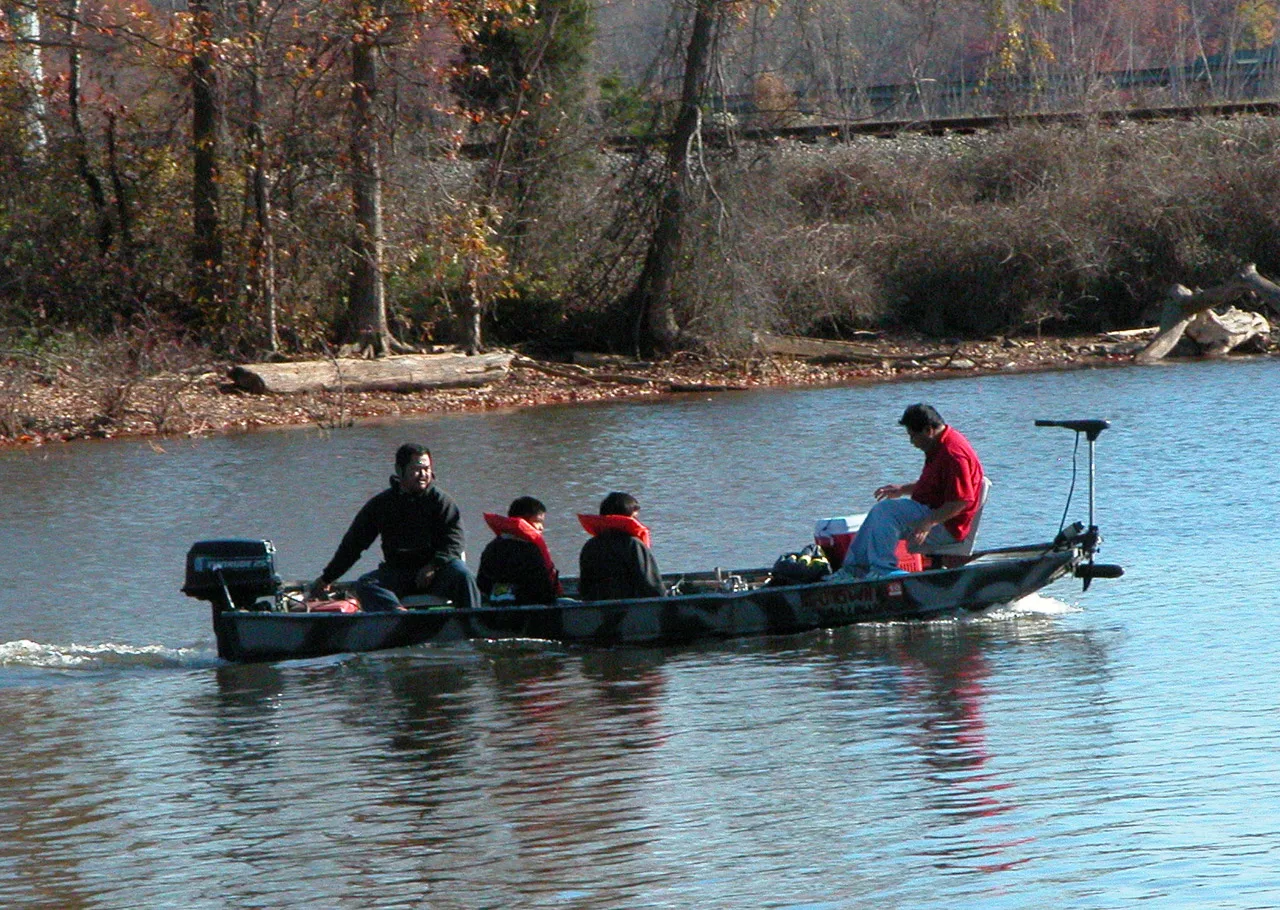
Both mounts come in the box, and owners report the difference. An Amazon reviewer with the transducer on his trolling motor writes that “it cuts out if you’re trying to go fast”. One with a transom install says it “reads depths at high speeds”. The trolling-motor mount puts the sonar right under where you fish and needs no drilling, but its view swings with the motor and it hangs low in the water.
On a boat that runs on plane, mount it on the transom. The makers’ distances and clearances for aluminum and fiberglass hulls are in the table on the depth finder for a boat page. On a kayak, Wendell uses a 4 in YakAttack GearTrac and suggests screwing the track to a piece of plywood on a canoe or jon boat.
Check the wiring too. One Amazon owner who liked the unit still called the battery leads “super frail thin wire”, so make that connection solid before the first trip.
How long does the battery last?
The 0.23 A typical draw is low enough to run all weekend on a small lithium battery. Wendell’s 4.4 Ah battery gave him about 19 hours, and 4.4 ÷ 0.23 = 19.1, so the spec held. His review prints the draw as “.28AH” elsewhere; Garmin’s 0.23 A is the figure to use. The maximum is 1.0 A, so a bright screen in midday sun runs shorter. The kayak fish finder page turns the draw into hours on 7, 10 and 12 Ah batteries.
How do you read a Striker 4?
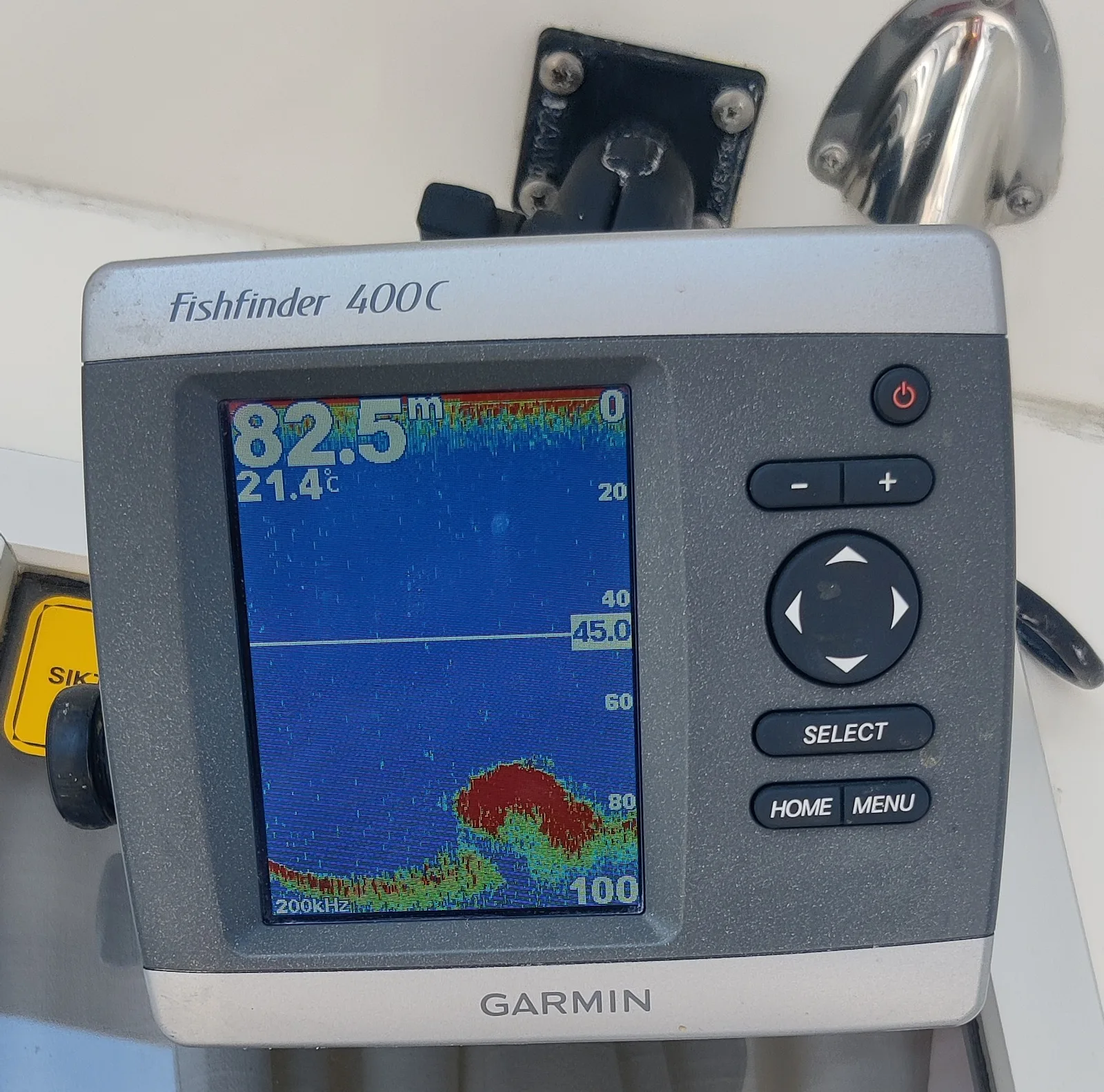
What does a fish look like? That depends on Fish Symbol ID. Switched on, it replaces sonar returns with fish icons, with or without the target depth and with or without the background sonar. Switched off, fish show as arches, the curve a fish draws as it passes through the cone. Wendell calls Fish Symbol ID “training wheels”: use it for a few trips, then turn it off and learn the arches.
The flasher is for a jig straight down or an ice hole. Garmin says it shows the bottom, “whether it is solid or muddy, your jig or weighted bait, and the depth of fish as they swim into the sonar beam”.
The A-scope is the live strip at the right edge, a “real time display of fish passing through transducer beam”, in Garmin’s words.
Settings to start with: Wendell runs gain on Auto-Medium. Trolling on his lakes, “1.75 to 2.2 miles per hour was the magic speed for bass and crappie”; the GPS speed on screen is how you hold it.
The general skill, from a soft bottom to the thermocline, is on the how to read a fish finder page.
How we chose
The specs, part numbers and prices are from Garmin’s pages, read in October 2026, and the Striker Plus manual. The verdicts are from the reviews named in the text, one of them a long-term owner’s, and from the Amazon listing on the date given. No unit was run on the water for this page. The fish finders hub explains the sonar behind every row of the family table.
Free PDF · 16 pages
Stop guessing. Know what's biting before your first cast
A whole Saturday on the water with nothing to show for it. That is what guessing costs you.
The Water Temperature Fishing Chart. Take one water temperature reading, find it on the chart, and see which of 26 freshwater fish are spawning, feeding hard or slowing down. Six pages go deeper: bass, crappie, bluegill, walleye, catfish and trout. For your phone and the tackle box.
- Where they sit and what to throw at every temperature: bass, crappie, bluegill and walleye. Catfish, one by one. Trout: the 68 °F line where you stop, and where they hide
- A bass that drops 3 ft feels more pressure change than the biggest cold front: the front day by day, and what to throw on each
- The three thermometer mistakes that make a reading lie (the first one is the surface)
- The 26-fish chart: who's spawning, feeding hard or slowing down at your reading
What it costs you: one email address. No card, nothing to buy. You get a version for your phone and one to print, and they're yours to keep. Then a few short emails to help you use it and one a week on what's biting, with an unsubscribe link in every one.
The chart's numbers come from state fish and wildlife agencies and fisheries research: 61 sources, each listed on the site.
Enter your email, confirm it with one click, and the PDF is on its way. Privacy.
Related
Section guide
Fish Finders: How Sonar Works, the Types, and Which Unit to BuyA fish finder is a sonar: how it works, what 2D, CHIRP, side imaging and live sonar show, what each costs, and the three brand ladders from $120 up.
 Depth Finder for a Boat: Which Unit, and Where the Transducer Goes
The best boat depth fish finder is a $120–200 sonar, not a dash gauge. The picks by boat, and the makers' rules for where the transducer goes.
 Forward Facing Sonar: How It Works, What It Costs, and the 2026 Rules
Forward facing sonar shows fish and your lure ahead of the boat, live. LiveScope 2, MEGA Live 2, ActiveTarget 2 compared, from $999, plus the rules.
 Garmin Fish Finder: Striker vs ECHOMAP vs GPSMAP, and Which to Buy
Garmin fish finders as a ladder: Striker (sonar only), ECHOMAP (charts, LiveScope 2), GPSMAP. Current prices, the model-number decoder, the pick by boat.
 Humminbird Fish Finder: PiranhaMAX, HELIX, SOLIX, XPLORE and APEX
Humminbird fish finder picks: PiranhaMAX 4 for a jon boat, HELIX 5 or 7 for a kayak, XPLORE 9 for a bass boat that may add MEGA Live 2. No HELIX runs it.
 Best Fish Finder for the Money: What Each Price Step Buys
The best fish finder at each price from $120 to $3,000, what every step adds, and the Black Friday price to wait for on each pick.
 How to Read a Fish Finder: Arches, Bottom, Bait and Imaging
How to read a fish finder: why fish show as arches on 2D sonar and dots on down imaging, what hard and soft bottom look like, bait, the thermocline, settings.
Sources
- Garmin, STRIKER 4 with dual-beam transducer, part 010-01550-00 (specifications, in the box and price, October 2026)
- Garmin, STRIKER Plus 4, part 010-01870-00 (specifications and price)
- Garmin, STRIKER Vivid 4cv with GT20-TM, part 010-02550-00 (specifications and price)
- CampSaver, Garmin Striker Plus 4cv with GT20, part 010-01871-00 ("discontinued by Garmin", specifications)
- Garmin Ireland, STRIKER 4dv, part 010-01551-01
- Garmin, STRIKER Plus Owner's Manual (Fish Symbol ID, frequencies, transducer types)
- Garmin, Transducer Selection Guide (dual-beam beam widths, GT20-TM 4-pin and 8-pin versions, adapter cables 010-12719-00 and 010-11947-00)
- Outdoor Life (Daren Wendell), Garmin Striker 4 review, May 29, 2026
- Chrome Catchers, Garmin STRIKER 4 fish finder review
- Amazon, Garmin Striker 4 listing and customer reviews (read October 17, 2026)
- Reddit r/carverscave, Garmin Striker 4 GPS fishfinder review
- FishUSA, Garmin Striker 4 listing (1,600 ft fresh, 750 ft salt)