 By
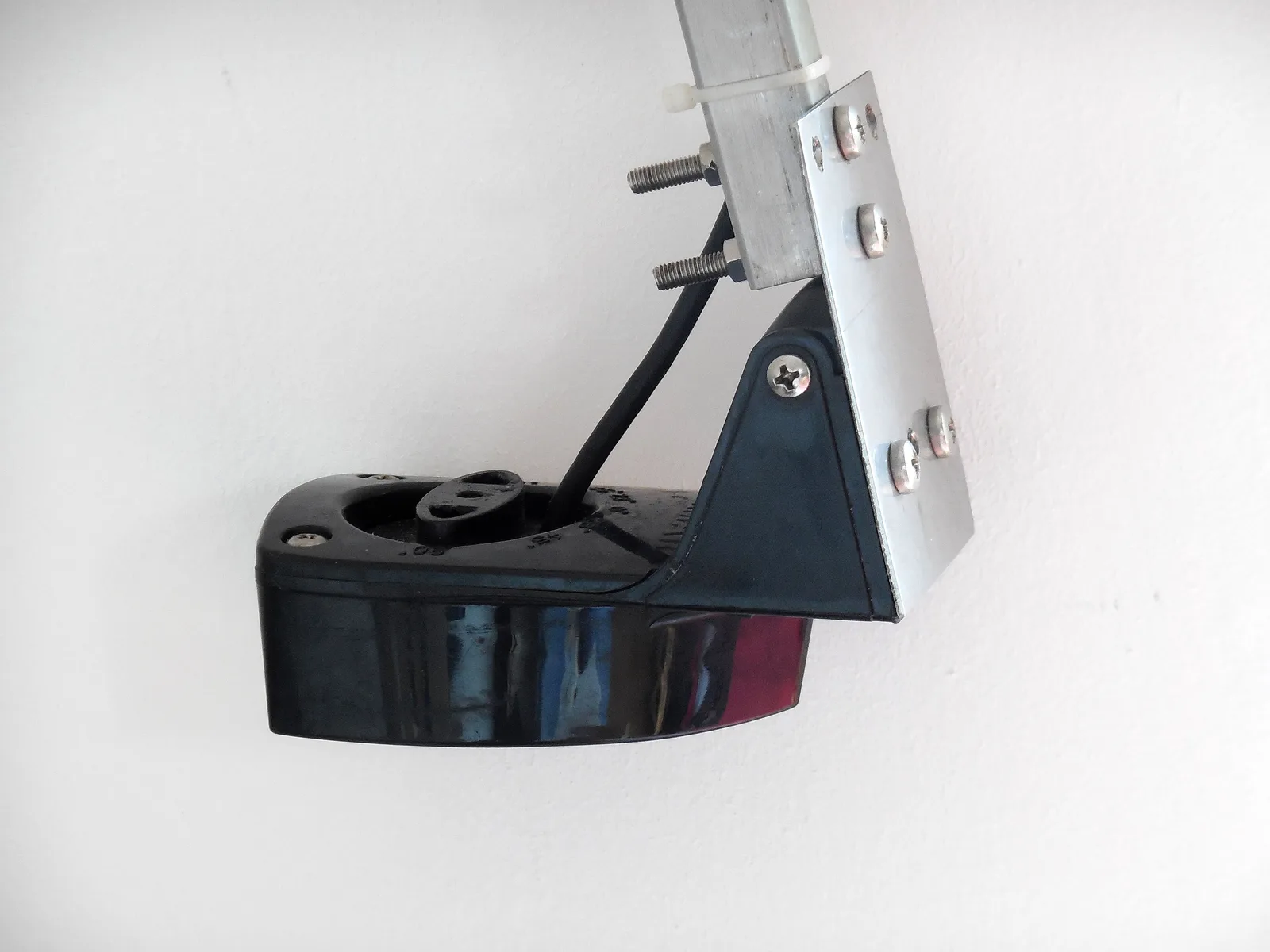
The best depth finder for most boats is a fish finder that costs $120 to $200. It shows the depth as a number, like a dash gauge, and draws the bottom and the fish under it as well. A Garmin Striker 4 at $159.99 is the cheapest with GPS, and the Striker Vivid 4cv at $199.99 adds down imaging. What decides how well any of them works is less the screen than where the transducer goes, and the makers’ install guides are precise about that.
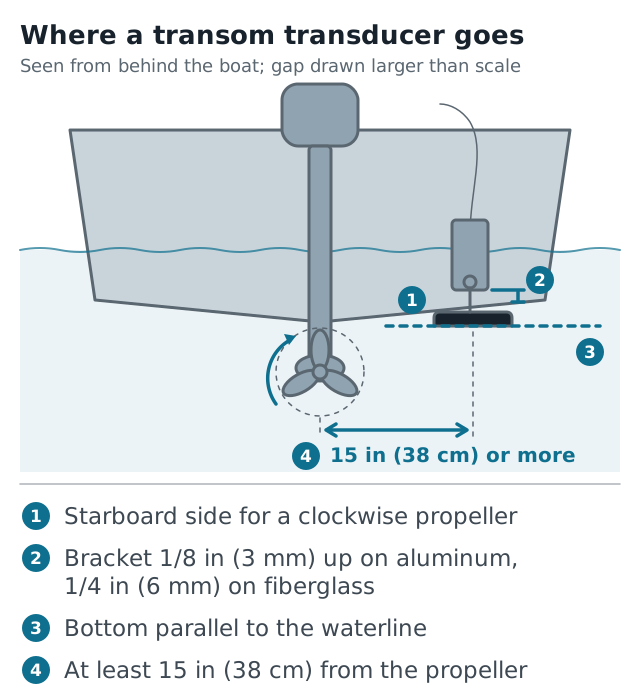
Humminbird’s install guide sets the transducer bracket 1/8 in (3 mm) above the bottom of the transom on an aluminum boat and 1/4 in (6 mm) on fiberglass. Lose the bottom at speed, and Garmin’s fix is to lower it another 1/8 in.
Depth finder or fish finder?
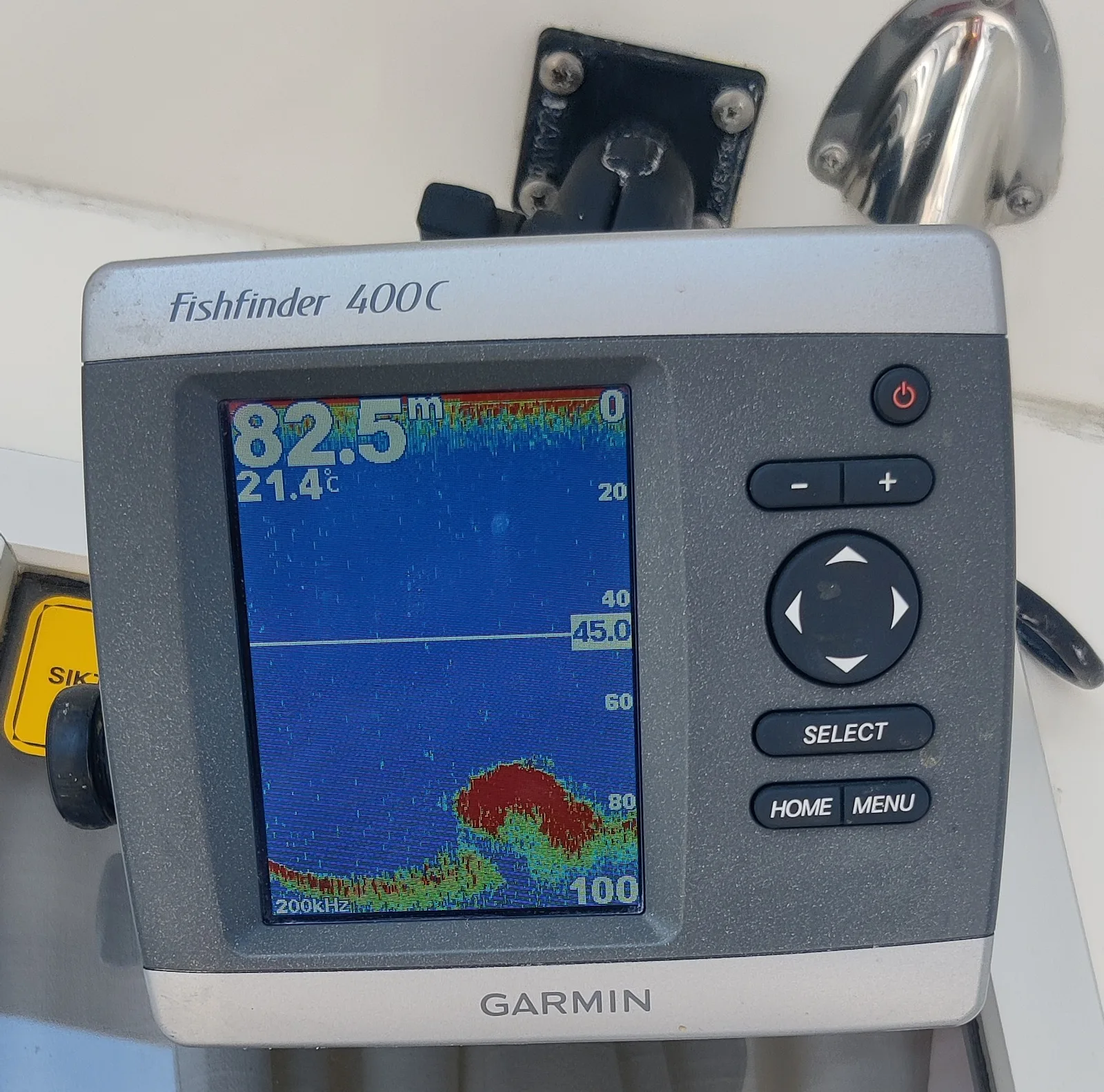
A depth finder and a fish finder are the same machine. Both send a sound pulse down from a transducer, time the echo and turn it into depth. A dedicated depth gauge shows only the number. A fish finder shows the number and draws every echo as a scrolling picture, so the bottom, weeds and fish appear too.
The gauge has its place. HawkEye’s DepthTrax 2BX is a dash instrument that reads to 600 ft (180 m), updates four times a second and sounds an alarm when the water gets shallower or deeper than the limits you set. It suits a console with no room for a screen, or a boater who never looks at a fish. For an inboard or sailboat, Raymarine’s i40 Depth gauge ships with a thru-hull transducer ($329.99 at Overton’s). For anyone who fishes, the cheapest fish finders cost about the same and do more.
Is a depth finder required? Not by federal law. The Coast Guard’s guide to required equipment for recreational boats lists life jackets, fire extinguishers, sound and visual signals, ventilation and lights, and never mentions a depth sounder. On water you do not know, it is cheap insurance. Outdoor Life’s Pete Robbins puts it plainly: “A simple depth finder can also prevent you from running aground.”
Can a phone be a depth finder?
A phone alone cannot be a depth finder: it has no transducer. A chart app shows the charted depth, not the water under you today. A castable sonar ball can stream live depth to the phone, and that portable fish finder is the bank angler’s answer.
Which unit for which boat?
- A jon boat or small aluminum boat on one lake. The Striker 4 ($159.99). GPS lets you save the brush pile you found and drive back to it, and both a transom and a trolling-motor mount come in the box.
- The same boat, but you fish cover. The Striker Vivid 4cv ($199.99). Down imaging draws a picture of what is under the hull, so a stump reads as a stump.
- A dock boat, a pond or a tight budget. The Lowrance Eagle 4x ($123) or Humminbird PiranhaMAX 4 ($139.99 at TackleDirect). Depth, bottom and arches, no GPS.
- Older eyes or a bigger lake. The Humminbird HELIX 5 CHIRP GPS G3, about $370, with a 5 in screen and a basemap.
- A console boat that only needs the number. The DepthTrax 2BX gauge.
- A kayak. A kayak fish finder follows different rules for screen, battery and mounting.
Above $400 the choice turns into side imaging, charts and live sonar, and the best fish finder page walks each price step up to $3,000.

Free PDF · Water temperature chart Which fish are biting at today's water temperature?
One reading, and the 16-page chart shows which of 26 fish are spawning, feeding hard or slowing down; for bass, crappie, bluegill and walleye, where they sit and what to throw. Every number sourced.
Enter your email, confirm it with one click, and the PDF is in your inbox. Plus one email a week on what's biting. Unsubscribe anytime. Privacy.
What matters on a boat, and what does not
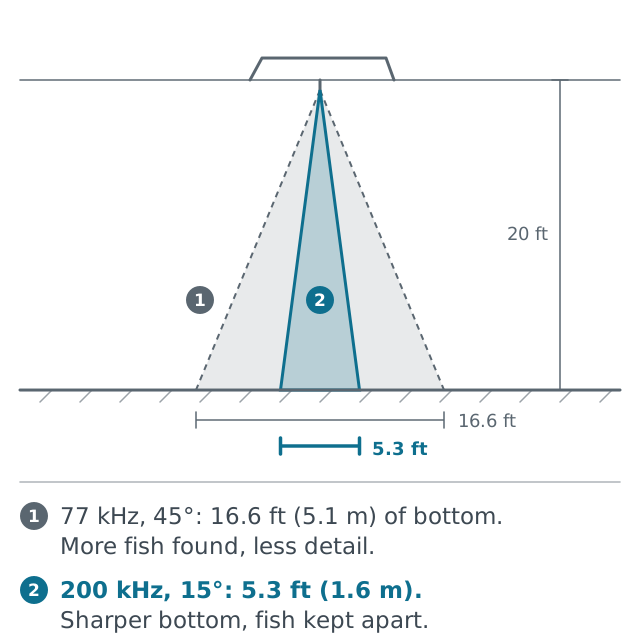
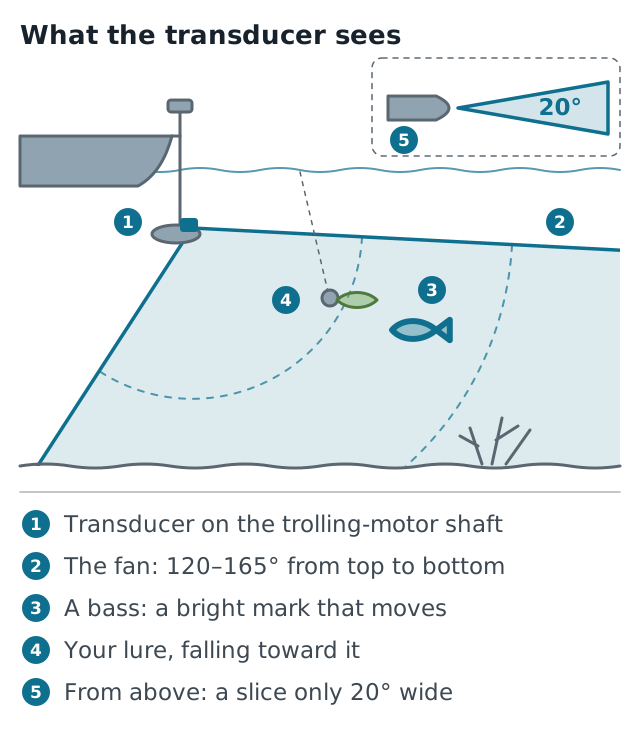
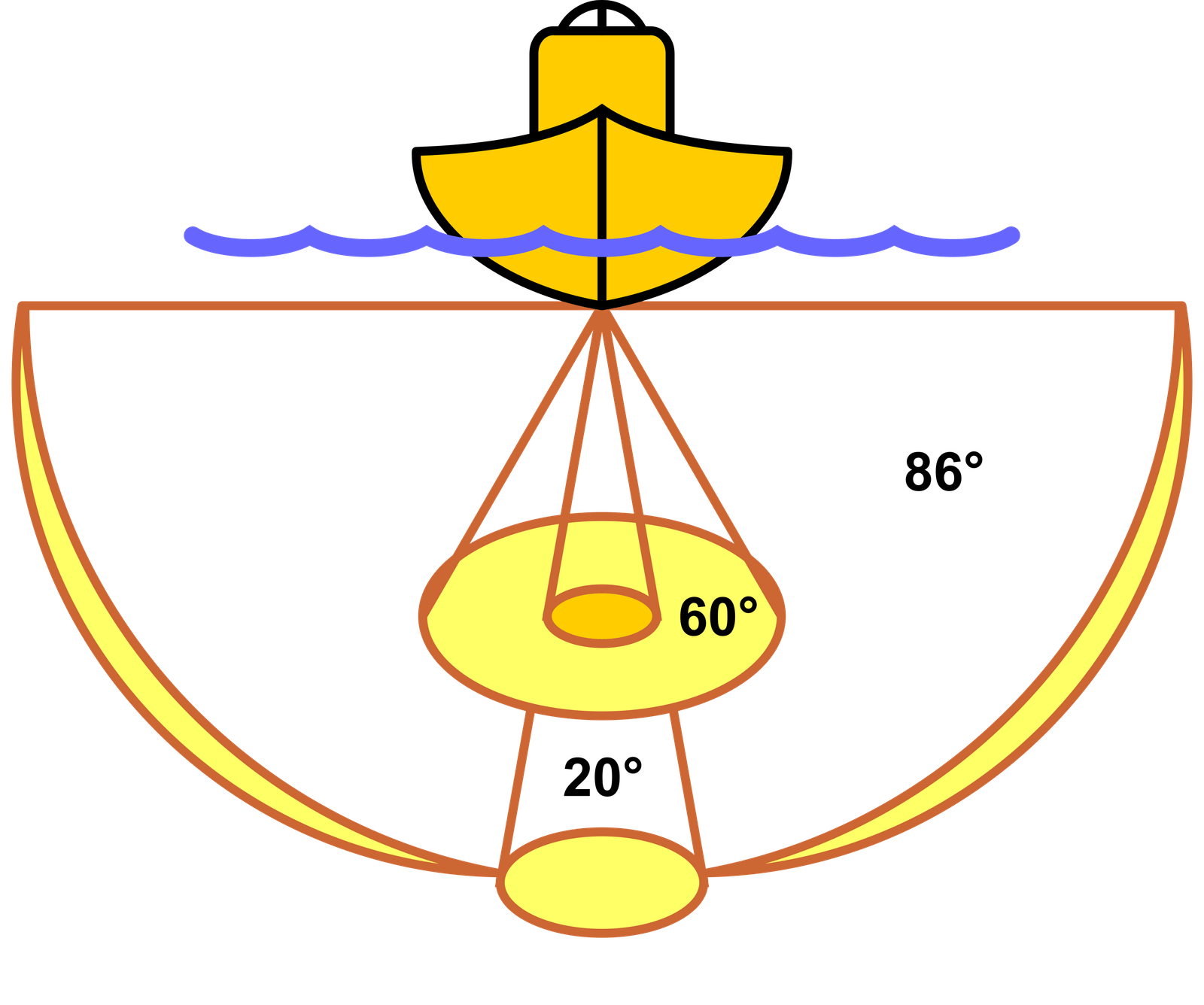
Frequency decides what you see. In Garmin’s manual, higher frequencies use narrow beams that are “better for high-speed operation and rough sea conditions” and give better bottom definition. Lower frequencies use wider beams that “can let the fisherman see more targets” and “perform better in deep water”. Garmin rates its 77/200 kHz dual-beam transducers at 45 degrees and 15 degrees. At 20 ft (6.1 m) the wide beam covers about 16.6 ft (5.1 m) of bottom and the narrow one about 5.3 ft (1.6 m). The how to read a fish finder page shows what that cone does to the marks on the screen.
Depth ratings are far beyond most fishing. The PiranhaMAX 4 is rated to 600 ft at 200 kHz and 320 ft at 455 kHz. Retailers list the Striker 4 at 1,600 ft (488 m) in fresh water and 750 ft (229 m) in salt, a figure Garmin’s own spec sheet no longer prints. Salt water always gets the smaller number. On a lake under 100 ft deep, any of these reads the bottom with room to spare.
CHIRP helps separate fish. Garmin’s manual says sweeping each pulse through a range of frequencies gives “better target separation in deep water”. It adds that some fish “may show up better using a fixed frequency”, so give the plain 2D view a try before you judge.
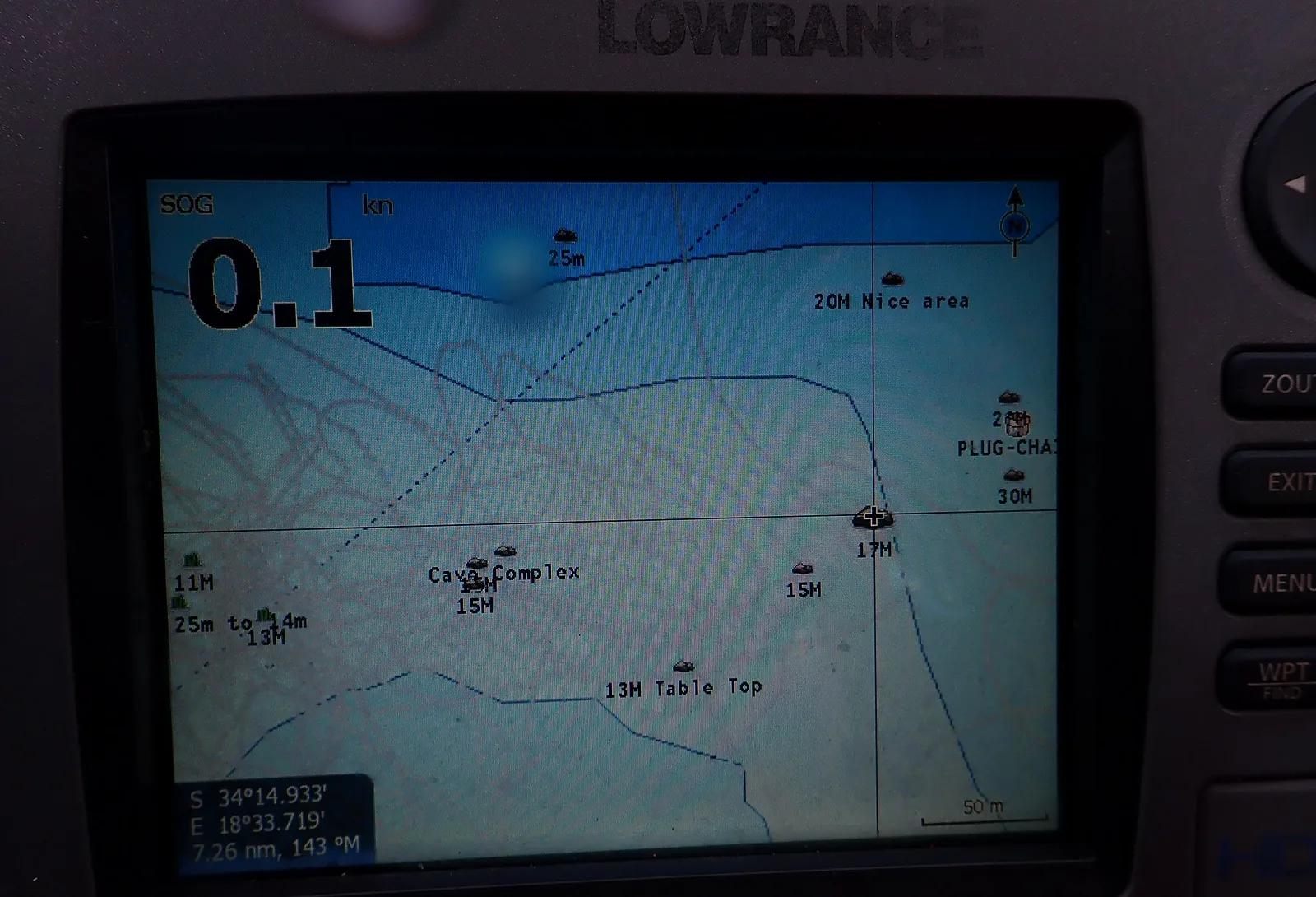
GPS is the feature that pays first. A depth reading tells you where you are now. A waypoint lets you come back to the hump, the creek channel or the brush pile next weekend. That is why the Striker 4 is the cheapest unit worth buying for a boat that fishes the same water often.
Screen size matters less than mounting. A 4 in screen read from the console at arm’s length works. A transducer in turbulent water shows nothing at any screen size.
Where does the transducer go on your boat?
In clean water, away from anything that throws bubbles, at least 15 in (38 cm) to the side of the propeller: on that, Garmin’s and Humminbird’s install guides agree, and the table sorts the rest of their rules by boat.
| Boat and hull | Mount | Why | Watch out | Maker rule |
|---|---|---|---|---|
| Riveted aluminum jon or V-hull | Transom | Garmin does not recommend shooting through a metal hull | Rivet rows throw bubbles | Bracket 1/8 in (3 mm) up; a little less on flat-bottom rivets (Humminbird); Garmin: no in-hull on metal |
| Solid fiberglass bass or ski boat | Transom, or in-hull for speed | In-hull keeps reading at high speed, with no drag and no hole below the waterline | In-hull loses some signal | Laminate no thicker than 5/8 in (16 mm) for Garmin’s GT15M-IH; 2D sonar only on Humminbird |
| Cored or foam-filled fiberglass | Transom or thru-hull | Sound will not cross the core | No in-hull | Garmin: not for cored hulls; Humminbird: single-layer fiberglass only |
| Inboard, sailboat or stepped hull | Thru-hull | The usual mount on inboards and sailboats; a transom mount behind a step pops out of the water at speed | Needs a hole below the waterline; Humminbird says a mount on the step itself may work | Humminbird recommends a professional install |
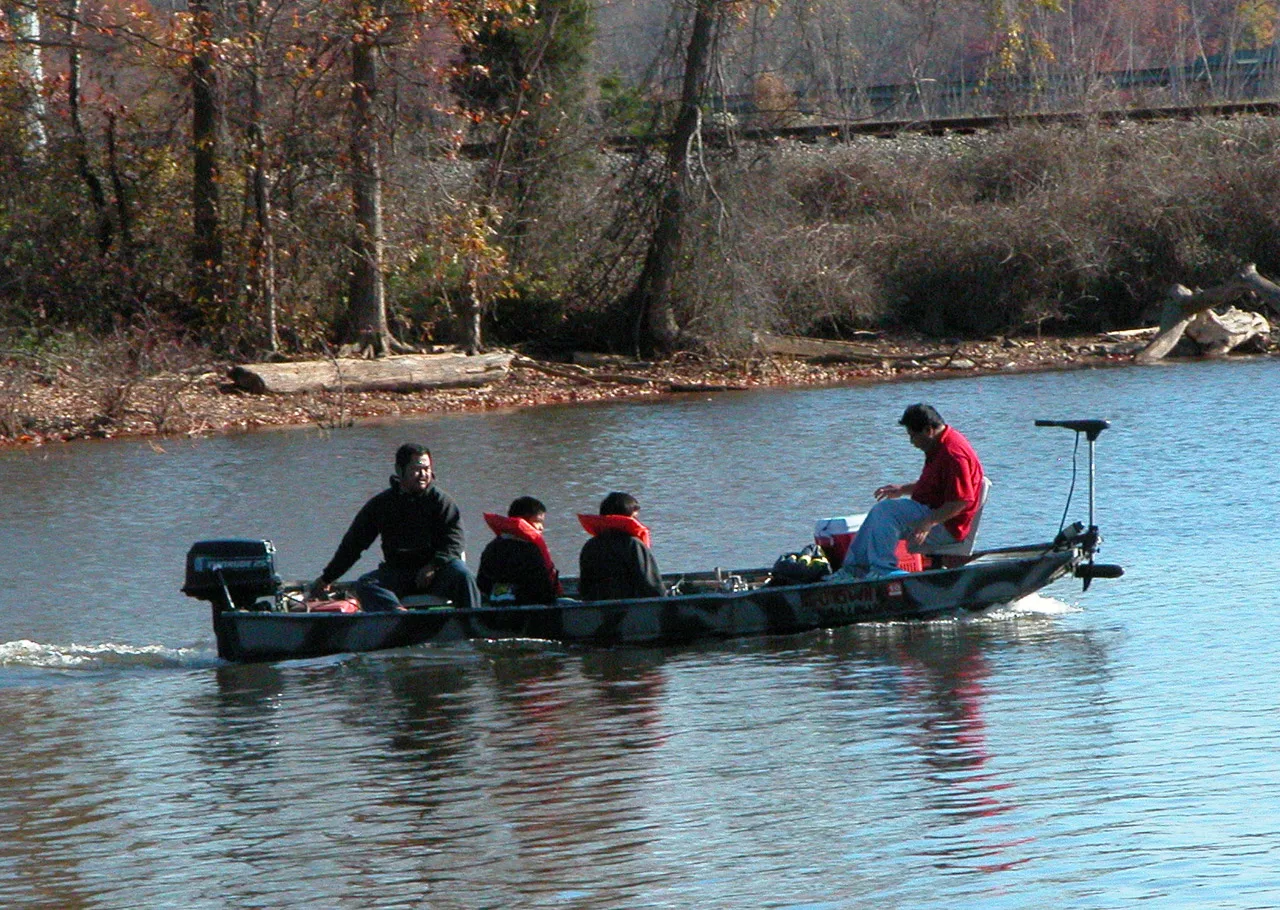
| Bow-mount trolling motor | Trolling motor | Sonar right under where you fish, no drilling | The view swings with the motor; it hangs low | Hose clamp; narrow end away from the propeller; route the cable so stowing never pinches it |
On a transom, Garmin wants the transducer parallel to the waterline and as close to the center of the boat as possible. It goes on the starboard side of a clockwise propeller and the port side of a counterclockwise one. Humminbird adds where the bubbles come from: “immediately aft of ribs, strakes, or rivets”. Then test it. Garmin’s procedure is to run slowly, speed up until the bottom reading drops out, and note that speed. If turning the boat brings the bottom back, lower the transducer another 1/8 in and run the test again.
Two details save a transducer. Tighten the bracket bolt enough to hold at speed but loose enough for the transducer to swing up if it hits a log. And never cut the cable to shorten it, which Garmin says voids the warranty. Route the cable away from ignition wires and trolling-motor leads, which put noise on the screen.
Speed has a ceiling too. Garmin’s selection guide rates transom mounts for good performance below 30 knots (34 mph), and Humminbird’s XNT guide advises against running over 65 mph with its transom transducers in the water. On a fast fiberglass boat that is the case for an in-hull or thru-hull mount.
The entry units compared
| Unit | Screen | Sonar | Depth rating | GPS, price |
|---|---|---|---|---|
| Lowrance Eagle 4x | 4 in (10 cm) | Single-frequency 2D (Outdoor Life); “wide-angle CHIRP” (Lowrance) | Not stated | No; $123 |
| Humminbird PiranhaMAX 4 | 4.3 in (11 cm) | Dual beam 200/455 kHz | 600 ft (183 m) at 200 kHz | No; $139.99 |
| Garmin Striker 4 | 3.5 in (8.9 cm) | CHIRP 77/200 kHz | 1,600 ft (488 m) fresh, retailer listing | Yes; $159.99 |
| Garmin Striker Vivid 4cv | 4.3 in (11 cm) | CHIRP plus ClearVü down imaging | 1,900 ft (579 m), transducer rating | Yes; $199.99 |
| Humminbird HELIX 5 CHIRP GPS G3 | 5 in (13 cm) | Dual Spectrum CHIRP | 1,200 ft (366 m) | Yes, with basemap; about $370 |
| HawkEye DepthTrax 2BX | Digital readout | Depth gauge | 600 ft (180 m) | No; dash gauge |
The picks in detail
Lowrance Eagle 4x
For a pond, a dock boat or a first boat, it does what a sonar has to do: depth, bottom and fish as arches on a 4 in portrait screen. Robbins admits his first thought was that it suits someone who only needs to know the depth, then calls that “unfair” because the color picture surprised him. Skip it if you want to save a spot: it has no GPS.
Humminbird PiranhaMAX 4
Two beams, a wide 28-degree and a narrow 16-degree one, rated to 600 ft at 200 kHz. Its 180 mA draw is the lowest in the table. It has no GPS either, so it shows where the fish are but cannot take you back to them.
Garmin Striker 4
The cheapest unit here that marks a waypoint, and our pick to start with on a small boat. It ships with both the transom and the trolling-motor mount, so one box covers either choice above. The screen is the limit: 3.5 in is small to read from the console. The Garmin Striker 4 sits in the same family as the Plus 4 and the Vivid 4cv.
Garmin Striker Vivid 4cv
The $40 step above the Striker 4 buys ClearVü down imaging and a 4.3 in screen. For anyone who fishes brush, rock or weed, that is the step worth taking. It has no preloaded lake chart, but like every Striker Vivid it draws its own Quickdraw contour map as you drive; the Garmin fish finder page explains where the charts begin.
Humminbird HELIX 5 CHIRP GPS G3
A 5 in screen at 800 × 480, CHIRP and a basemap, for about $370. Robbins writes that it “punches far above its price point” and lists the small screen for older eyes as its con. Buy it for the map and the bigger picture, not for imaging, which it lacks.
HawkEye DepthTrax 2BX
A depth gauge for the dash, with depth alarms you set for shallow and deep water and a keel offset so the number reads from the bottom of your hull. It is a navigation instrument, not a fishing tool; it draws no fish and no bottom.
How we chose
The mounting rules come from Garmin’s and Humminbird’s installation guides and Garmin’s transducer selection guide. The specs and prices come from the makers’ pages and retailer listings in October and November 2026, and the verdicts come from Outdoor Life’s long-running buyer’s guide, named where they are used. No unit was installed or run on the water for this page, and prices move weekly.
The words on a box, from waypoint to down imaging, are explained on the fish finders hub, along with the sonar behind every row above.
Free PDF · 16 pages
Know what's biting before your first cast
The Water Temperature Fishing Chart. Take one water temperature reading, find it on the chart, and see which of 26 freshwater fish are spawning, feeding hard or slowing down. Six pages go deeper: bass, crappie, bluegill, walleye, catfish and trout. For your phone and the tackle box.
- Where they sit and what to throw at every temperature: bass, crappie, bluegill and walleye. Catfish, one by one. Trout: the 68 °F line where you stop, and where they hide
- A bass that drops 3 ft feels more pressure change than the biggest cold front: the front day by day, and what to throw on each
- The three thermometer mistakes that make a reading lie (the first one is the surface)
- The 26-fish chart: who's spawning, feeding hard or slowing down at your reading
The chart's numbers come from state fish and wildlife agencies and fisheries research: 61 sources, each listed on the site.
Enter your email, confirm it with one click, and the PDF is in your inbox. Plus one email a week on what's biting. Unsubscribe anytime. Privacy.
Related
Section guide
Fish Finders: How Sonar Works, the Types, and Which Unit to BuyA fish finder is a sonar: how it works, what 2D, CHIRP, side imaging and live sonar show, what each costs, and the three brand ladders from $120 up.
 Forward Facing Sonar: How It Works, What It Costs, and the 2026 Rules
Forward facing sonar shows fish and your lure ahead of the boat, live. LiveScope 2, MEGA Live 2, ActiveTarget 2 compared, from $999, plus the rules.
 Garmin Fish Finder: Striker vs ECHOMAP vs GPSMAP, and Which to Buy
Garmin fish finders as a ladder: Striker (sonar only), ECHOMAP (charts, LiveScope 2), GPSMAP. Current prices, the model-number decoder, the pick by boat.
 Humminbird Fish Finder: PiranhaMAX, HELIX, SOLIX, XPLORE and APEX
Humminbird fish finder picks: PiranhaMAX 4 for a jon boat, HELIX 5 or 7 for a kayak, XPLORE 9 for a bass boat that may add MEGA Live 2. No HELIX runs it.
 Best Fish Finder for the Money: What Each Price Step Buys
The best fish finder at each price from $120 to $3,000, what every step adds, and the Black Friday price to wait for on each pick.
 How to Read a Fish Finder: Arches, Bottom, Bait and Imaging
How to read a fish finder: why fish show as arches on 2D sonar and dots on down imaging, what hard and soft bottom look like, bait, the thermocline, settings.
Sources
- Sportsman's Warehouse, Humminbird HELIX 5 CHIRP GPS G3 ($369.99, November 2026)
- Garmin, Transom/Trolling Mount Transducer Installation Instructions (February 2020)
- Garmin, Transducer Selection Guide (beam widths, depth ratings, mounting types)
- Garmin, STRIKER Plus Owner's Manual (frequency and CHIRP notes)
- Humminbird, XNT transom transducer installation guide 532239-5_B (hosted by Defender)
- Humminbird, Transducer Resource Guide 532651-1 (in-hull rules; hosted by Defender)
- Tackle Warehouse, Lowrance Eagle Series (Eagle 4x Sonar $123.00, November 2026)
- Overton's, Raymarine i40 Depth Display System with Thru-Hull Transducer ($329.99, November 2026)
- Humminbird Help Center, Humminbird installation overview
- U.S. Coast Guard, A Boater's Guide to the Federal Requirements for Recreational Boats (revised November 2023)
- Garmin, STRIKER 4 (specifications and price, October 2026)
- Garmin, STRIKER Vivid 4cv (specifications and price, October 2026)
- Humminbird, PiranhaMAX 4 specifications
- TackleDirect, Humminbird PiranhaMAX 4 (price)
- Humminbird, HELIX 5 CHIRP GPS G3 specifications
- Lowrance, Eagle 4x with Bullet Skimmer transducer (price, October 2026)
- TackleDirect, HawkEye DepthTrax 2BX in-dash depth and temperature gauge
- Outdoor Life (Pete Robbins), The best fish finders, updated Feb 20, 2026
- FishUSA, Garmin Striker 4 listing (1,600 ft fresh, 750 ft salt)