 By
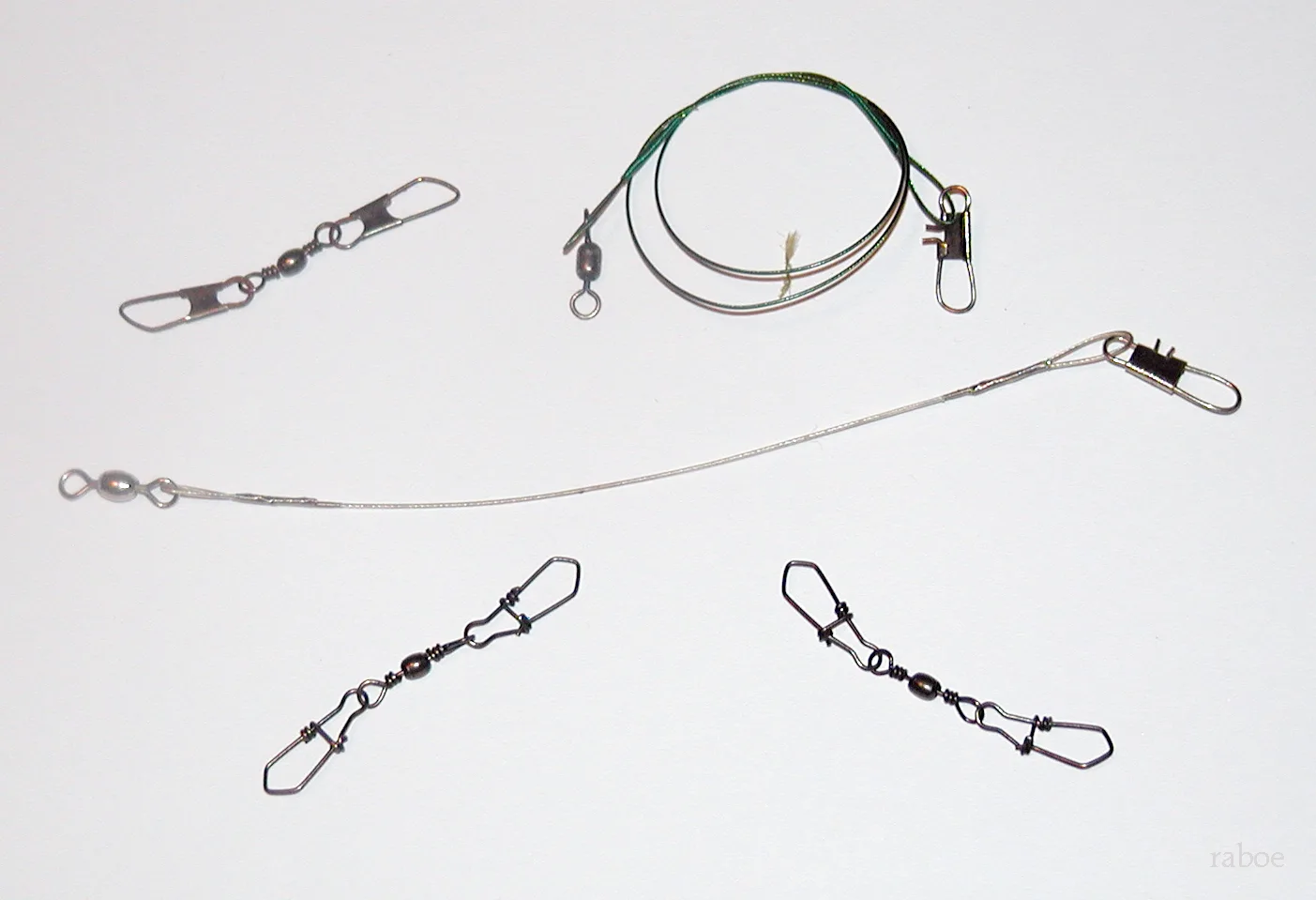
Fishing swivels are small metal joints that stop line twist. Most anglers need one kind: a plain swivel rated about 35 lb, around size 10. Tie one in when something on your line can spin: a spoon, an inline spinner, cut bait in current. On a jig it’s just extra metal. Every rating here comes off the maker’s own page, and none of these swivels was tested by hand.
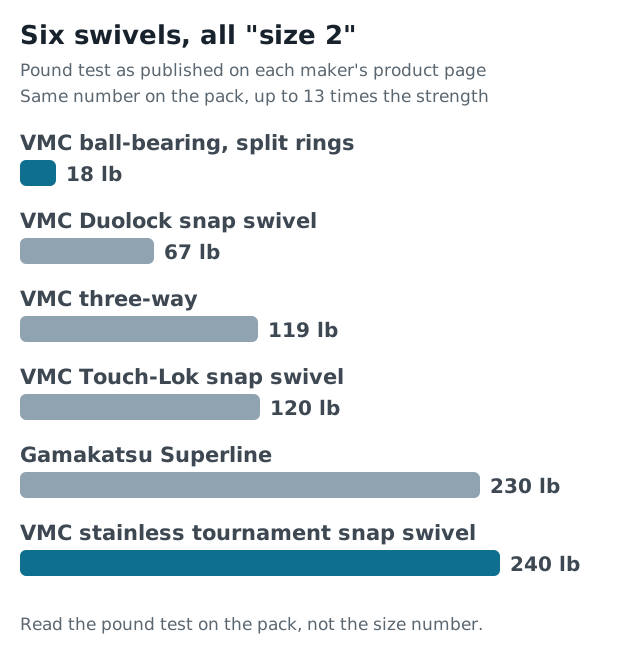
VMC rates one size 2 swivel at 18 lb and another size 2 at 240 lb. Read the pound test on the pack, not the number.
Which fishing swivel do you need?
Go by what’s on the end of your line. Here’s the pick for each job.
- Everyday twist, bait in current, joining line to leader: a plain swivel, size 10 for line up to 20 lb. Get the Gamakatsu Superline first.
- Spoons: a small snap swivel. “You should never, ever fish a spoon without a good swivel in front of it,” MeatEater’s Sam Lungren says, and we’d listen.
- Inline spinners: a size 12 or 14 swivel, tied in about 12 in (30 cm) above the lure. Tackle App adds it only once twist shows.
- Spoons you troll, or anything that spins hard: a ball-bearing swivel.
- Bait on one line, sinker on another: a three-way swivel.
- Jigs, worms, crankbaits: no swivel. Tie direct.
A swivel is cheap, but it isn’t free. It’s a second knot, and it’s one more thing a fish can see.
Barrel, snap, ball-bearing or three-way?
A swivel is two eyes that turn on their own. Twist coming up from the bait stops there and never reaches your main line. The types differ in how freely they turn and in what you can hang on them.
| Type | What it is | Use it for |
|---|---|---|
| Barrel swivel | Two eyes on a barrel-shaped body | Everyday twist, line to leader, the stop on a slip rig |
| Rolling or crane swivel | Cylinder or machined body, smaller and stronger than a barrel | Twist under load; the Carolina rig |
| Ball-bearing swivel | Bearings inside, turns with the least twist | Trolling, spoons, hard-spinning lures |
| Snap swivel | Swivel joined to a snap clip | Changing lures without retying; spoons and spinners |
| Three-way swivel | Three eyes that turn on posts | Main line, leader and sinker on one fitting |
Barrel swivels are the ones you’ll use most. Each eye turns a full 360 degrees, Outdoor Life’s Joe Cermele points out. So cut bait spinning in current can’t send twist up your line. They also give you two strong tie-in points between main line and leader.
Barrels have a limit. Under heavy load, The Tackle Room says, “the friction inside a barrel swivel increases and the swivel essentially locks up.” That’s a problem for offshore trolling, and it rarely matters on a pond. British Sea Fishing says rolling swivels still spin and shed twist under considerable pressure. It rates crane swivels the strongest and smoothest of all, at the highest price.
A three-way swivel takes your main line on one eye, your leader on the second and a sinker on the third, either on a snap or a short dropper. Each eye turns on its own post. Two of them spaced apart make a high-low rig.
Is a ball-bearing swivel worth it?
Pay for one when something really spins. Salt Strong measured how much twist each kind took before it started turning. A traditional swivel started at around seven twists per inch. A ball-bearing swivel started at fewer than two.
Keep that in proportion. It’s one test, done in air, with no count of how many tries it took. The ball-bearing swivel cost $2 against $0.30 for the regular one. The man who ran the test also said a properly weighted spoon shouldn’t spin much anyway. On a pond, buy plain swivels and spend the difference on hooks.
Free PDF · Hook size chart What size is that hook? Lay it on the chart.
Print the free chart, lay any hook on it and read its size: 14 hooks from 9/0 to #8 at actual size, a gap ladder from #32 to 12/0, and the size for 17 fish and 16 baits on the back.
No card, nothing to buy, and the PDF is yours to keep. Confirm with one click and it's on its way. Then a few short emails and one a week on what's biting. Unsubscribe anytime. Privacy.
Fishing swivel size chart: what’s the pound test?
Size numbers on swivels are not standard. The Tackle Room says so flat out, and the makers’ pages prove it. What the shop won’t tell you: the numbers run in opposite directions.
On plain and snap swivels, a smaller number is a stronger swivel. These are two makers’ tables.
| Size | Gamakatsu Superline (plain) | VMC Duolock snap swivel |
|---|---|---|
| 10 | 35 lb (16 kg) | 20 lb (9 kg) |
| 8 | 50 lb (23 kg) | 30 lb (14 kg) |
| 7 | 75 lb (34 kg) | Not listed |
| 6 | 80 lb (36 kg) | 30 lb (14 kg) |
| 5 | 120 lb (54 kg) | Not listed |
| 4 | 130 lb (59 kg) | 50 lb (23 kg) |
| 2 | 230 lb (104 kg) | 67 lb (30 kg) |
| 1 | 330 lb (150 kg) | Not listed |
On the two ball-bearing swivels below, a bigger number is the stronger one. A size 4 in this table is the bigger swivel. A size 4 in the table above is the smaller one.
| Size | VMC brass ball-bearing | Owner Hyper stainless |
|---|---|---|
| 0 | 11 lb (5 kg) | Not listed |
| 1 | 13 lb (6 kg) | Not listed |
| 2 | 18 lb (8 kg) | Not listed |
| 3 | 18 lb (8 kg) | 100 lb (45 kg) |
| 4 | 26 lb (12 kg) | 125 lb (57 kg) |
| 5 | Not listed | 160 lb (73 kg) |
| 6 | Not listed | 190 lb (86 kg) |
| 7 | Not listed | 300 lb (136 kg) |
| 8 | Not listed | 400 lb (181 kg) |
And the same number can be almost anything. VMC’s snap swivels and three-way all carry a size 2, and that one number covers six different strengths across the makers we read.
What size swivel for your line?
Buy by the rating on the pack. The Tackle Room’s rule for snap swivels is a rating of at least 1.5 times your line’s breaking strength. It’s a shop’s rule, written with saltwater in mind, but it’s a sensible floor for any swivel. Here it is worked out against Gamakatsu’s Superline ratings.
| Your line | Swivel rated at least | Smallest Superline that clears it |
|---|---|---|
| Up to 20 lb (9 kg) | 30 lb (14 kg) | Size 10 (35 lb) |
| 30 lb (14 kg) | 45 lb (20 kg) | Size 8 (50 lb) |
| 40 lb (18 kg) | 60 lb (27 kg) | Size 7 (75 lb) |
| 50 lb (23 kg) | 75 lb (34 kg) | Size 7 (75 lb) |
| 65 lb (29 kg) | 98 lb (44 kg) | Size 5 (120 lb) |
| 80 lb (36 kg) | 120 lb (54 kg) | Size 5 (120 lb) |
| 100 lb (45 kg) | 150 lb (68 kg) | Size 2 (230 lb) |
Notice what the top row means. On 10 lb line, a size 10 is already three and a half times stronger than the line. For most freshwater fishing you can stop worrying about the swivel’s strength and buy for small. One catch: VMC’s light ball-bearing swivels really are light. Its #2 holds 18 lb, so on 20 lb line it’s the weak link.
What size swivel for each kind of fishing?
| Fishing | Swivel | Size |
|---|---|---|
| Inline spinners | Barrel or snap swivel about 12 in (30 cm) above the lure | Size 12 or 14 |
| Spoons, cast or trolled | Snap swivel in front of the spoon | Smallest that clears your line |
| Drop-shot rig with twist | Barrel swivel above the bait | Size 8 (Mark Menendez) |
| Carolina rig | Barrel or rolling swivel under the bead | Size 10 to 6; Jacob Wheeler fishes a 4 |
| Fish finder rig, surf | Barrel swivel | 75 lb or heavier |
| Catfish, three-way rig | Three-way swivel | From the line table above |
On a Carolina rig, too small is the real danger. A tiny swivel wedges inside the sinker or the bead, which is why Jason Sealock stays between No. 10 and No. 6.
When should you skip a swivel?
More often than the shop wall suggests. Salt Strong puts it plainly: “I’ve found the best results going without swivels in most situations.” It saves swivels for three jobs: casting a lure that twists on the retrieve, trolling baits that twist, and soaking baits in current.
Here’s why you’d leave one off:
- It’s another knot. A swivel means two connections instead of one.
- It can chip a guide. Reel a swivel into your rod guide and you can damage it.
- It adds weight in the wrong place. Salt Strong warns that the swivel’s weight can drop your line into abrasive bottom.
- Hard baits like to swim free. On jerkbaits and other hard baits, Master Fishing Guide prefers a plain snap so the lure moves freely. The snap swivel stays for spoons and spinners.
- The twist isn’t coming from the lure. Joe Shead names another cause. “Cranking the reel when the drag on your spinning reel is paying out line is another way to twist up your line quickly,” he writes. A swivel at the far end of the line can’t fix that. Neither can it fix a bad spooling job.
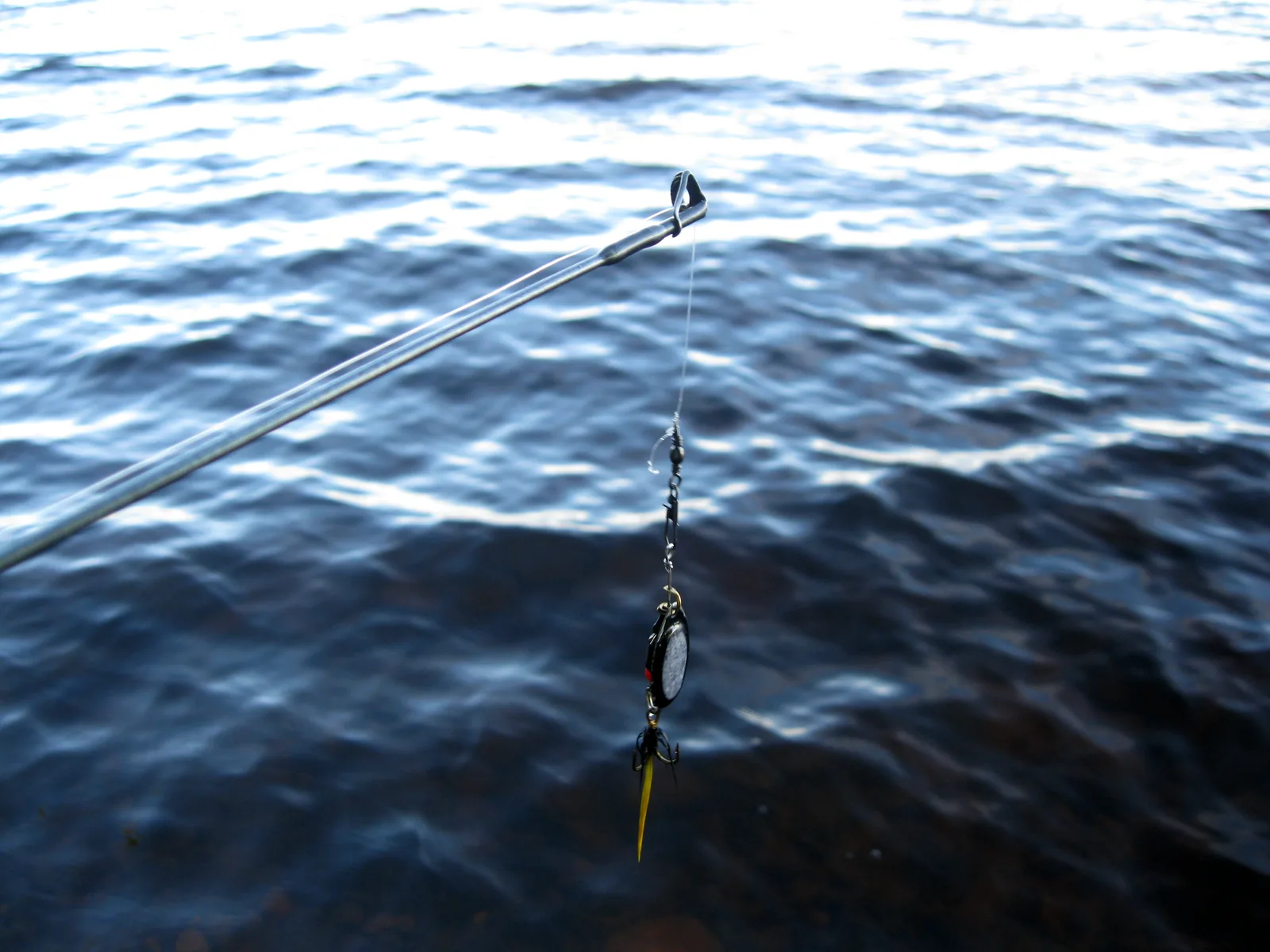
A swivel tied in a short way above a spinner, clear of the blade. Photo: Santeri Viinamäki, Wikimedia Commons (CC BY-SA 4.0).
Do snap swivels scare fish?
Salt Strong’s Wyatt Parcel thinks so, calling them “too big and bulky” for artificial lures. Nobody has measured it, as far as we can find. Our advice is the boring one: use the smallest snap that clears your line, and leave it off a slow bait in clear water. Dark finishes like Gamakatsu’s black coating are sold as stealthier, and that’s about all anyone can say.
How do you tie a swivel into your line?
Tie your main line to one eye with a Palomar knot or a uni knot, then your leader to the other eye the same way. On braid, Salt Strong’s knot contest picked the uni, passed through the eye twice and tied with 10 or more turns. A Palomar needs the swivel to pass through its loop. With a leader already on the other eye, the whole leader has to go through too.
Put the swivel high. Salt Strong’s advice is “at the top of the leader”, away from the hook. On a slip rig the swivel is also the stop for your sliding sinker, so thread a bead on first. Without one, Cermele notes, the sinker knocks the swivel and chafes your knot.
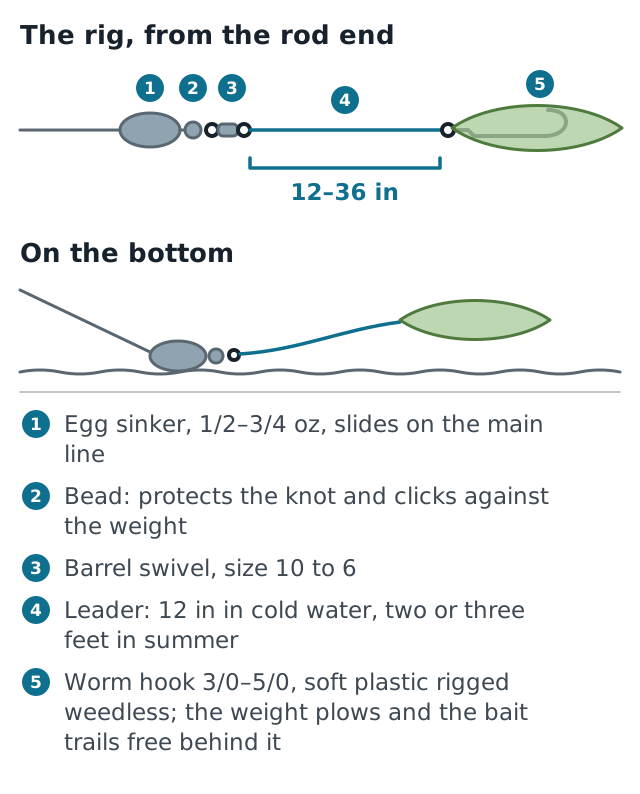
A Carolina rig, the classic swivel job: the swivel stops the bead and joins line to leader. Drawing: fishing.info.
Brass or stainless?
Brass is fine in fresh water. Take stainless for salt. “Brass snap swivels corrode fast in saltwater,” The Tackle Room warns. VMC builds its three-way and its light ball-bearing swivels from brass with a black nickel finish. Of the five VMC swivels we read, only the all-stainless tournament snap swivel is called “saltwater ready.” In the surf or trolling salt, take stainless, like the Owner Hyper.
The picks in detail
We picked these from what each maker publishes: a full table of sizes and ratings, and a price.
Superline Swivel (Gamakatsu)
For the everyday swivel in your tackle box. It’s made in Japan, and the table runs from size 10 at 35 lb to size 1 at 330 lb. There’s no size 3. Its limit: it doesn’t go smaller than a 10, so spinner anglers who want a 12 or 14 need another brand.
Duo Lock Snap with Superline Swivel (Gamakatsu)
For spoons and quick lure changes. Size 12 and size 10 are both rated 35 lb, so go with the 12 unless the bait is big. Gamakatsu aims it at freshwater anglers and light saltwater. Skip it on crankbaits and jerkbaits.
BBSSR Ball Bearing Swivel with Split Rings (VMC)
For trolling small spoons on light line. It’s the swivel that makes the size 2 surprise so big: 18 lb. Don’t put it on heavy line.
TWS Three Way Swivel (VMC)
For bait rigs and spreaders. One quirk on the table: the size 1 is rated 110 lb and the size 2 is rated 119 lb, so the smaller swivel holds more. Another reason to read the pack.
Hyper Ball Bearing Swivels (Owner)
For saltwater trollers. Owner sells it for “no-twist protection when trolling and for big game leader connections.” Stainless and strong, and it costs like it. Leave it on the shelf for bass.
How we chose
We read every rating off the maker’s own product page, not a shop’s or a reviewer’s. Sampo, Berkley and Eagle Claw aren’t here because we couldn’t read their tables from the maker. We didn’t pull apart or test any swivel by hand, and we didn’t analyze owner reviews. The size-per-fishing numbers come from the anglers and editors named in the sources.
Ratings change, and a maker can reprint a table, so check the pack before you trust a number. For the rest of the end of your line, start with the fishing tackle guide and fishing weights.

Free PDF · 2 pages
Stop guessing hook sizes. Lay any hook on this page and read it
A jar of loose hooks and no packet in sight. Guess wrong and you find out with a fish on.
The True-Size Hook Chart. Print it at actual size, lay a hook on the outlines, and the one its bend fills is its size. One sheet, front and back, for the tackle box.
- 14 hooks from 9/0 to #8 at true size, plus a ladder from #32 to 12/0
- The size for 17 fish and 16 baits, from bluegill to tuna
- A 2/0 circle that gapes less than a #4: why a 2/0 is not always a 2/0
Every outline drawn from Mustad's published dimensions; every size from the 25 sources on the page, Maryland DNR and Idaho Fish and Game among them.
No card, nothing to buy. Confirm with one click and the PDF is on its way, one version for your phone and one to print, yours to keep. Then a few short emails and one a week on what's biting, with an unsubscribe link in every one. Privacy.
Related
Section guide
Fishing Tackle: The Types, What a First Box Holds, and the Lead LawsFishing tackle explained: hooks, sinkers, swivels and floats, a first box for panfish, bass, catfish or the surf, what it costs, and where lead is banned.
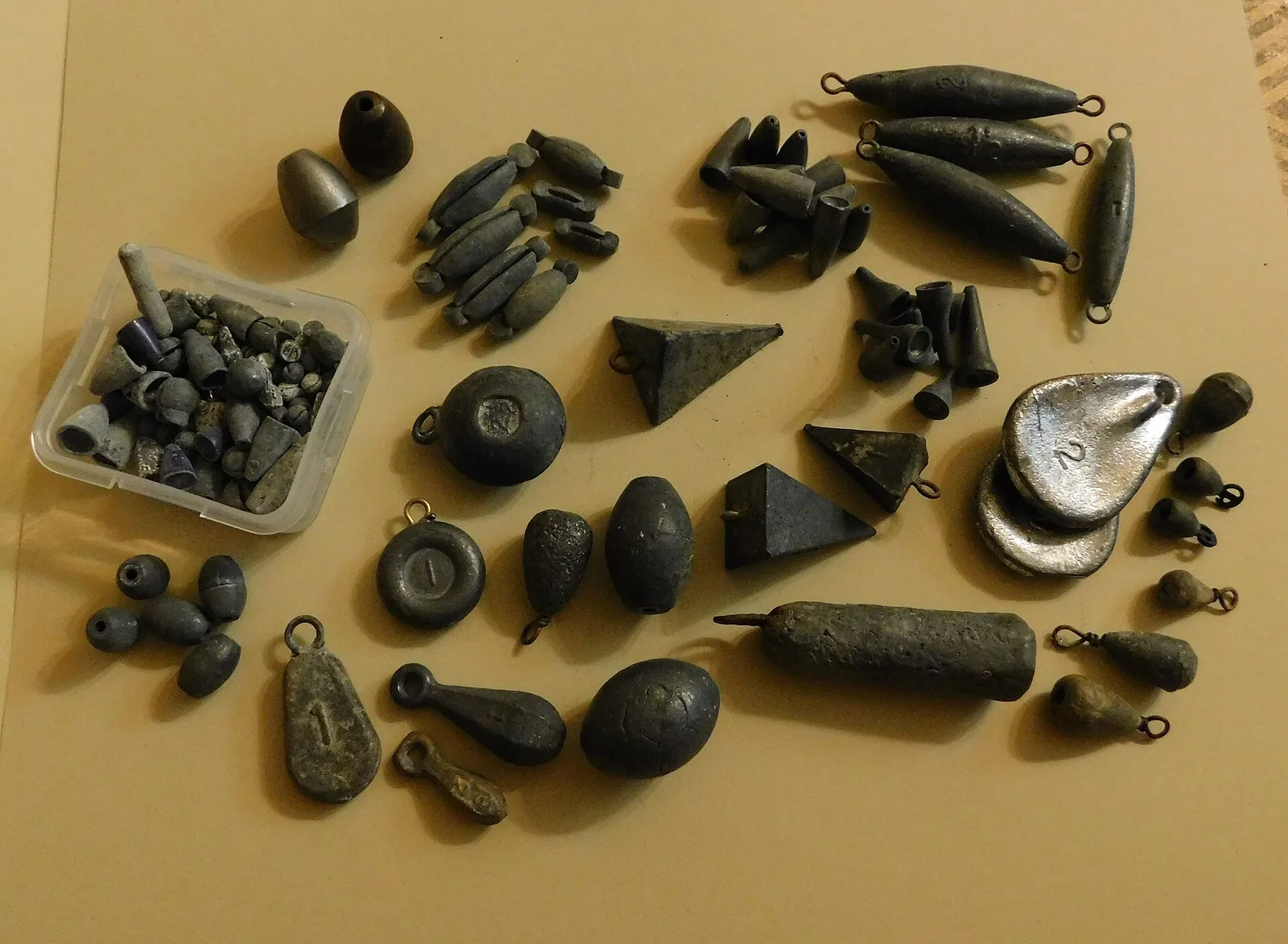 Fishing Weights: Every Sinker Type, the Sizes, and the Lead Laws
Fishing weights: 10 sinker types and their jobs, a split shot size chart in ounces, how heavy to go, tungsten vs lead, and where lead is banned.
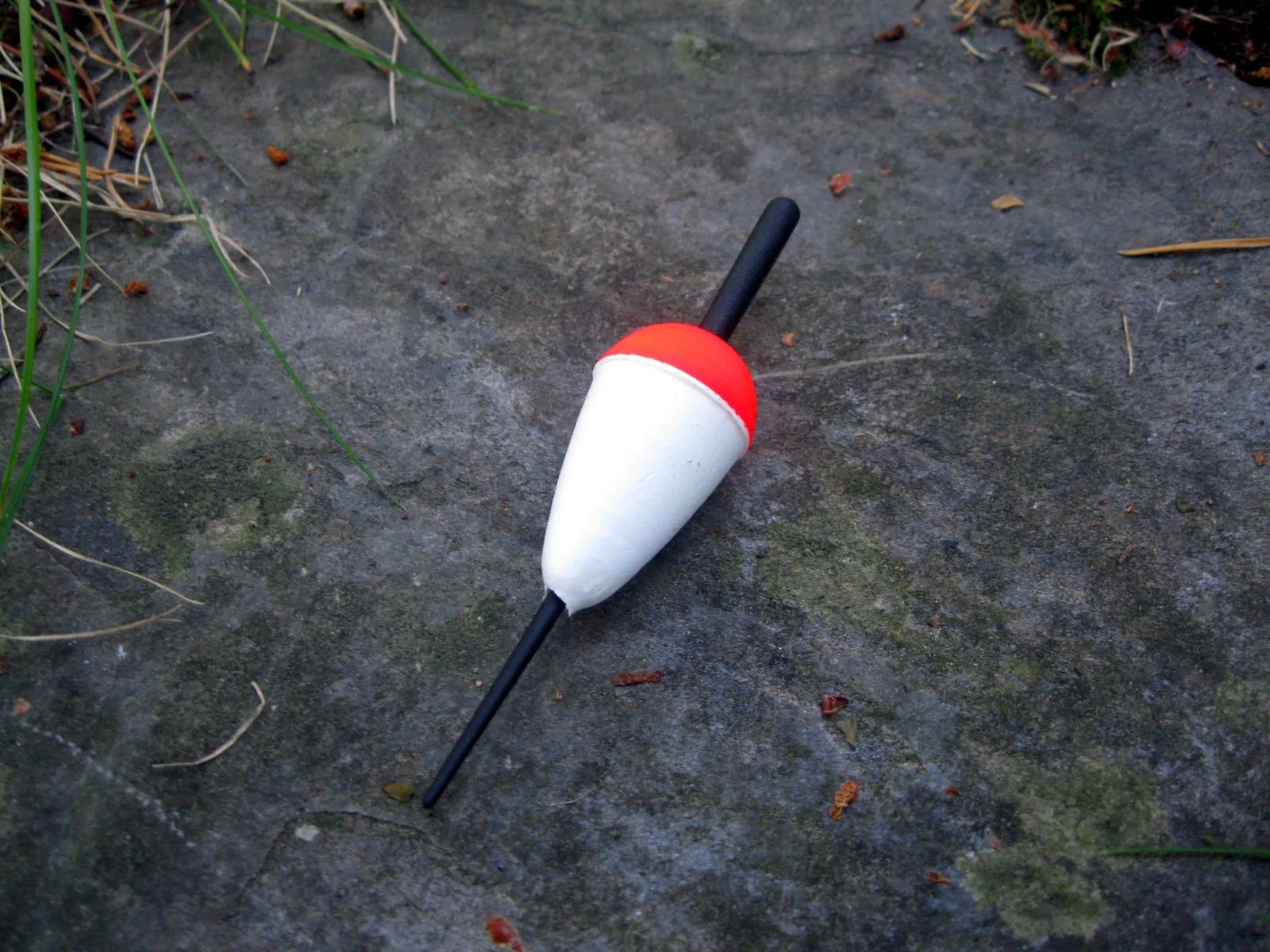 Fishing Bobbers: Which Float to Buy, and How to Set a Slip Bobber's Depth
Which fishing bobber to buy: round, spring, pencil or slip, the size for bluegill and crappie, five picks from $2.74, and how to set a slip bobber's depth.
 Plano Tackle Box: Every Series, Size and Model Number Decoded
Every Plano tackle box series and size: StowAway, ProLatch and EDGE trays, racks, bags and kits, with Plano's own prices and what each model number means.
 Tackle Box: The Best Boxes, Trays and Bags, and What 3700 Means
The best tackle box for bank, boat, kayak, kid or musky: eight picks with owner-complaint counts, and the 3600 and 3700 tray sizes explained.
Sources (24)
- Gamakatsu, Superline Swivel (sizes and break strengths)
- Gamakatsu, Duo Lock Snap with Superline Swivel (5 Pack)
- VMC, BBSSR Ball Bearing Swivel w/Split Rings
- VMC, DLSS Duolock Snap Swivel
- VMC, TLKSS Touch-Lok Snap Swivel
Show all 24 sourcesShow fewer sources
- VMC, SSTSS Stainless Steel Tournament Snap Swivel
- VMC, TWS Three Way Swivel
- Owner, Hyper Ball Bearing Swivels (5158)
- Outdoor Life (Joe Cermele), Terminal Tackle: What You Need to Know for Better Rigs
- Salt Strong (Luke Simonds), Ball Bearing vs. Traditional Swivel: Which Decreases Line Twists More? (June 2020)
- Salt Strong, when and where to use a swivel on a leader
- Salt Strong (Wyatt Parcel), snap swivels on artificial lures (July 2020)
- Salt Strong, Best fishing knot for braided line to swivel, hook or lure (uni, San Diego jam, Palomar, improved clinch)
- The Tackle Room, Snap Swivel Sizes Explained
- The Tackle Room, Fishing Swivels Explained (March 2024)
- British Sea Fishing, Swivels
- Joe Shead, How to Prevent and Fix Fishing Line Twist Like a Pro, On SI (May 2025)
- Seaguar, don't let line twist be a let down (Mark Menendez)
- Wired2Fish (Jason Sealock), The Carolina rig: how to rig and fish
- Wired2Fish (Kyle Peterson), Carolina rig 101: how to rig and fish with Jacob Wheeler (2020; archived copy)
- Wired2Fish (Nick Honachefsky), How to fish and tie the fish finder rig
- Tackle App, how to use inline spinners (sizes, swivel, retrieve, colors)
- Sam Lungren, The world's most versatile fishing lure, MeatEater (2021)
- Master Fishing Guide, pike fishing leaders: wire, fluorocarbon, length