 By
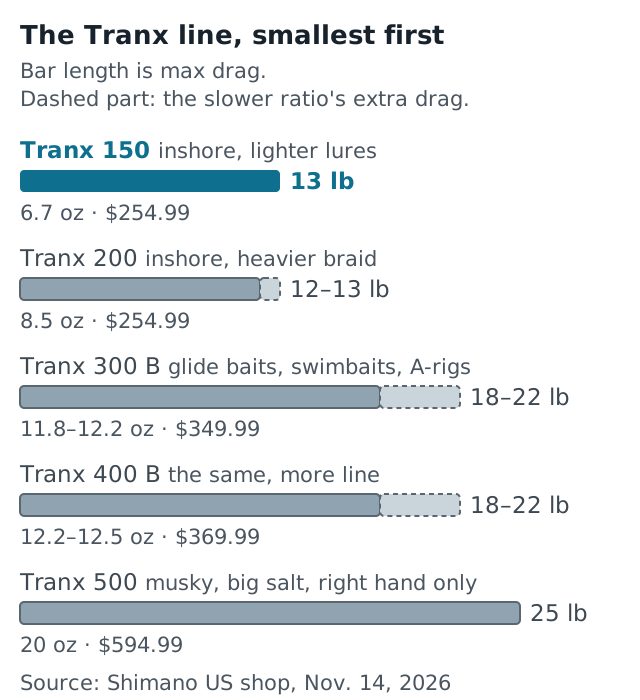
The Shimano Tranx is five casting reels, from $255 to $595, built for big baits and salt water. For most buyers the one to get is the $350 Tranx 300 B: 18 to 22 lb of drag in a low-profile reel. Inshore anglers should look at the $255 Tranx 150 or 200 first. The specs and prices here are Shimano’s own, and the owner scores Tackle Warehouse’s, as of Nov. 14, 2026. No reel was fished for this page.
The Tranx 300 B holds the same mono as a $245 Curado 300 K and carries the same 18 and 22 lb drag ratings. The extra $105 buys a one-piece frame, water protection and a big-bait brake, not more line.
Which Shimano Tranx should you buy?
Pick it by the fish and the lure. All five are baitcasters in a low-profile shape, the kind that sits in your palm.
| Your fishing | Tranx | Ratio |
|---|---|---|
| Wading the Gulf Coast with lighter inshore lures | 150 | 7.2:1 (HG) |
| Inshore with heavier braid, 30 to 65 lb | 200 | 7.2:1 (HG) |
| Glide baits, swimbaits, the Alabama rig | 300 B | 7.6:1 (HG) |
| The same baits, with more line on the spool | 400 B | 5.8:1 or 7.6:1 |
| Musky and big fish in salt | 500 | 6.6:1 (HG) |
Every size but the 500 has a left-hand model. On the 150 and 200 the left-hand reel comes in 7.2:1 only. An even number (150, 200, 300, 400) winds right and an odd one (151, 201, 301, 401) winds left. Shimano lists the 500 for the right hand only.
Every Tranx reel side by side
| Reel | Price | Weight | Max drag | Line it holds |
|---|---|---|---|---|
| Tranx 150 | $254.99 | 6.7 oz (190 g) | 13 lb | 135 yd of 30 lb braid |
| Tranx 200 | $254.99 | 8.5 oz (241 g) | 12–13 lb | 180 yd of 8 lb mono |
| Tranx 300 B | $349.99 | 11.8–12.2 oz | 18–22 lb | 230 yd of 12 lb mono |
| Tranx 400 B | $369.99 | 12.2–12.5 oz | 18–22 lb | 260 yd of 14 lb mono |
| Tranx 500 | $594.99 | 20 oz (567 g) | 25 lb | 160 yd of 30 lb mono |
Where a cell shows a range, it depends on the gear ratio. On the 300 B and 400 B the faster model weighs more and carries less drag: 18 lb against 22 lb.
The Tranx 150 has no mono rating at all. Shimano lists it as “Braid Only,” with 150 yd of 20 lb, 135 yd of 30 lb or 105 yd of 40 lb PowerPro braid. Every Tranx has a star drag of Cross Carbon, which Shimano says gives a wider range of drag settings than older drag materials.
The five aren’t one design scaled up, though. They split into three builds.
| Reel | Brake | Frame and water protection |
|---|---|---|
| 150, 200 | SVS Infinity | HAGANE Body, CoreProtect |
| 300 B, 400 B | SVS Infinity MD Tune | CoreSolid Body, X PROTECT |
| 500 | VBS | HAGANE Body |
SVS Infinity uses brake weights that rub against the raceway on the cast, with a knob outside to set it. The MD Tune on the B models is the version for heavy lures. Shimano says it allows “maximum adjustability when tossing large glide baits or paddletail swimbaits.” VBS on the 500 brakes by centrifugal force, not magnets.
Free PDF · Hook size chart What size is that hook? Lay it on the chart.
Print the free chart, lay any hook on it and read its size: 14 hooks from 9/0 to #8 at actual size, a gap ladder from #32 to 12/0, and the size for 17 fish and 16 baits on the back.
No card, nothing to buy, and the PDF is yours to keep. Confirm with one click and it's on its way. Then a few short emails and one a week on what's biting. Unsubscribe anytime. Privacy.
Tranx 150 or 200?
Same price, same brake and the same drag: 13 lb, or 12 on the 200 XG. The 150 is the light one. It weighs 6.7 oz and takes braid only, up to 40 lb test. The 200 weighs 8.5 oz and takes heavier line, such as 120 yd of 50 lb braid, and it’s rated for mono too. So get the 150 if you wade with lighter lures, and the 200 if you fish 50 or 65 lb braid. The 200’s XG is also the fastest small Tranx, at 36 in a turn.
Is the Tranx 300 B worth it?
Yes, if you throw big glide baits and swimbaits all day. It’s the Tranx owners rate highest: 4.9 out of 5 from 10 reviews on Tackle Warehouse.
The B is the redesign of the 300. Its CoreSolid Body makes the side plate, the level-wind guard and the frame one solid aluminum piece. Shimano calls it the first design of this type in a low-profile baitcaster. The point is a frame that doesn’t flex when a big fish leans on it. Shimano also gives it X-Ship, which it says cuts friction between the spool shaft and the gear.
Owners use it for what Shimano built it for. One throws A-rigs and 6.8 to 7.8 in swimbaits on a 7 ft 11 in heavy rod with the 5.8:1. One owner who had always used Curado DCs bought it for big glide baits. He says it’s smooth enough that “it doesnt need the digital control.” Another pairs it with a musky rod and 40 lb braid. A California owner says it “Handles calicos sand bass and spottied bass with ease,” but calls it “Not the best for deep water jigging.”
The one 4-star owner sums up the trade. To him it’s “a Curado that’s a little bigger and more solid in all ways,” worth nearer $299 than $349. The small handle paddles are “very outdated,” he says. One owner swapped his for a 120 mm aftermarket handle.
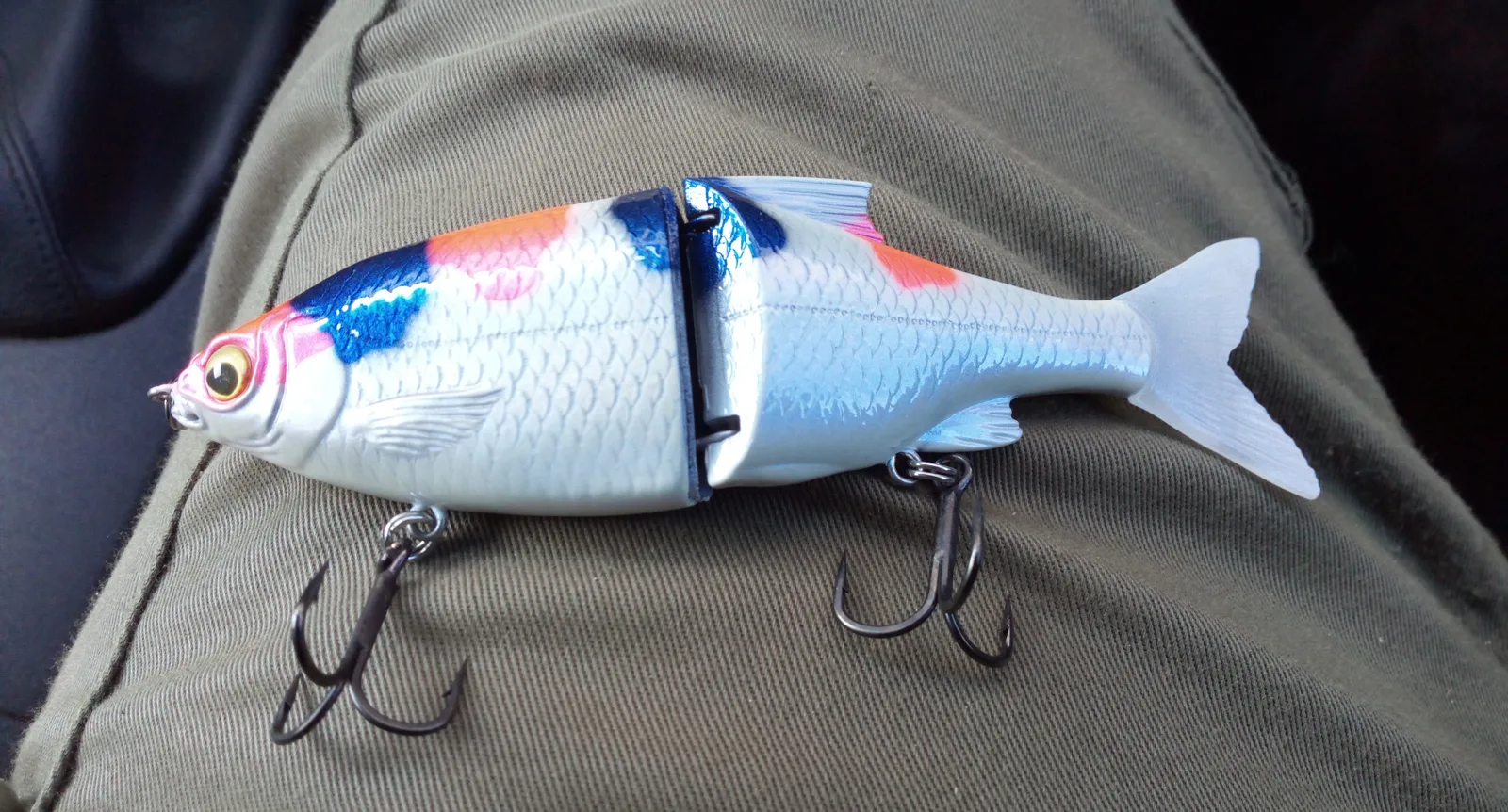
A glide bait, the lure the Tranx 300 B and 400 B brakes are tuned for. Photo: Jiří Zelenka, Wikimedia Commons (CC BY-SA 4.0), cropped.
Tranx 300 or 400?
Get the 300 B unless you need the line. The two share the brake, the frame, the ratios and the drag. The 400 B costs $20 more and adds one bearing, 5+1 against 4+1, and a bigger spool.
| Tranx 300 B | Tranx 400 B | |
|---|---|---|
| Price | $349.99 | $369.99 |
| Weight | 11.8–12.2 oz | 12.2–12.5 oz |
| Mono | 230 yd of 12 lb, 180 yd of 14 lb | 260 yd of 14 lb, 160 yd of 20 lb |
| PowerPro braid | 180 yd of 50 lb, 135 yd of 65 lb | 180 yd of 65 lb, 150 yd of 80 lb |
| Bearings | 4+1 | 5+1 |
That spool counts when a fish runs far, not when you cast. One 400 B owner throws glide baits for bass and fishes big catfish with it. The 400 B has only two reviews, though, at 3.5 out of 5. The low one is from an owner whose drag went rough after about a month and whose free spool broke in the second.
Tranx or Curado?
At the 150 and 200 size in fresh water, the Curado. For big baits it’s closer. Shimano sells a Curado to match each of the three smaller Tranx sizes. It holds the same line, or near it, for less money and with more bearings.
| Size | Tranx | The Curado of that size |
|---|---|---|
| 150 | $254.99, 6.7 oz, 3+1 | 150M: $234.99, 6.7 oz, 6+1 |
| 200 | $254.99, 8.5 oz, 3+1 | 200 M: $224.99, 7.4–7.6 oz, 6+1 |
| 300 | $349.99, 11.8–12.2 oz, 4+1 | 300 K: $244.99, 10.6–10.8 oz, 5+1 |
The 200s match on mono and braid. The 150s match on braid, and only the Curado 150M is rated for mono too. The 300s match on mono. On braid they’re within 20 yd: the Tranx holds more 40 and 65 lb line, the Curado more 50 lb line. The drag ratings match too, size for size. So on the 150 and 200 the extra money buys the build, not the numbers. That’s CoreProtect, a coating that makes water bead up and roll off the reel. Shimano lists it on neither Curado. On the 300 B it’s the one-piece CoreSolid frame, X PROTECT on the drive-gear bearing and the MD Tune brake. The Curado 300 K has the VBS brake instead. The 300 B is also geared faster. At either ratio it takes up 6 in more line a turn than the Curado 300 K.
So for a glide-bait reel you’ll throw all day, the 300 B’s brake, frame and faster gears are what the $105 pays for. If that’s more than you want to spend, the Curado 300 K holds the same mono.
Some owners say the same. One Tranx 200 owner thinks his Curado 200 is better. Another notes the Tranx 200 looks the same size as his Curado 150. For bass in fresh water, the Shimano Curado 150M is the reel to compare first.
Can a Tranx go in salt water?
Yes, it’s built for it, but it isn’t sealed. Shimano designed the Tranx 150 “with Texas and Gulf Coast wading anglers in mind,” it says. The Tranx 200 came out of a ten-year corrosion study, built “to withstand the harshest saltwater environments.”
What Shimano lists is water resistance, not a sealed reel. CoreProtect, on the 150 and 200, is a coating on critical areas that Shimano says cuts down how much water gets inside. X PROTECT, on the 300 B and 400 B, is waterproofing on the inside bearing of the drive-gear shaft. Shimano names no IP rating on any of them.
Owners split. A Tranx 150 owner in New Jersey has had his fully under water several times, and it’s “still as smooth as can be,” he says. A Florida owner says he’s abused his Tranx 200 in salt for months and it still works perfectly. But one 150 owner who fishes saltwater bays found so much corrosion inside after a few months that he threw it away. Another opened his after two weeks and says there was no grease or oil in it.

Snook in clear shallows at Homosassa, on Florida’s Gulf Coast, the water Shimano says it designed the Tranx 150 for. Photo: dande, iNaturalist (CC0).
So open a new Tranx and check for grease before its first trip in salt. The saltwater reels page has the Tranx 150 among its picks for the salt.
Which Tranx gear ratio should you get?
On the 300 B and 400 B, get 7.6:1 (HG) to pick up 41 in a turn. Get 5.8:1 for the most drag: 22 lb instead of 18. One owner fishes his 5.8:1 with A-rigs and big swimbaits. The gear ratio is how many times the spool turns for one turn of the handle.
What you feel is the line that comes back per turn.
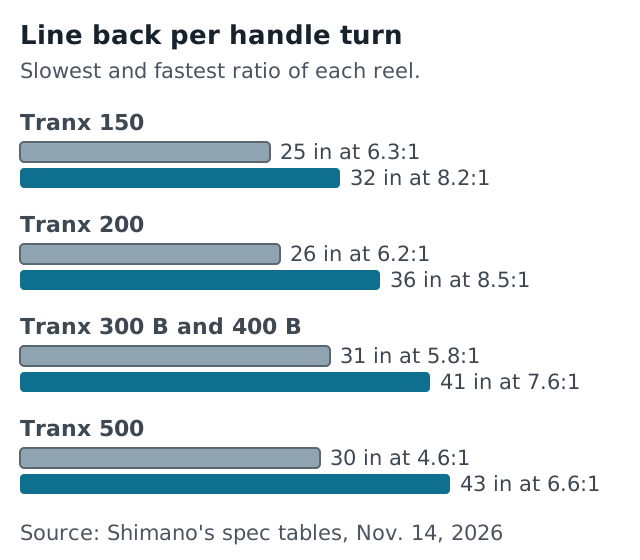
The bigger the spool, the more line each turn brings back. So the slow 300 B, at 5.8:1, picks up 31 in a turn, nearly the 32 in of the fastest 150. The middle ratio on the small reels is 7.2:1: 28 in a turn on the 150 and 30 in on the 200. The 200 XG at 8.5:1 is the only small Tranx rated for 12 lb of drag instead of 13.
The model code tells you the rest. Take TRX301HGB. TRX is Tranx, 301 is the 300 size for the left hand, HG is the high gear, and B is the current model. The 150 and 200 carry an A instead. On the 200 it sits before the gear letters, as in TRX200AHG. A code with no HG or XG, like TRX300B, is the slowest ratio of that reel. On the 500, PG is the power gear, 4.6:1.
What is the Tranx 500 for?
Musky, and big fish in salt. Shimano says it gives “the comfort of low-profile reel with the capacity of a conventional reel,” and the spool backs that up. It holds 420 yd of 50 lb braid or 160 yd of 30 lb mono, and it’s rated for 25 lb of drag. It’s also the heaviest Tranx by far, at 20 oz, and it costs $594.99.
On Tackle Warehouse it has no star rating yet, only older comments. One owner of both models calls it “The absolute undisputed king of the musky reels,” and another says the handle is “absolute trash.” The musky fishing page covers the fishing it’s built for.
Tranx 500 or a round reel?
If you troll more than you cast, look at a round reel. Shimano’s Tekota 500HG A costs $264.99, weighs 15.5 oz and is rated for 24 lb of drag. But Shimano calls the Tekota A “Purpose built for trolling applications,” and some models carry a line counter. The Tranx 500 is the one shaped for casting all day.
What do owners complain about?
Five things come up on Tackle Warehouse.
- Salt inside a Tranx 150. One owner found heavy corrosion after a few months on saltwater bays. Another found no grease after two weeks.
- A stripped drive shaft. One 150 owner says the shaft the handle sits on is aluminum. Two of his stripped their threads when he took the handle nut off.
- A tight 200 out of the box. One owner’s second Tranx 200 reeled tight, and another calls his XG “not smooth at all” from new.
- A small brake dial. A 200 owner finds it hard to read and hard to turn with wet hands.
- The handle. Owners of the 300 B and the 500 both knock it.
Shimano’s warranty covers each Tranx for one year from manufacturing defects, so keep the receipt.
The reels hub sets casting reels beside spinning ones, and the Shimano reels page shows where the Tranx sits in Shimano’s whole line.

Free PDF · 2 pages
Stop guessing hook sizes. Lay any hook on this page and read it
A jar of loose hooks and no packet in sight. Guess wrong and you find out with a fish on.
The True-Size Hook Chart. Print it at actual size, lay a hook on the outlines, and the one its bend fills is its size. One sheet, front and back, for the tackle box.
- 14 hooks from 9/0 to #8 at true size, plus a ladder from #32 to 12/0
- The size for 17 fish and 16 baits, from bluegill to tuna
- A 2/0 circle that gapes less than a #4: why a 2/0 is not always a 2/0
Every outline drawn from Mustad's published dimensions; every size from the 25 sources on the page, Maryland DNR and Idaho Fish and Game among them.
No card, nothing to buy. Confirm with one click and the PDF is on its way, one version for your phone and one to print, yours to keep. Then a few short emails and one a week on what's biting, with an unsubscribe link in every one. Privacy.
Related
Section guide
Fishing Reels: Types, Sizes, Gear Ratios and How to ChooseThe five types of fishing reels and who each is for, what a 2500 or 4000 size and a 6.4:1 gear ratio mean, how much drag you use, and what more money buys.
 Penn Slammer IV: Which Size to Buy, the DX, and Is It Worth $330?
The Penn Slammer IV costs $309.95 to $469.95 in eight sizes. Which size fits your fish, what the DX adds, and when a Spinfisher or Authority wins.
 Avet Reels: Every Series, Which Size, and What They Cost
Every Avet reel series from the $213.99 SXJ to the $1,649.99 T-RX130, what J, 6/4, MC and Raptor mean, and how to pick a size by drag.
 Daiwa BG: BG, BG LT, BG MQ and BG SW Sizes Compared
Daiwa BG spinning reels on weight, drag, line and price, from the $150 BG 2500 to the BG MQ 20000, which size to buy, and the BG vs the Penn Battle IV.
 Piscifun Reels: Which Carbon X, Viper X or Baitcaster to Buy
Piscifun reels from the $34.99 Viper X to the $159.99 AlinoX 400 LC: weight, drag and price by size from Piscifun's own charts, and which to buy.
 Shimano Sedona FJ: Which Size to Buy, and Is It Worth $90?
The Shimano Sedona FJ costs $90 to $100 in six sizes. Which size fits your fishing, what it gives up to the $125 Nasci, and when to skip it.
 13 Fishing Rods and Reels: The Main Lines by Price, and Which to Buy
13 Fishing rods from the $65.99 Defy to the $199.99 Myth, and the SHYFT, Slate and Concept reels: specs from 13 Fishing's own charts, and which to buy.
Sources (14)
- Shimano, Tranx 150 product page (spec table, CoreProtect)
- Shimano, Tranx 200 product page (spec table, CoreProtect)
- Shimano, Tranx 300 B product page (spec table, CoreSolid, X PROTECT)
- Shimano, Tranx 400 B product page (spec table)
- Shimano, Tranx 500 product page (spec table)
Show all 14 sourcesShow fewer sources
- Shimano, Curado 150M product page (spec table)
- Shimano, Curado 200 M product page (spec table)
- Shimano, Curado 300 K product page (spec table)
- Shimano, Tekota A product page (spec table)
- Tackle Warehouse, Shimano Tranx 150 casting reels (owner reviews)
- Tackle Warehouse, Shimano Tranx 200 A casting reels (owner reviews)
- Tackle Warehouse, Shimano Tranx 300 B casting reels (owner reviews)
- Tackle Warehouse, Shimano Tranx 400B casting reels (owner reviews)
- Tackle Warehouse, Shimano Tranx 500 casting reels (owner comments)