 By
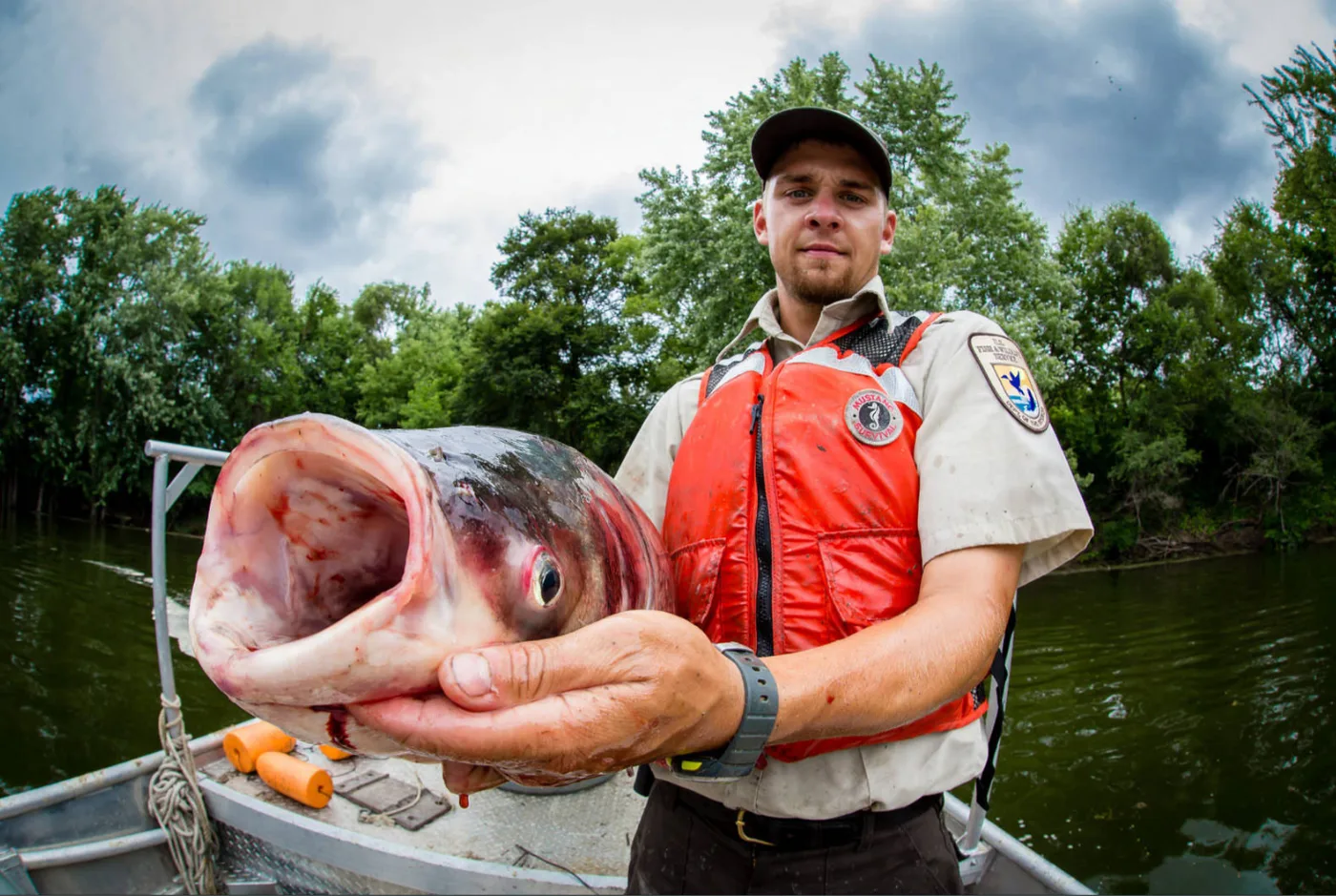
A bighead carp is a huge invasive plankton-eater with a very large head, eyes set below its mouth and dark blotches on a gray body. It lives across the Mississippi, Missouri and Ohio river systems, and it can top 80 pounds. It rarely takes bait, because it strains its food from the water. If you land one, don’t assume you can put it back: Michigan says “DO NOT RELEASE IT,” and Minnesota wants a call right away.
A bighead “can reach 40 to 50 pounds in 5 years,” Missouri’s field guide says.
How do you identify a bighead carp?
Look at the eyes first. They sit far forward and low on the head, “as if the fish were looking down,” says Missouri’s field guide. Michigan gives you a quick test for bighead and silver carp. “Both species have eyes that are below a line from the fork of the tail to the mouth.”
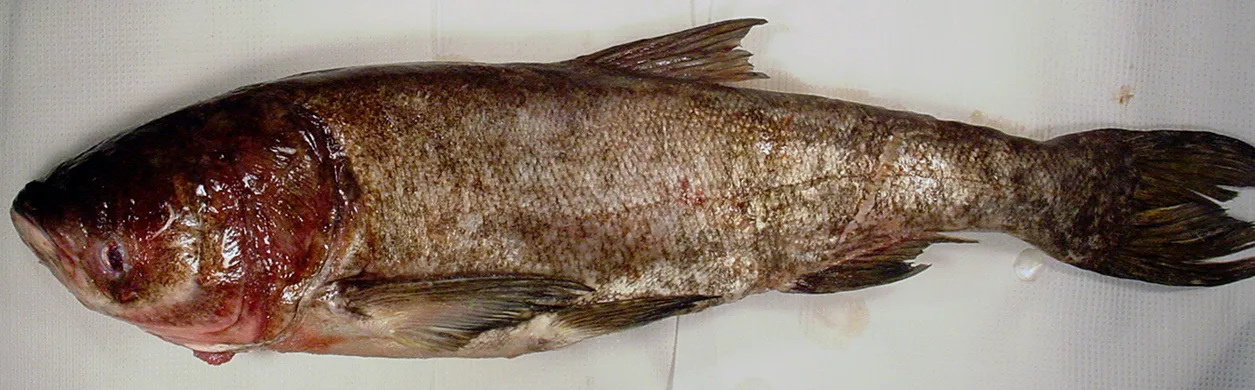
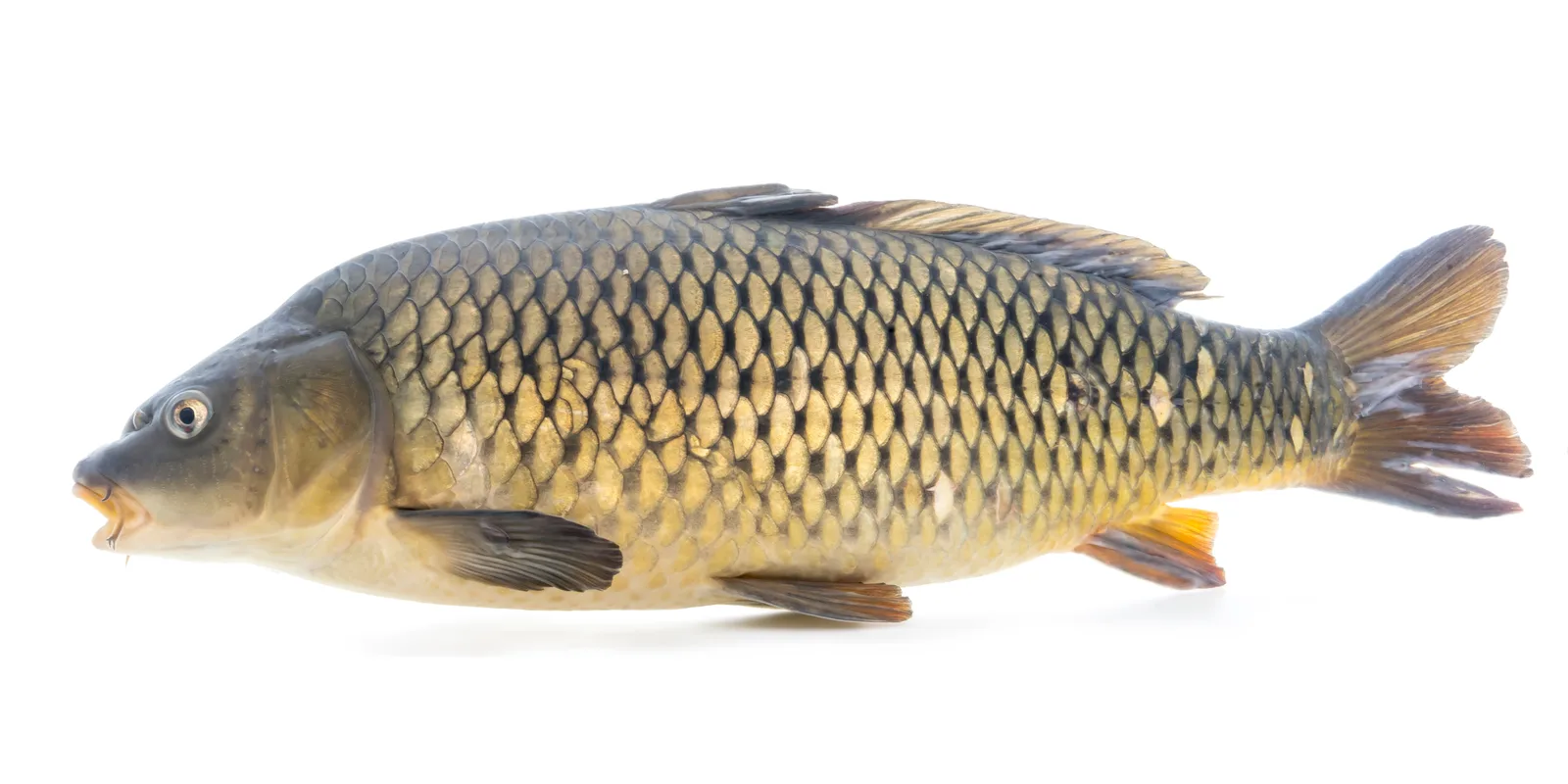
A bighead carp, side-on: the big head, the low eye and the small scales. Photo: J. Deeds, U.S. Food and Drug Administration (public domain).
Then check the mouth. It has no barbels, the whiskers a common carp wears at the corners of its mouth. It has no teeth in the jaw either, and the lower jaw sticks out. A grass carp has its eye level with the mouth and big dark-edged scales, so it’s easy to rule out.
The fish you’ll mix it up with is the silver carp, and the belly settles it. Both have a keel, a sharp ridge along the belly. On a bighead it’s short. Run your thumb forward from the vent: the ridge stops at about the pelvic fins, the pair of fins on the belly.
| Mark | Bighead carp | Silver carp |
|---|---|---|
| Eyes | Below the mouth, far forward, turned down | Below the mouth, far forward |
| Belly keel | Short, from the vent to about the pelvic fins | Long, nearly to the throat |
| Body | Dark gray with scattered dark blotches | Silver, no blotches |
| Head | Very large, lower jaw sticks out | Smaller |
| Gill rakers | Long and slender, not fused | Fused into a spongelike structure |
| Jumping | Leaps when disturbed | Known for it, as high as 10 ft (3 m) |
| Average size, per Minnesota | 40 in (102 cm) | 33 in (84 cm) |
The two can breed with each other, and the federal carp committee says the hybrids can reproduce. A fish that looks halfway between them may be exactly that.
Young ones are the trap. “Juvenile invasive carp can be easily confused with minnows and you may find one in your bait bucket,” Michigan warns. Its advice is short: “Anglers are reminded to dispose of any unused bait in the trash!” For every other fish called carp in American water, start with the carp hub.
What should you do if you catch a bighead carp?
Don’t put it back until you know your state’s rule, and take a photo. Federal law lists the bighead as injurious, and some states want the fish reported, not released. Here’s what the agencies say, in their own words.
| Where | What the agency says | Who to contact |
|---|---|---|
| Federal, every state | “The importation, transportation, or acquisition of any of the species listed in this paragraph is prohibited,” except under a federal permit. The list covers live bighead carp, their viable eggs and hybrids. Live fish may not be “released into the wild” except by the state agency “or by persons having prior written permission from such agency.” (50 CFR 16.13) | Your state wildlife agency |
| Michigan | “If you believe you have seen or caught an invasive carp, DO NOT RELEASE IT.” “Please TAKE A PHOTO and visit Michigan.gov/Invasives to fill out an online invasive carp reporting form” | 517-284-5830 |
| Minnesota | “Invasive carp captures in Minnesota must be reported to the DNR immediately by calling 651-587-2781 or emailing” the DNR. “People are asked to take a photo and transport the carp to the nearest DNR fisheries office.” A permit can be requested to keep one. | 651-587-2781 or Invasive.carp@state.mn.us |
| Missouri | “It is illegal to use it as live bait, though you may use it as dead or cut bait.” | Missouri Department of Conservation |
| Texas | On the prohibited list: “No person may possess or place them into water of this state except as authorized by the department.” | Texas Parks and Wildlife |
Your state isn’t on the list? Open its fishing regulations before you do anything with the fish, because the rule changes at the state line. Michigan’s two plain rules are good habits anywhere. “DO NOT move fish or fish parts from one body of water to another.” And “DO NOT release unused bait into the water.” So don’t drive a live one anywhere, and don’t dump your bait bucket at the ramp.
Free PDF · Water temperature chart When do carp bite?
One reading, and the 16-page chart shows which of 26 fish are spawning, feeding hard or slowing down; for bass, crappie, bluegill and walleye, where they sit and what to throw. Every number sourced.
No card, nothing to buy, and the PDF is yours to keep. Confirm with one click and it's on its way. Then a few short emails and one a week on what's biting. Unsubscribe anytime. Privacy.
Can you catch a bighead carp on a rod and reel?
You can, but don’t plan on it. “Bighead carp are filter-feeders, eating only plankton and stray bits of organic matter,” says the Missouri Conservationist. It calls snagging with treble hooks the only method that works. Snagging means jerking a hook through the water to pin the fish wherever it hits. It’s easiest in summer, when bighead school in the lower reaches of streams that feed the Missouri and Mississippi rivers.
Snagging is legal only on some waters and in some seasons, so check your state’s rule first. If it’s legal where you fish, that’s your first choice. Your second choice is a bow, where bowfishing is allowed. The heaviest bighead on record came that way.
Nebraskaland Magazine looked at bait too, after a long video of anglers trying it. Its verdict: “they do not find an effective way to catch Bighead and Silver Carp other than snagging them.” The bottom rigs in how to catch carp are built for a fish that roots along the bottom. A bighead doesn’t eat that way.
Then there’s the odd fluke. In March 2024, George Chance was casting a crankbait for big flathead catfish near Festus, Missouri, when a bighead hit it. He was in a slough off the Mississippi. It weighed 97 pounds, and it’s the IGFA all-tackle record. He buried it in his garden and planted tomatoes over it.
How big do bighead carp get, and how old is a 40-pound fish?
A 40-pound bighead may be only about five years old, going by Missouri’s growth figure. Missouri’s field guide calls 12 to 24 inches and 12 to 15 pounds typical, with a maximum of 48 inches and 80 pounds. It also says they have reached 90 pounds and lived 9 years. The federal carp committee gives a maximum of 88 pounds and nearly 5 feet, and a life of up to 20 years. Minnesota’s flyer lists 40 inches as the average size.
The record fish outgrow all those numbers:
| Weight | The fish | Record |
|---|---|---|
| 125 lb 5 oz (56.8 kg) | Matt Neuling, Lake Perry, Missouri, July 24, 2021, bow | Missouri, alternative methods |
| 118 lb 10 oz (53.8 kg) | Bryan Lee Baker, Neosho (Grand) River, Oklahoma, April 26, 2025, 58.75 in (149 cm) | Oklahoma, rod and line |
| 97 lb (44 kg) | George Chance, Mississippi River, Missouri, March 19, 2024, crankbait | IGFA all-tackle |
The Oklahoma fish is heavier than the IGFA record, which still stands at 97 pounds. Missouri said Neuling’s fish also beat the existing bowfishing world record of 104 pounds 15 ounces.
Where do bighead carp live?
Most reports come from the Missouri, Ohio and Mississippi river basins. The U.S. Fish and Wildlife Service says they have spread through those rivers “within or along the border of 23 states.” It names 18 states with established wild populations. Captures have come as far north as Lake Pepin in Minnesota. In Missouri, look in the Mississippi and Missouri rivers and the lower ends of big tributaries such as the Osage. Tailwaters below Bagnell Dam and Cannon Dam hold them too.
They came here on purpose. An Arkansas fish farmer first imported them in 1973, and they were brought in to clean up fish ponds and sewage lagoons. They were in the wild by the early 1980s. In April 1994 more escaped when high water flooded hatchery ponds near Lake of the Ozarks.
They hurt the river by eating what native fish need. Missouri names paddlefish, bigmouth buffalo and young native fish as the ones that lose out. It also says bighead have no beneficial role in its waters.
Will bighead carp reach the Great Lakes?
Not as a population, so far. At the spring 2025 update, the front on the Illinois River was “approximately 47 miles from Lake Michigan.” The electric barrier at Romeoville sits about 10 miles upstream of it.
| Point on the waterway | Miles from Lake Michigan |
|---|---|
| Lake Michigan | 0 |
| Electric barrier, Romeoville | 37 (60 km) |
| Carp population front, spring 2025 | About 47 (76 km) |
Crews who searched the Chicago Area Waterway System in fall 2025 reported that “No bighead or silver carp were captured or observed.” An Army Corps of Engineers survey of Lake Calumet in May 2026 reported the same.
A warning came in 2026. That August, crews found hundreds of small silver carp about 80 miles from Lake Michigan, Wisconsin Public Radio reported. It was the farthest north young fish had been detected since monitoring began in 2010. Those were silver carp, not bighead, and they were below the 47-mile front. Young fish mean spawning. The head of the Alliance for the Great Lakes told the station it shows “the front of the invasion is advancing.”
Two things are holding the line right now. One is netting: more than 7 million pounds of invasive carp came out of the Illinois River in 2025. With commercial harvest over 25 years, the total is more than 106 million pounds. Most of the upper-river catch was silver carp. The other is the barrier system.
The next barrier is the Brandon Road Interbasin Project on the Des Plaines River near Joliet, Illinois. It’s meant to combine noisemakers, a bubble curtain, an electric barrier and a flushing lock, at a listed cost of $1.15 billion. Work stopped for the second time in July 2026, in a pause of about six weeks. That September, a group of U.S. senators wrote a letter pressing the administration over the delays.
A float rig: the float at the surface, the bait below it. Photo: mihtiander / Depositphotos.
Is bighead carp good to eat?
Yes, and Illinois is trying hard to get you to try it. The state markets silver, bighead and grass carp under the name copi. So if you’ve wondered about another name for this fish, that’s it. Older pages call it Asian carp. “It has a nice, mild flavor,” chef Brian Jupiter told the Associated Press, and Missouri’s field guide says many anglers value the meat.
The catch is the bones. The same report mentions “the fish’s notorious boniness,” which makes clean fillets hard to get. Check for a consumption advisory on your water before you keep one. A study reported in 2014 found that fillets from the lower Illinois River averaged below the federal action level for mercury, with more in bighead than in silver carp. For the highest fish, the advice was that “children < 15 years and women of childbearing age” stick to “1 meal/week.”
Seafood Watch backs the commercial catch. “Invasive carp caught by gillnets and seine nets in Illinois and by seine nets in Missouri is rated green.” That’s its Best Choice rating. Don’t expect to sell one, though. The same report puts the market price at $0.09 to $0.30 a pound.
What do bighead carp eat, and how do they spawn?
They eat plankton, detritus and small invertebrates, almost nonstop, because they have no true stomach. Long gill rakers strain it out of the water. They take bigger plankton than silver carp do. The federal carp committee says they start feeding above 35 °F (2 °C). They prefer a water temperature of 39 to 78 °F (4 to 26 °C).
They spawn in moderate to large rivers on rising water, usually after rain, from spring into late summer. The eggs drift in the current and hatch on the way. Missouri says bighead are “not known to successfully spawn in ponds or lakes,” which is why the big rivers matter so much. They mature at 2 to 3 years.

Free PDF · 16 pages
Stop guessing. Know what's biting before your first cast
A whole Saturday on the water with nothing to show for it. One reading tells you who's feeding.
The Water Temperature Fishing Chart. Take one water temperature reading, find it on the chart, and see which of 26 freshwater fish are spawning, feeding hard or slowing down.
- Where bass, crappie, bluegill and walleye sit, and what to throw. Trout: the reading where you stop.
- Why a 3 ft drop beats a cold front, and what to throw each day of the front
- The three thermometer mistakes that make a reading lie
The chart's numbers come from state fish and wildlife agencies and fisheries research: 61 sources, each listed on the site.
No card, nothing to buy. Confirm with one click and the PDF is on its way, one version for your phone and one to print, yours to keep. Then a few short emails and one a week on what's biting, with an unsubscribe link in every one. Privacy.
Related
Section guide
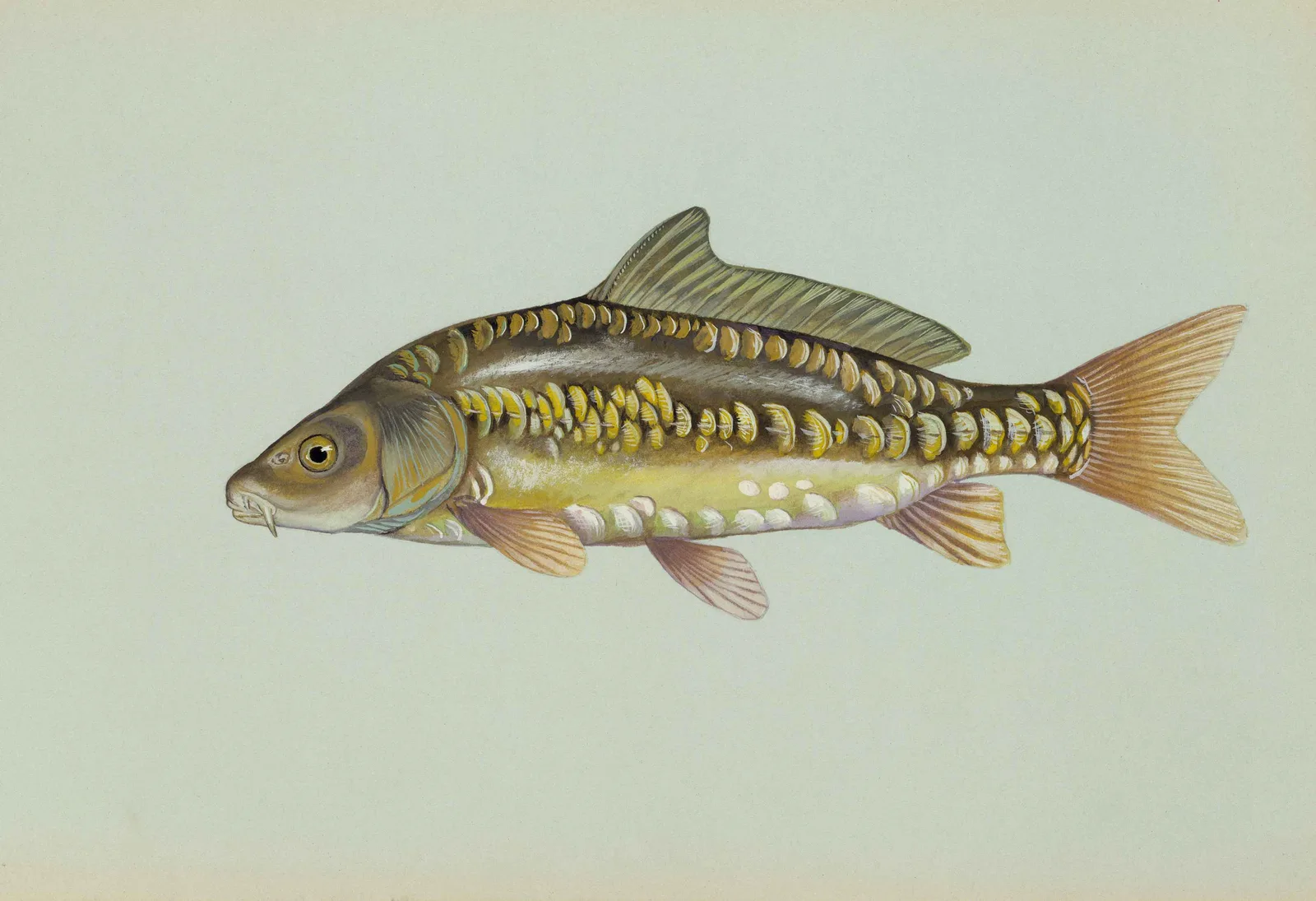
Carp: Common, Grass and Asian Carp, How to Tell Them Apart and Catch ThemCarp fish in US waters: common, mirror, grass and the invasive Asian carp told apart, where and when they feed, baits and rigs, records, laws and eating.
 Common Carp: Identification, Mirror and Leather Carp, Size and Age
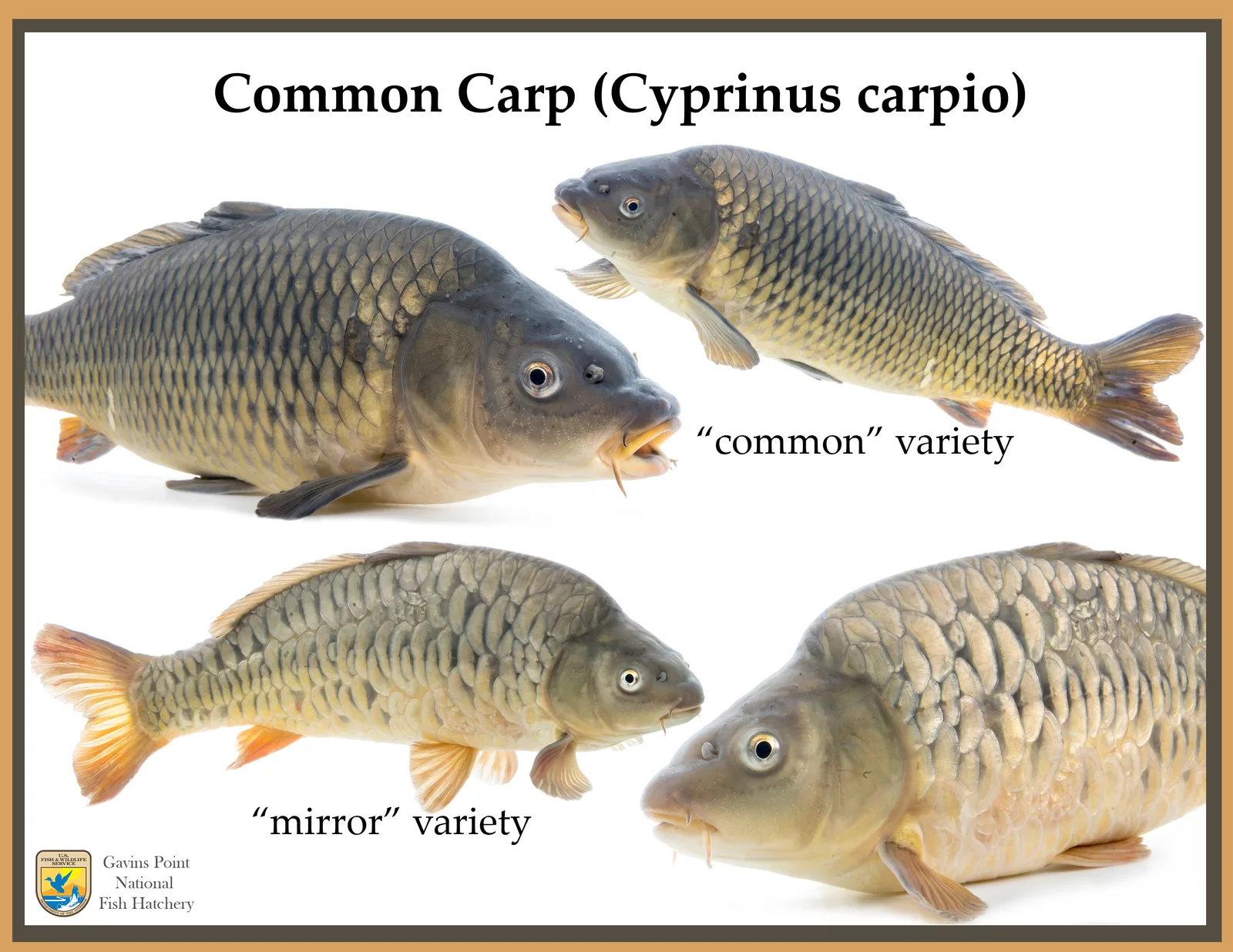
Common carp: two barbels each side and a saw-toothed back fin, 12–25 in and 1–8 lb. Mirror and leather forms, spawning, and how old a 20 in carp is.
 Grass Carp: How to Identify, Catch and Eat the White Amur
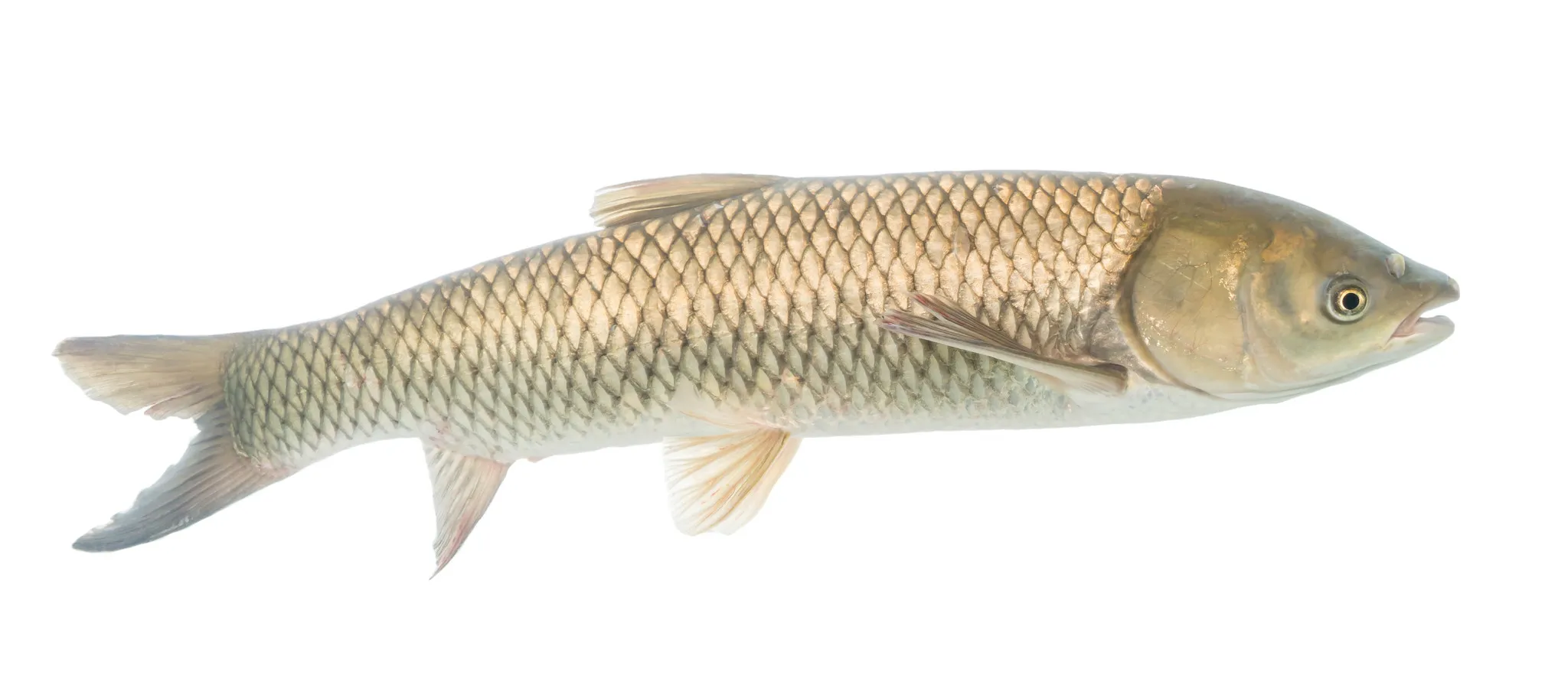
Grass carp (white amur): no barbels, a short back fin, up to 48 in and 50 lb or more. Triploid rules by state, the baits that catch them, and eating one.
 Carp Bait: What Works, Homemade Recipes and How to Rig It
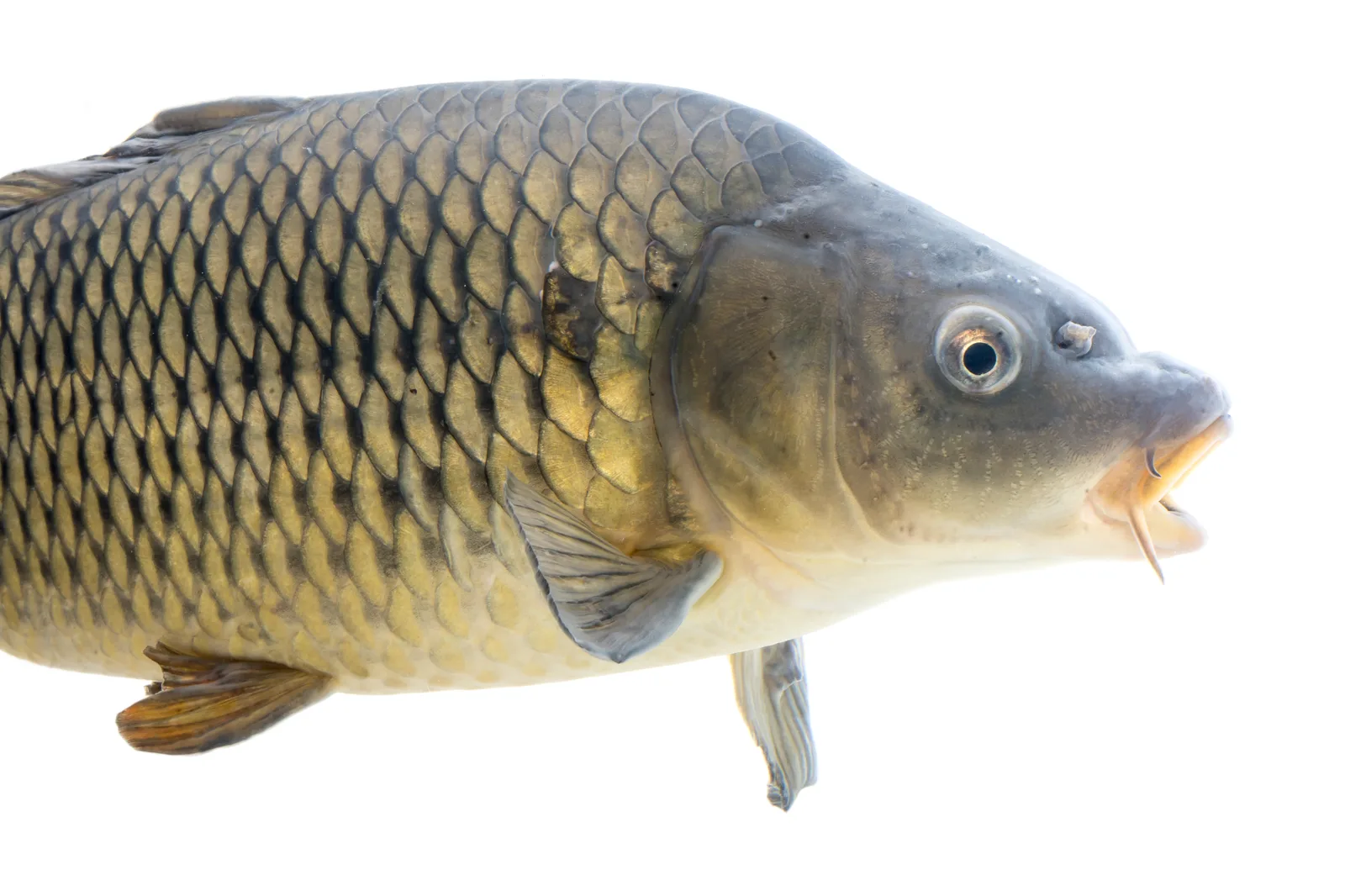
Carp bait: start with canned sweet corn or bread. Eight baits with their recipes and ratios (the 1-2-3 doughball, pack bait, field corn) and the chum laws.
 Carp Fishing: How to Catch Carp With a Simple Rig or a Hair Rig
Carp fishing for beginners: the setup, where carp feed by season, bread free-lined close in, and the hair rig with a baitrunner for big carp.
Sources (25)
- Bighead Carp | Missouri Department of Conservation field guide
- Silver Carp | Missouri Department of Conservation field guide
- Bighead Carp | Invasive Carp Regional Coordinating Committee
- Bighead carp (Hypophthalmichthys nobilis) | U.S. Fish and Wildlife Service
- Bighead Carp (Hypophthalmichthys nobilis) - Species Profile (USGS Nonindigenous Aquatic Species)
Show all 25 sourcesShow fewer sources
- 50 CFR 16.13, Importation of live or dead fish, mollusks, and crustaceans, or their eggs
- Aquatic Invasive Species, Michigan Fishing Regulations (eRegulations)
- Have you seen an invasive carp? (Minnesota DNR flyer, 2024)
- Tagged fish lead biologists to school of invasive carp in Mississippi River Pool 8 (Minnesota DNR news release, July 1, 2025)
- Prohibited aquatic species (Texas Parks and Wildlife)
- Niche Fish, by Jim Low (Missouri Conservationist, November 2016)
- Hook & Line Asian Carp?????, by Daryl Bauer (Nebraskaland Magazine, 2016)
- Missouri angler lands monster invasive carp, buries it (Flatland, April 26, 2024)
- IGFA world records, Carp, bighead
- State Records | Oklahoma Department of Wildlife Conservation
- Perry County bowfisherman catches world record sized bighead carp (Missouri Department of Conservation, August 5, 2021)
- Intensive monitoring in the Chicago Area Waterway System, spring 2025 (Invasive Carp Regional Coordinating Committee)
- No bighead or silver carp captured during 2025 seasonal intensive monitoring (Invasive Carp Regional Coordinating Committee, November 25, 2025)
- USACE Chicago crews conduct electrofishing survey in Lake Calumet during 2026 seasonal intensive monitoring (DVIDS, May 27, 2026)
- 2025 annual update: targeted mass removal of invasive carp in the Illinois River (Invasive Carp Regional Coordinating Committee)
- Great Lakes lawmakers say delays on invasive carp barrier threaten ecosystems, economy (Wisconsin Public Radio, September 29, 2026)
- Copi is a fresh and locally caught wild fish | Choose Copi
- A copi fillet? Illinois hopes new name for invasive carp will convince diners (AP via PBS NewsHour, June 22, 2022)
- Heavy metals in Asian carp not a health concern to most (The Fish Site, January 31, 2014)
- Invasive carp, United States (Seafood Watch report, January 13, 2025)