 By
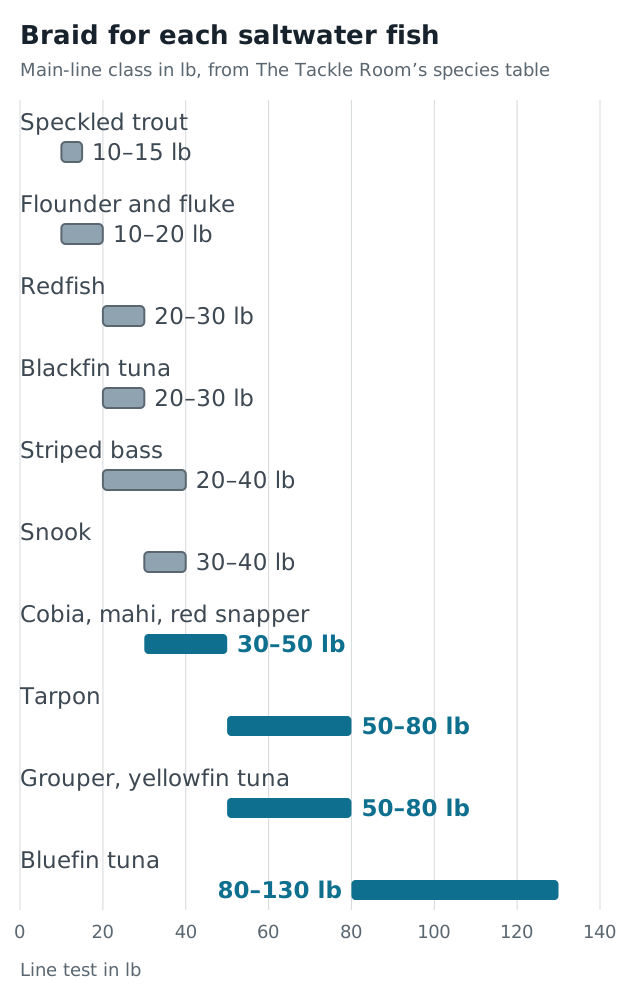
For redfish and most of what swims in a bay, the saltwater fishing reel to buy is a 3000–4000 spinning reel. Penn’s Battle IV 4000 is $164.95 and holds 260 yd of 20 lb braid. For bottom fishing and heavy line from a boat, go conventional. Go baitcast inshore only if you already cast one. No reel was fished for this page. The line comes from The Tackle Room’s species table. The specs and prices are from the makers’ pages, read on November 11, 2026.
The IPX test is done with fresh water, so the rating doesn’t promise protection against salt water. Rinse even a sealed reel.
Which saltwater fishing reel, and what size, for which fish?
Start with the fish you’re after. It sets the line, the line sets the drag, and the drag and line together tell you the reel size.
| Fish | Braid | Leader | Drag to set | Smallest Battle IV |
|---|---|---|---|---|
| Speckled trout | 10–15 lb | 12–20 lb fluoro | 2–4.5 lb (0.9–2 kg) | 2000 |
| Flounder and fluke | 10–20 lb | 15–20 lb fluoro | 2–6 lb (0.9–2.7 kg) | 2500 |
| Redfish | 20–30 lb | 20–30 lb fluoro | 4–9 lb (1.8–4.1 kg) | 4000 |
| Striped bass | 20–40 lb | 30–50 lb fluoro | 4–12 lb (1.8–5.4 kg) | 5000 |
| Snook | 30–40 lb | 30–50 lb fluoro | 6–12 lb (2.7–5.4 kg) | 5000 |
| Cobia, mahi, red snapper | 30–50 lb | 40–60 lb fluoro | 6–15 lb (2.7–6.8 kg) | 6000 |
| Tarpon | 50–80 lb | 60–80 lb fluoro | 10–24 lb (4.5–10.9 kg) | 8000 |
| Grouper, yellowfin tuna | 50–80 lb | 60–100 lb fluoro | 10–24 lb (4.5–10.9 kg) | 8000 |
How to read it: the braid and leader are The Tackle Room’s. The drag column is our math: The Tackle Room’s 20–30% rule applied to the braid. Tie on a leader lighter than your braid and you set it by the leader. The last column is our cut: the smallest Battle IV whose chart lists at least 150 yd of the heaviest braid in the row. We use one reel family so the sizes compare, and the Penn reels page has the rest of the ladder.
The sizes line up with AFTCO’s guide. It puts redfish on a 3000–4000 spinning reel, and Northeast surf stripers on a 6000 with a 10 ft rod. That’s one size up from our column, for the long cast over breaking waves. Our redfish 4000 is sized for 30 lb braid. On 10–20 lb braid a 2500–3000 does the same job.
The bottom two rows are where a conventional reel starts to make more sense than a big spinner. More on that next.
Spinning, conventional or baitcast?
Spinning: where most anglers start
Spinning is easier to cast, and it’s the right call for your first salt reel. AFTCO’s guide says the same. It handles light lures well and shines with topwater plugs.
It has limits: line capacity and drag durability. Heavy mono is stiff and tends to jump off a spinning spool when you open the bail. The saltwater spinning reel page goes size by size, from 2500 inshore to 10000 offshore.
Outdoor Life’s Ric Burnley likes spinning for a fight, too. The reel hangs under the rod, so you hold the pull like a bucket by its handle. With a casting reel on top, he says, you balance it like a bucket on your palm.
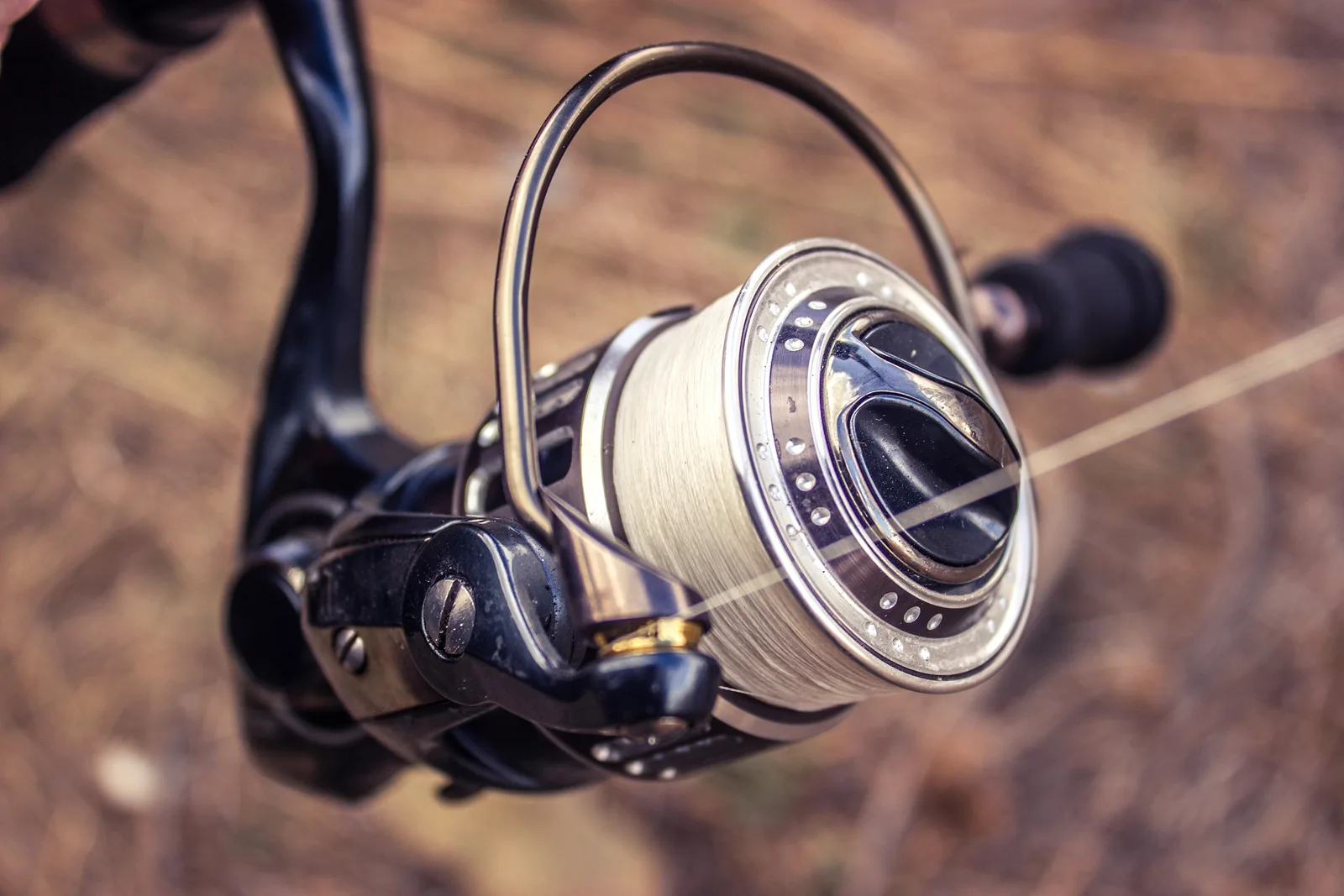
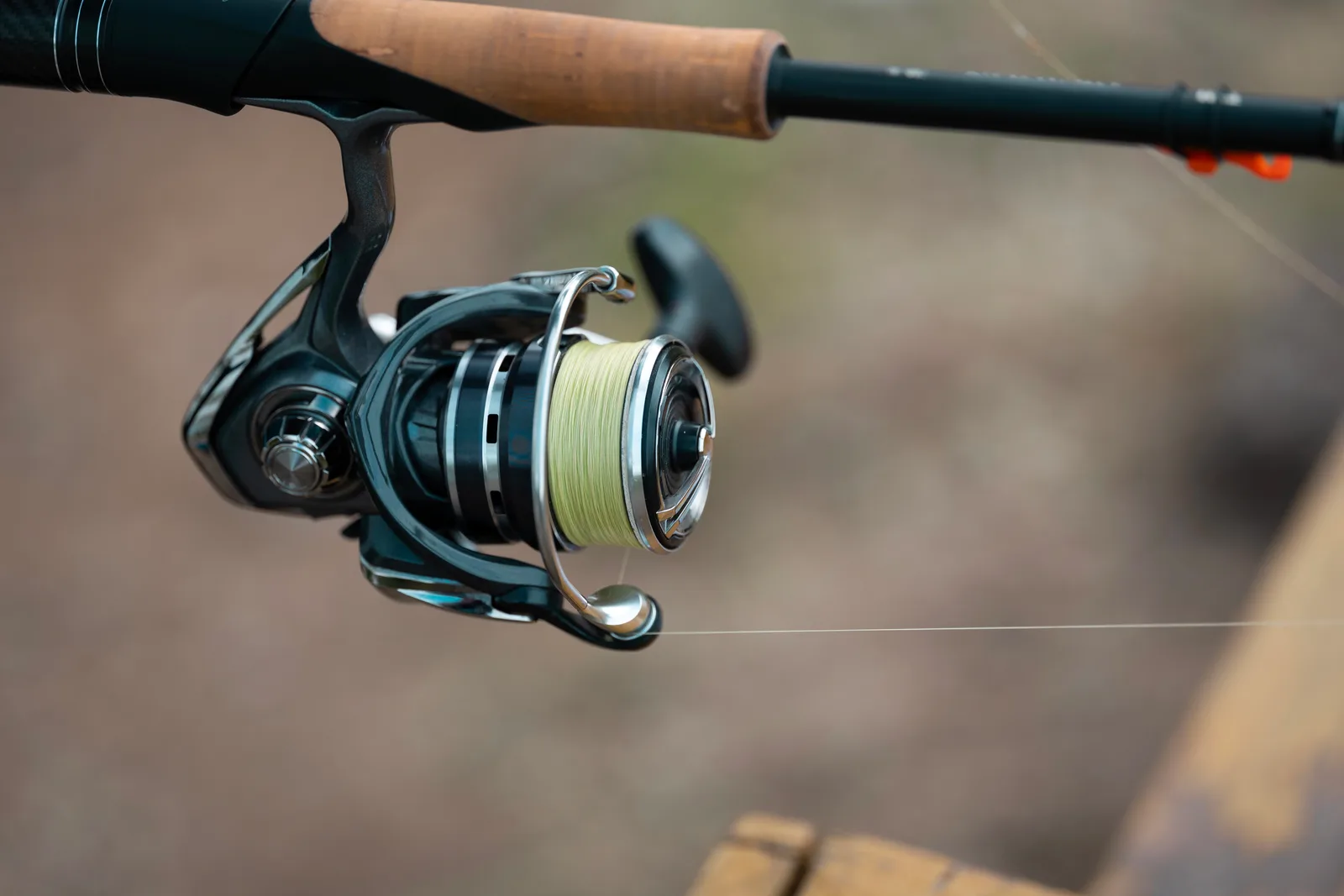
A spinning reel spool up close. Photo: Hryshel / Depositphotos.
Conventional: the boat reel
A conventional reel is a round revolving-spool reel for heavy line. Its spool can be deeper and wider, so it holds more line, and the numbers show it. Penn’s Squall II 20 holds 650 yd of 30 lb braid. The Battle IV 6000, a big spinning reel, holds 490.
Take one when you’re bottom fishing, soaking live bait or trolling from a boat. Penn’s Squall II and Fathom II have a level wind, the guide that lays line evenly across the spool. Reels built for extremely large fish leave it off, because the mechanism can’t take the strain. Offshore reels add low gear ratios, and some carry two speeds: a fast one to pick up line and a low one to fight. Avet machines two-speed lever drags like that in California.
Low-profile baitcaster: inshore, if you already cast one
Low-profile baitcasters have moved into inshore fishing. Some inshore guides, Captain C.A. Richardson among them, now rarely pick up spinning gear, Outdoor Life reports. Experienced anglers tend to like a baitcaster for big baits and heavy line, Bass Pro says.
If you already throw a baitcaster for bass, it’ll feel familiar. Out only a few times a year after speckled trout? A lighter reel that’s easier to cast may suit you better, says Outdoor Life’s Kevin Hughes.
Free PDF · Hook size chart What size is that hook? Lay it on the chart.
Print the free chart, lay any hook on it and read its size: 14 hooks from 9/0 to #8 at actual size, a gap ladder from #32 to 12/0, and the size for 17 fish and 16 baits on the back.
No card, nothing to buy, and the PDF is yours to keep. Confirm with one click and it's on its way. Then a few short emails and one a week on what's biting. Unsubscribe anytime. Privacy.
How much drag do you need?
Less than the box says. Set the drag at 20–30% of the lightest part of your line, The Tackle Room says. On a redfish setup with 20 lb braid and 20 lb leader, set 4–6 lb of drag. Its drag page says 25–30%, and warns against jamming the lever all the way down.
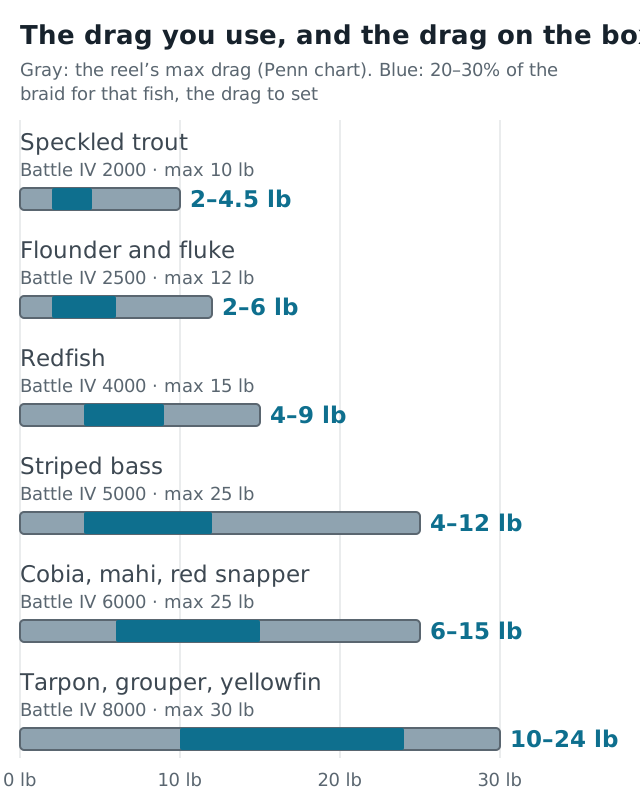
So a 15 lb max drag isn’t a weak reel for redfish. You’ll use up to 9 lb of it. The rest is reserve. On 50–80 lb braid the drag to set reaches 24 lb. That’s a job for the Battle IV 8000 (30 lb) or a conventional reel (30–33 lb of drag).
Two things change the number. Braid has no stretch, so the drag and the rod take every head shake. And if your leader is lighter than your braid, set the drag by the leader. The table’s leader column gives the fishing leader for each fish.
What makes a reel a saltwater reel?
Salt gets into your reel and eats the metal. In Outdoor Life, Burnley writes that a poor spinning reel exposed to salt water “will quickly corrode.” The bearings and joints seize, and the handle, bail and line guide fail.
A saltwater reel fights back in four places:
- Seals. Gaskets keep water and grit out. The Battle IV’s Hydro Armor “seals critical areas from water intrusion.” It carries no IP number.
- Bearings. Sealed or shielded stainless. Bass Pro’s take: bearings that resist salt “cost more, but last longer.”
- Frame. Aluminum or graphite. The strongest frames are machined from a solid block of aluminum, and graphite is lighter and cheaper but not as strong.
- Drag washers. Carbon fiber. On the Spinfisher VII they sit in a fully sealed spool.
Penn’s two 20-size level winds show what the frame costs. The Squall II has a graphite frame, 33 lb of drag and a $179.95 price. The Fathom II has a full-metal body, 30 lb of drag and costs $299.95. You pay $120 more for a frame that keeps the gears aligned, and get 3 lb less drag.
IPX5, IPX8: what the ratings mean
The IP code is a lab standard, IEC 60529. The X means there’s no dust rating, and the number after it is water.
| Rating | The test | On a reel |
|---|---|---|
| IPX5 | A 6.3 mm (0.25 in) water jet from any direction, at least 3 minutes | Penn Spinfisher VII: a wave or spray |
| IPX7 | Under 1 m (3 ft) of water for 30 minutes | A short dunk |
| IPX8 | Continuous immersion, on conditions the maker sets | A reel that goes under |
Two catches. IPX7 or IPX8 doesn’t automatically include IPX5: a jet and a dunk are separate tests. And every test is done in fresh water, so the rating doesn’t promise protection against salt water. The rinse still matters on a sealed reel.
Six saltwater reels compared
Prices are from the makers’ US sites, read on November 11, 2026. Capacity is braid, as the maker charts list it.
| Reel | Type | Max drag | Braid it holds | Price |
|---|---|---|---|---|
| Penn Battle IV 4000 | Spinning | 15 lb | 260 yd of 20 lb | $164.95 |
| Penn Spinfisher VII 5500 | Spinning, IPX5 | 25 lb | 380 yd of 30 lb | $259.95 |
| Shimano Tranx 150 | Low-profile casting | 13 lb | 150 yd of 20 lb | $254.99 |
| Penn Squall II LW 20 | Conventional | 33 lb | 650 yd of 30 lb | $179.95 |
| Penn Fathom II LW 20 | Conventional | 30 lb | 645 yd of 30 lb | $299.95 |
| Penn Fathom LP 300 | Low-profile casting | 30 lb | 235 yd of 30 lb | $349.95 |
Penn Battle IV 4000
The first saltwater reel for most people. A full-metal body, Hydro Armor seals and 5+1 sealed stainless bearings, at $164.95. It covers redfish, flounder and speckled trout. Want to spend less? The saltwater spinning reel page has a cheaper pick. It isn’t IP-rated, so rinse it every trip. For a beach rod, the 6000 ($174.95) holds 390 yd of 40 lb braid.
Penn Spinfisher VII 5500
The surf and pier reel. Penn says the IPX5 sealing keeps a wave, or the spray on the ride home, out of the gearbox and drag. The 5500 has 25 lb of drag and 380 yd of 30 lb braid for $259.95. Pair it with a long surf fishing rod.
Shimano Tranx 150
Shimano built it with Texas and Gulf Coast wading anglers in mind, for lighter inshore work. It weighs 6.7 oz and costs $254.99. Hughes named the Tranx his best overall saltwater baitcaster, and the 150 his inshore casting size. Shimano lists 13 lb of max drag, and Hughes called that “somewhat lacking.” That’s still above the 4–9 lb a redfish setup needs. The Tranx 300 is his size for fluke and topwater stripers. The Shimano Tranx page sets all five sizes side by side.
Penn Squall II Level Wind 20
The boat reel to buy first. 33 lb of drag, 3 lb more than the metal Fathom II, and 650 yd of 30 lb braid for $179.95. The line-counter version is $189.95. Its bearings are shielded rather than sealed, so rinse it every trip.
Penn Fathom II Level Wind 20
Same job, metal body. Penn calls it a favorite of charter boat captains, for bottom fishing and casting live bait. It’s $299.95 and has 30 lb of drag. Buy it if your reel lives on a boat that fishes every week. Otherwise the Squall II does the job for $120 less.
Penn Fathom Low Profile 300
Outdoor Life’s pick for jigging. 30 lb of drag and 235 yd of 30 lb braid in a reel that sits on top of a casting rod. Hughes found it heavy at 9.2 oz and hard to cast all day. It’s built for jigging, inshore to the nearshore wrecks and reefs. He listed it at $269.95. Penn now asks $349.95.
How do you rinse a saltwater reel?
- Rinse it with low-pressure fresh water after every trip, Burnley says.
- Shake it, loosen the drag and dry it with a chamois towel.
- Every two or three trips, take the reel apart and wipe out the salt and grime with a microfiber towel.
- Grease it the way the maker says.
Keep a spray bottle of fresh water handy, AFTCO’s guide adds, and rinse the gear between catches. Spinning reels need it most: the spool, bail and body are three separate parts, and water gets in between them.
Which rod and line go with it?
AFTCO pairs the 3000–4000 redfish reel with a 7 ft medium-heavy rod. Other jobs want other saltwater fishing rods, longer for the surf and shorter for jigging. For the line, 30 lb braid is roughly as thick as 8 lb mono, The Tackle Room says, so a reel holds far more of it. The braided fishing line page explains the rest.
How we chose
The fish came first, with the line classes in The Tackle Room’s species table. The drag follows from its 20–30% rule. The reel sizes come from Penn’s Battle IV chart, so they compare across one family. The six reels cover spinning, conventional and low-profile casting, so you can find your kind of fishing. Prices and specs were read from Penn’s and Shimano’s US sites on November 11, 2026. Where a figure or a verdict comes from Outdoor Life’s reviewers, the page names them. No reel was fished for this page. The reels hub covers the other reel types.

Free PDF · 2 pages
Stop guessing hook sizes. Lay any hook on this page and read it
A jar of loose hooks and no packet in sight. Guess wrong and you find out with a fish on.
The True-Size Hook Chart. Print it at actual size, lay a hook on the outlines, and the one its bend fills is its size. One sheet, front and back, for the tackle box.
- 14 hooks from 9/0 to #8 at true size, plus a ladder from #32 to 12/0
- The size for 17 fish and 16 baits, from bluegill to tuna
- A 2/0 circle that gapes less than a #4: why a 2/0 is not always a 2/0
Every outline drawn from Mustad's published dimensions; every size from the 25 sources on the page, Maryland DNR and Idaho Fish and Game among them.
No card, nothing to buy. Confirm with one click and the PDF is on its way, one version for your phone and one to print, yours to keep. Then a few short emails and one a week on what's biting, with an unsubscribe link in every one. Privacy.
Related
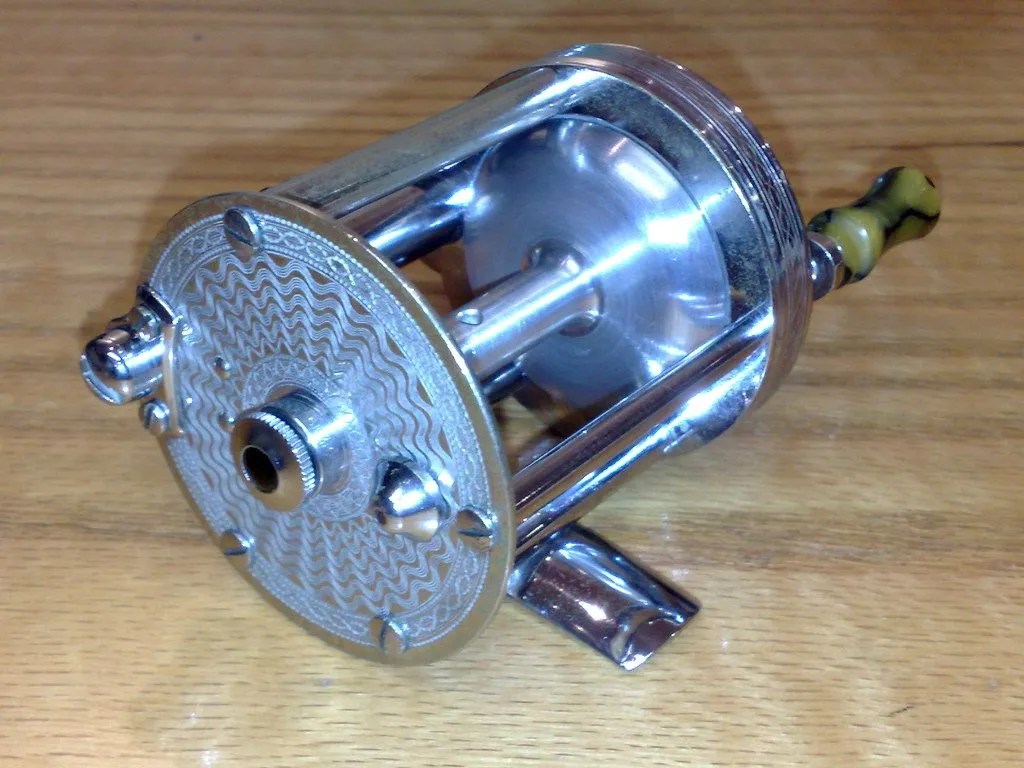
Section guide
Fishing Reels: Types, Sizes, Gear Ratios and How to ChooseThe five types of fishing reels and who each is for, what a 2500 or 4000 size and a 6.4:1 gear ratio mean, how much drag you use, and what more money buys.
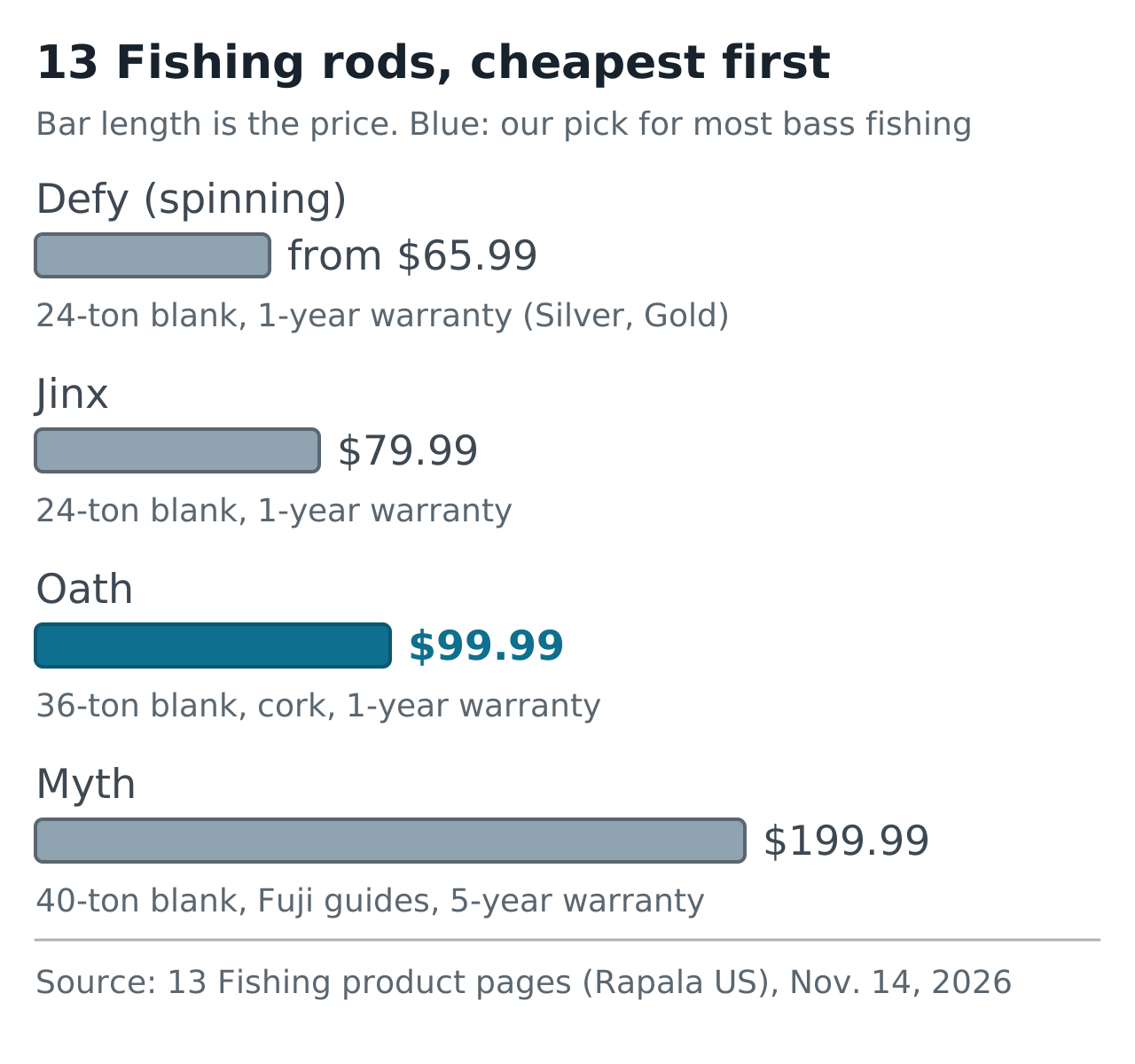 13 Fishing Rods and Reels: The Main Lines by Price, and Which to Buy
13 Fishing rods from the $65.99 Defy to the $199.99 Myth, and the SHYFT, Slate and Concept reels: specs from 13 Fishing's own charts, and which to buy.
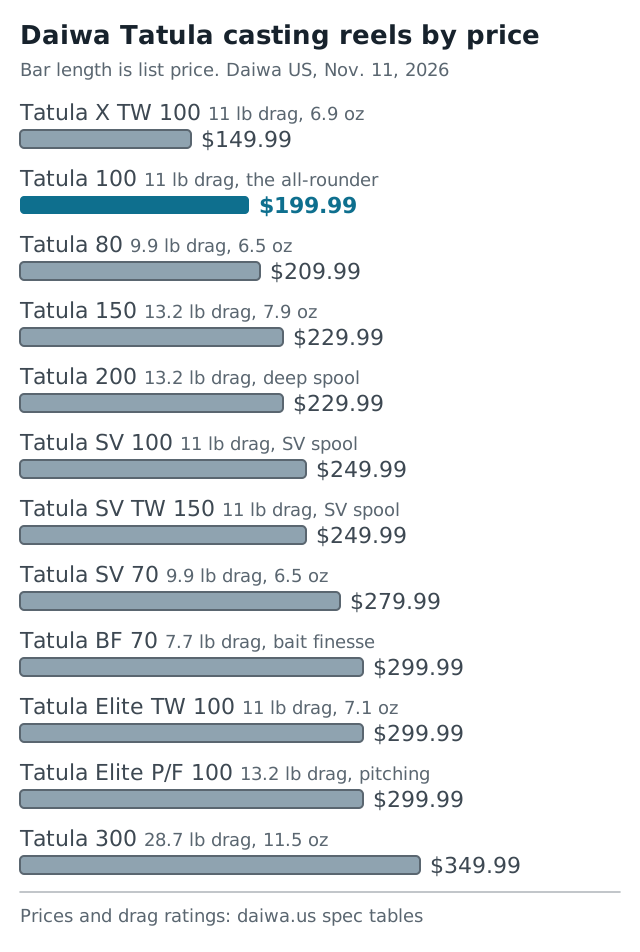 Daiwa Tatula Reels: Tatula 100, SV, X and Elite Compared
Every standard Daiwa Tatula casting reel on price, drag, weight and spool, from the $150 Tatula X to the $350 Tatula 300, and which one to buy for bass.
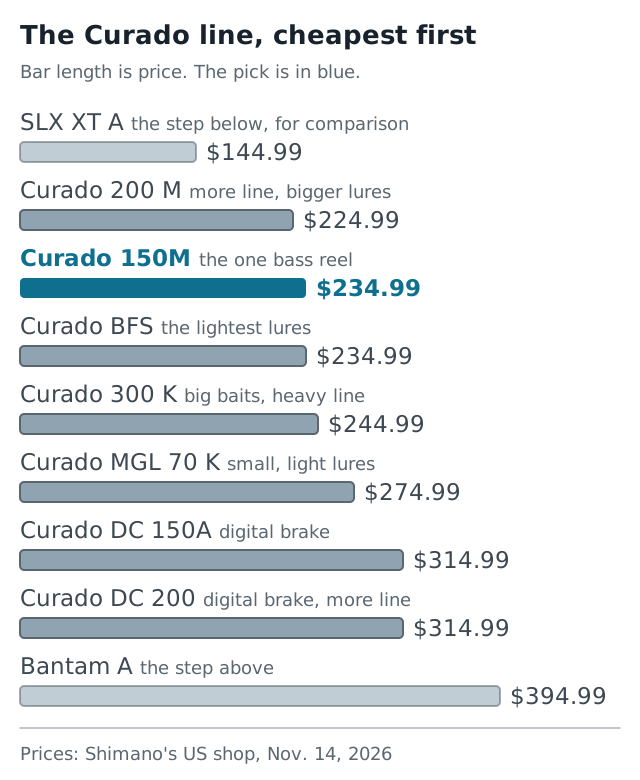 Shimano Curado Reels: 150M, 200 M, DC, 70, BFS and 300 K
Every Shimano Curado casting reel side by side: the 150M, 200 M, DC 150A, DC 200, 70, BFS and 300 K on price, weight, drag and line, and which to buy.
 Shimano Nasci FD: Which Size to Buy, and Is It Worth $125?
The Shimano Nasci FD costs $125 to $145 in six sizes. Which size fits your fishing, what it adds over the $90 Sedona, and when a Miravel wins.
 Shimano Vanford A: Which Size to Buy, and Is It Worth $285?
The Shimano Vanford A costs $285 to $295 in six sizes. Which size fits your fishing, what the light body buys, and when a Stradic or Sustain wins.
 Shimano SLX Reels: SLX A, XT A, 70 and DC Compared
Shimano SLX casting reels side by side: the SLX A, XT A, 70 A and DC on price, brake, weight and line per turn, and which one to buy for bass.
Sources (13)
- The Tackle Room, Fishing Line Weight Guide: What Pound Test for What Fish? (May 21, 2026)
- The Tackle Room, How to Set the Drag on a Conventional Reel
- Bass Pro Shops, Saltwater Fishing Reels Buyer's Guide
- Coty Perry, Buyer's Guide: Saltwater Fishing Rod & Reel, AFTCO (February 28, 2025)
- Ric Burnley, The Best Saltwater Spinning Reels, Tested, Outdoor Life (updated December 7, 2023)
Show all 13 sourcesShow fewer sources
- Kevin Hughes, The Best Saltwater Baitcasting Reels of 2026, Tested and Reviewed, Outdoor Life
- IP code (IEC 60529), water ingress ratings
- Penn, Battle IV spinning reel: models, specs and prices
- Penn, Spinfisher VII spinning reel: models, specs and prices
- Penn, Squall II Level Wind conventional reel: models, specs and prices
- Penn, Fathom II Level Wind conventional reel: models, specs and prices
- Penn, Fathom low profile baitcast reel: models, specs and prices
- Shimano US shop, Tranx 150 A: models, specs and prices