 By
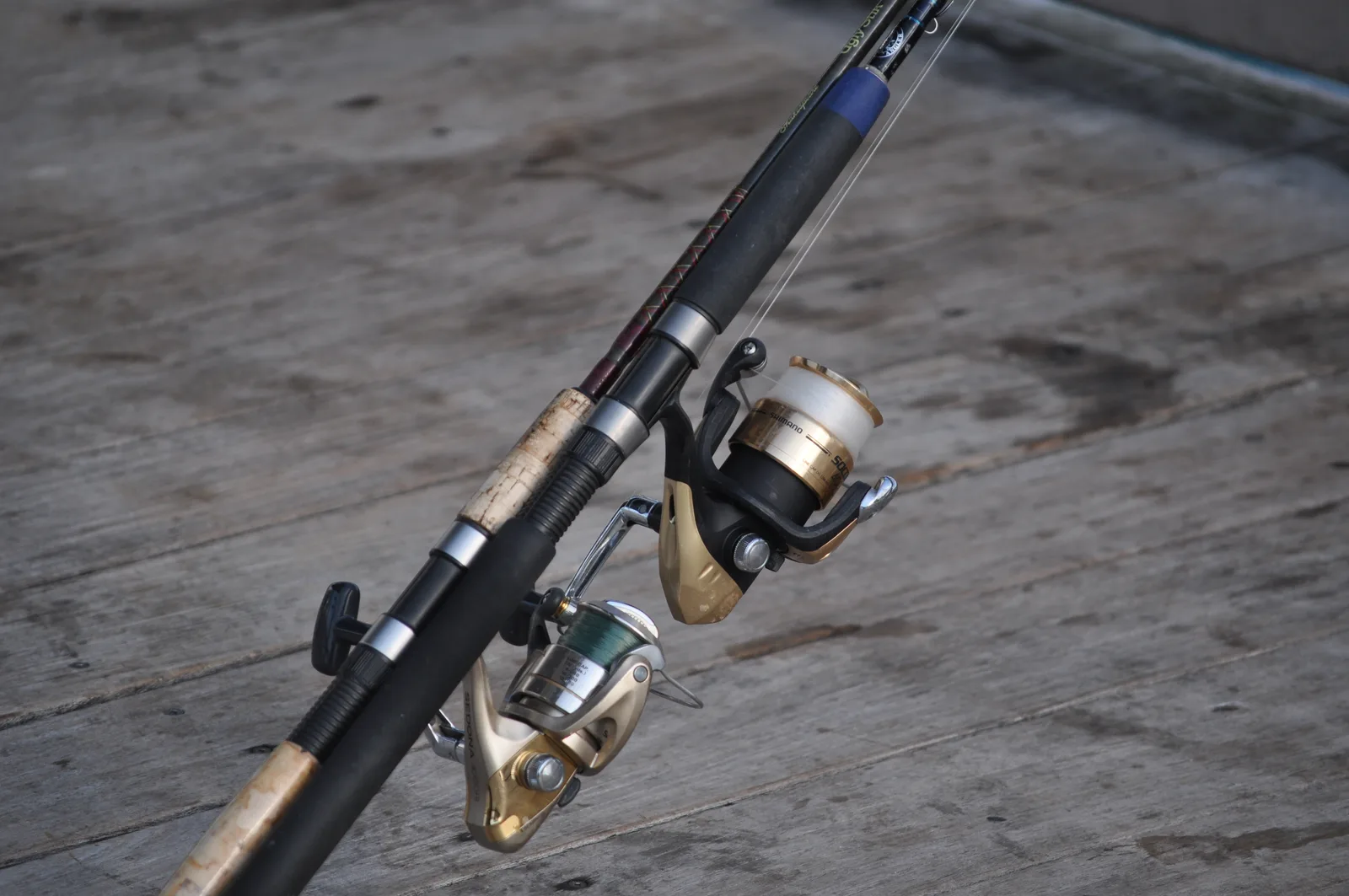
For most saltwater fishing, the rod to buy is a 7 ft medium spinning rod rated about 8–17 lb, and $85 gets you one. That’s the saltwater fishing rod for bays, flats, jetties and a friend’s boat. Go shorter and heavier only for deep water and big fish. None of these rods was fished for this page: the sizes come from Saltwater Sportsman’s writers, the specs and prices from the makers.
Wash it in warm water and let it dry before it goes in the bag. A quick blast from the dock hose likely pushes about as much salt into the crevices as it takes out.
Which saltwater fishing rod do you need?
Start with where you’ll fish. The rod follows.
| Where and what | Rod | Line and lure |
|---|---|---|
| Bays, flats and estuaries: redfish, seatrout | 6–7 ft (1.8–2.1 m), medium | 8–17 lb, 3/8–1 oz (11–28 g) |
| Channels and deeper oyster reefs | 7 ft (2.1 m), medium-heavy | 15–30 lb, 3/4–3 oz (21–85 g) |
| Boat: live bait and bottom fishing | 6 ft 6 in–7 ft (2–2.1 m) | 6–17 lb up to 40–80 lb on Ugly Stik’s Bigwater |
| Jigging | 6–6 ft 6 in (1.8–2 m), thin, bends through the middle | From the maker’s chart |
| Stand-up on 50 lb line | 5 ft 9 in–6 ft (1.8 m), fairly soft | Under 30 lb (14 kg) of drag at most |
| Stand-up on 80 lb line | 5 ft 6 in (1.7 m) or less, stiff butt | Up to 70 lb (32 kg) of drag |
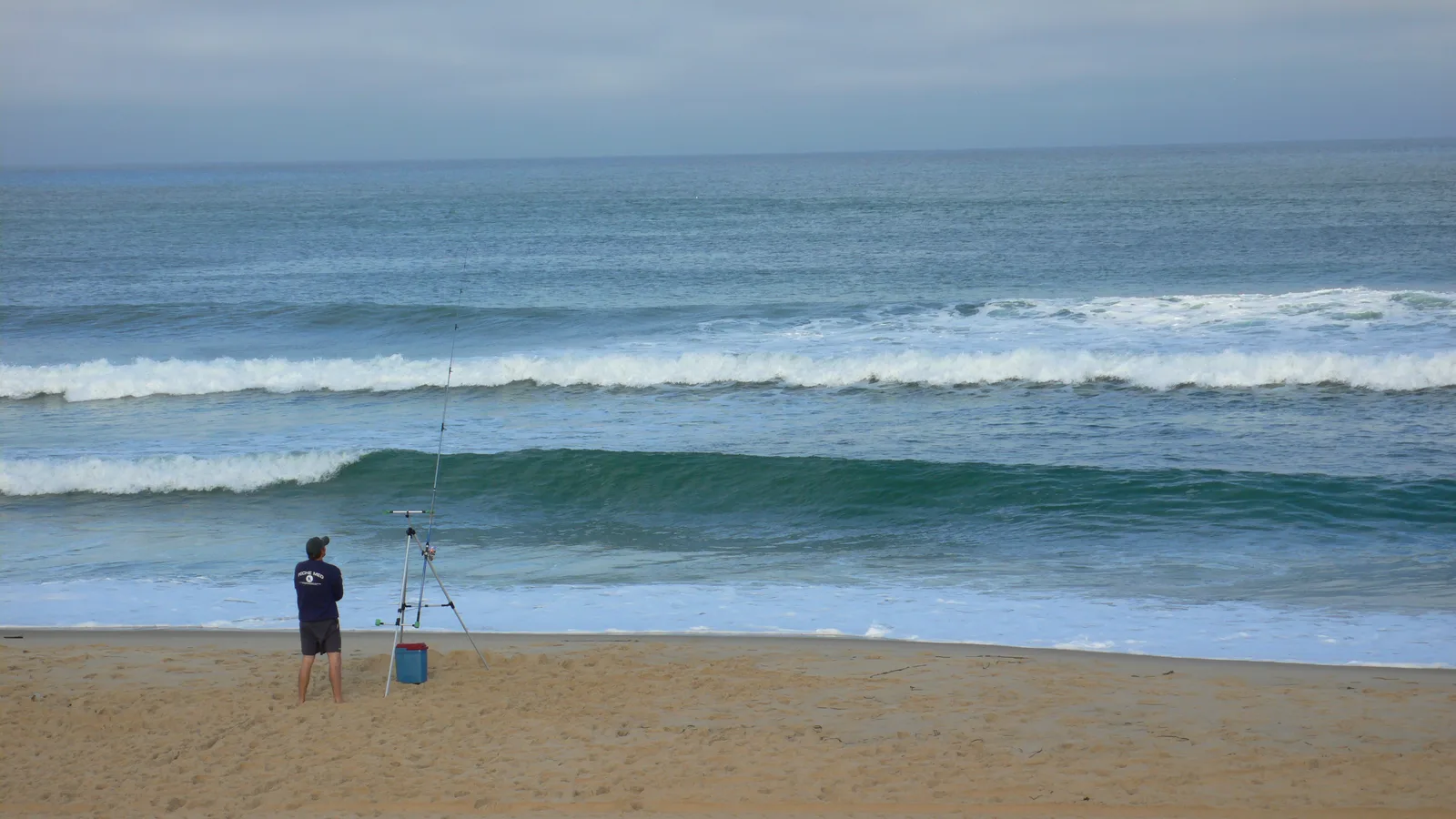
| Surf fishing rods | 9–11 ft (2.7–3.4 m), medium-heavy | 15–30 lb, 1–4 oz (28–113 g) |
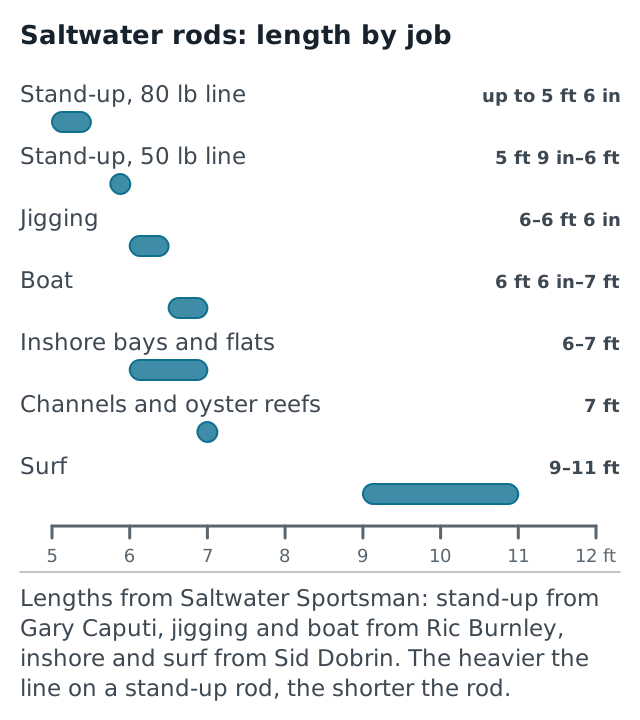
A longer rod is easier to work around the boat. A shorter rod lifts more, which is why the stand-up rods are the shortest on the chart. Writers don’t all agree at that end. Ted Lund likes a 5 to 5 ft 6 in stick for 30–50 lb line, which is shorter than the table. Treat those two rows as a starting point.
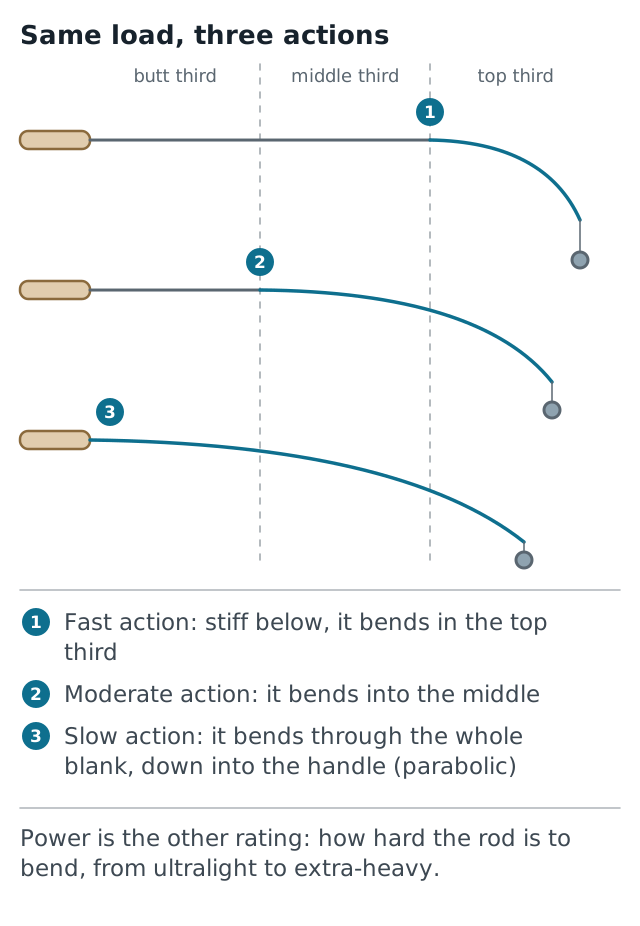
The rods hub explains power and action if those words still blur together.
The pick for each kind of fishing
Your first saltwater rod
Get the Ugly Stik Inshore Select, the 7 ft medium, for $84.95. Ugly Stik rates it for 8–20 lb line. It suits a bank, a pier or a bay boat, and it’s cheap enough to leave in the truck. Skip it if you want the lightest thing you can cast all day. The Carbon Inshore is the step up for $25 more, all graphite, and the 7 ft medium is rated 10–17 lb.
One good inshore rod
Go with the St. Croix Mojo Inshore JIS70MF, 7 ft medium fast, about $200. “Fast action rules the water for versatility,” St. Croix’s Jeff Schluter told Sportfishing, and that length and power is the spinning rod he named. If you throw live bait more than lures, go slower. Penn’s Mike Rice warns that a rod that’s too fast will throw live or dead baits off the hook.
Between the two sits Penn’s Battalion III Inshore at about $130.
Spinning or casting inshore?
Spinning, for most people. A spinning rod is the one to learn on. If you already fish a baitcaster, keep it. Scott Luft of Castaway rods told Sportfishing that “the 7-foot moderate-action casting rod is about as versatile as rods get.”
Deep sea fishing rods
For bottom fishing and live bait from a boat, take a 6 ft 6 in or 7 ft conventional rod. The Ugly Stik Bigwater Conventional 6 ft 6 in medium-heavy, rated 30–50 lb, is $94.95. Fighting a big fish standing up is a different job, and it wants a shorter rod and a belt and harness. The Bigwater Stand Up is the cheap way in at $179.95.
Ugly Stik’s Tiger is a 7 ft spinning rod at $84.95. The maker says it’s “at home catching tuna in the Pacific.”
Jigging
“We design rods more to work a jig than to fight the fish,” Shimano’s Tristin Poole told Ric Burnley of Saltwater Sportsman. Poole wants a jigging rod 6 to 6 ft 6 in and “pencil-thin.” The best ones bend through the middle, Burnley adds. The Ugly Stik Tiger Elite Jig comes in both lengths at $94.95. The all-graphite Carbon Jigging, 6 ft or 6 ft 4 in, is $129.95.
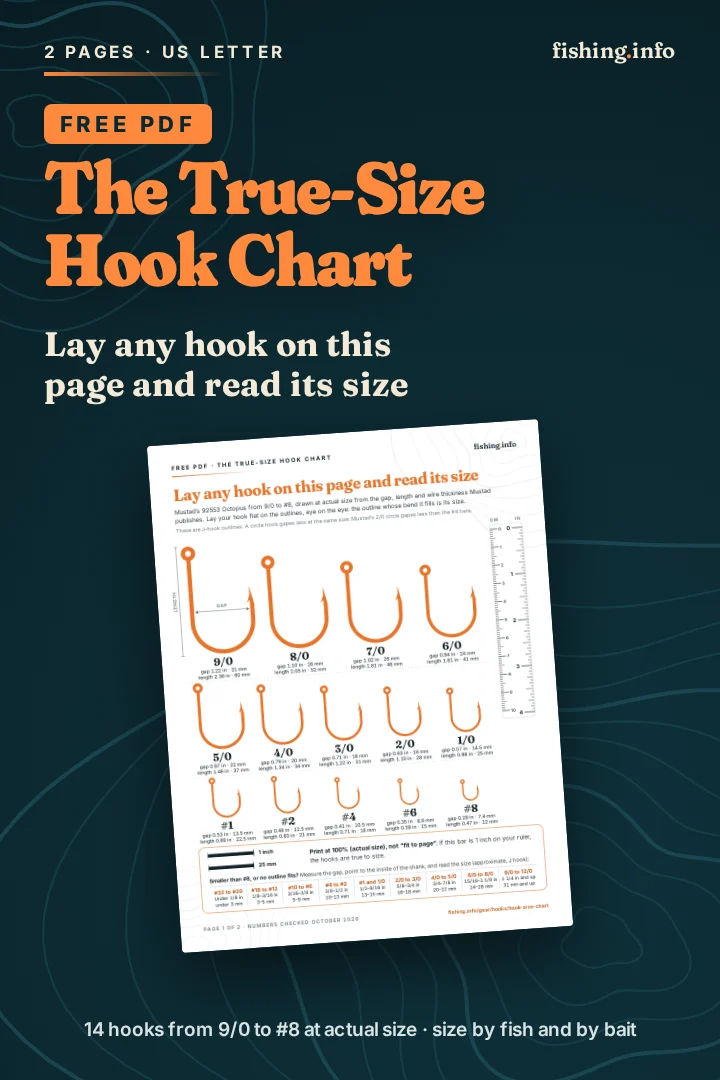
Free PDF · Hook size chart What size is that hook? Lay it on the chart.
Print the free chart, lay any hook on it and read its size: 14 hooks from 9/0 to #8 at actual size, a gap ladder from #32 to 12/0, and the size for 17 fish and 16 baits on the back.
No card, nothing to buy, and the PDF is yours to keep. Confirm with one click and it's on its way. Then a few short emails and one a week on what's biting. Unsubscribe anytime. Privacy.
What makes a rod a saltwater rod?
The metal, not the bend. “The action and power don’t change from one category to the next,” Salt Strong’s Tony Acevedo writes. He told a reader the two are “pretty much identical from inshore to freshwater rods.”
Salt goes after three parts:
- The guides. These are the rings the line runs through, and each sits on small metal feet wrapped to the rod. More on these next.
- The reel seat. Outdoor Life wants metal or high-impact graphite clamps, so the reel stays tight on the rod. Offshore rods use an aluminum seat and butt, Burnley says.
- The grip. Buzz Bryson of Saltwater Sportsman puts the cork on his list of places to wash.
Outdoor Life says all saltwater rods use corrosion-resistant parts, and that a higher price mostly buys lighter blanks, guides and seats. So a cheap rod built for salt can still last, if you look after it.
Stainless, titanium or ceramic guides?
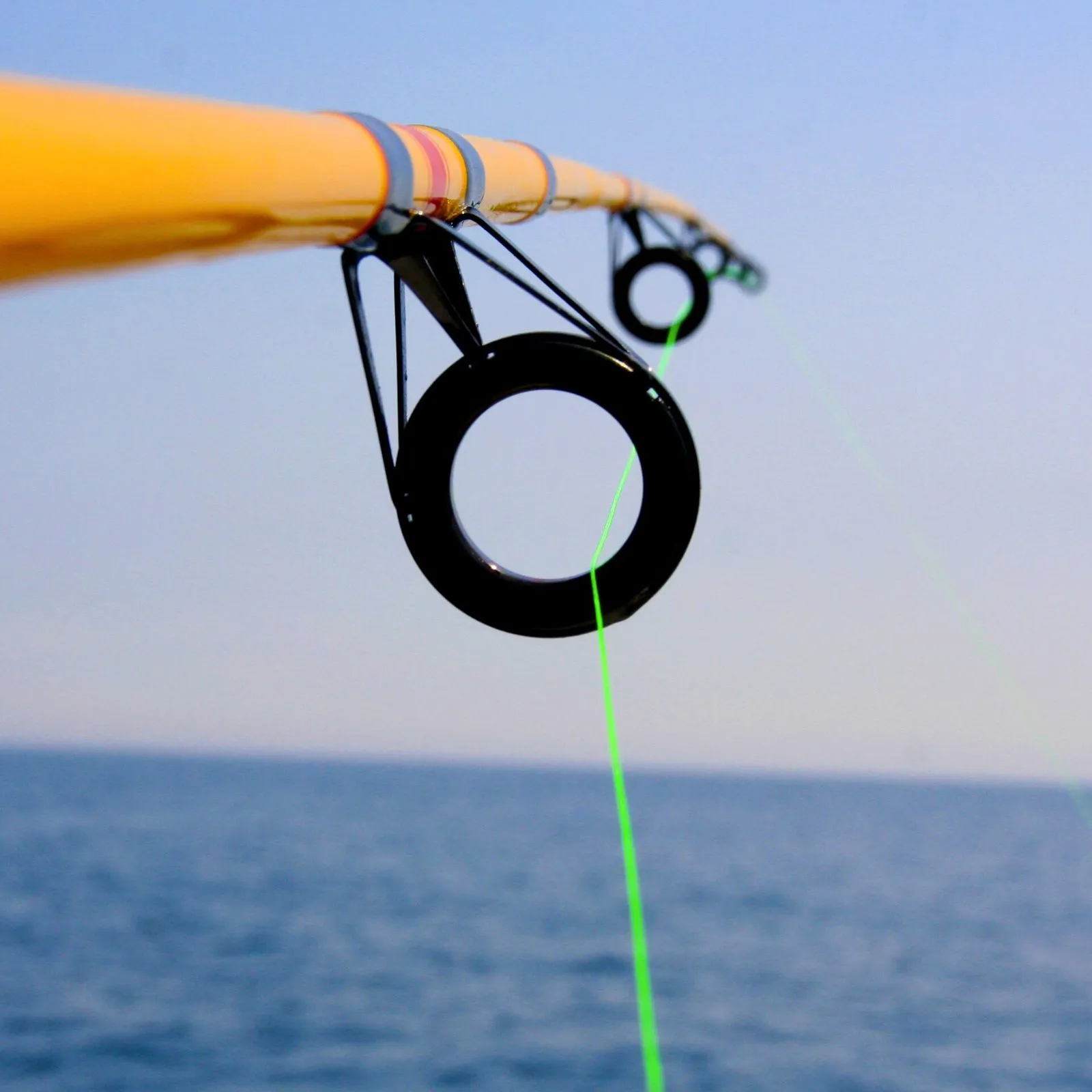
Photo: Jay Erickson (CC BY 2.0)
Stainless is plenty for most anglers. The grade matters a little: St. Croix’s Schluter told Florida Sportsman that 316 frames offer “improved corrosion resistance” over standard 304 stainless. Florida Sportsman adds that a thorough freshwater rinse and towel-dry should stave off corrosion on stainless frames “for many seasons.”
Titanium is one of the best materials for salt, and it’s lighter. But Mud Hole’s Chris Adams, writing for rod builders, points out the savings can be “fractions of grams.” Pay for it only if you’ve already got everything else.
The ring inside the frame is the real choice. Outdoor Life says the toughest guides are single-piece stainless or titanium, and that ceramic or composite inserts “cast farther but seem to break faster.” Burnley goes the other way for braid: he wants guides with inserts to resist wear from braided line.
So pick by what you do. For a rod that gets knocked around a boat deck, take one-piece guides. For casting braid all day, take inserts and check them for chips.
On heavy offshore rods, the guides turn into rollers. Lund’s favorite stand-up setup is a roller stripping guide, then five or six ring guides, then a roller tip. Ugly Stik sells nearly that exact split: the 6 ft Bigwater Stand Up is $179.95 with ring guides and a roller stripper and tip, and $229.95 with all rollers. That’s $50 for the rest of the rollers.
Can you use a freshwater rod in saltwater?
Yes, but it probably won’t last as long. That’s Acevedo’s answer, and the rod is the smaller worry. He told a reader that corrosion causes more trouble in reels than in rods. So a sealed saltwater spinning reel matters more than the rod for the odd trip to the coast. Take your bass rod for a weekend, wash it well, and don’t lose sleep over it.
If you fish salt more than a few times a year, buy the $85 rod. It’s built for the job.
How do you keep a saltwater rod from rusting?
- Wash it soon after the trip with warm water, a mild soap without detergent and a washcloth.
- Work the cloth around the guides and their feet, the cork grip and the reel seat.
- Rinse with warm water.
- Let it dry all the way before it goes in a cloth bag.
- Store it in its sock and a hard tube.
Bryson’s warning is the one to remember. Put wet, salty rods in a bag and the salt moves into the cloth, until the bag itself can corrode the guides and reel seat. His view of the dock hose is just as blunt: it’s nearly pointless, and it likely pushes about as much salt into the crevices as it washes out.
A surf rod in a tripod stand on an Atlantic beach. Photo: CPSH, Wikimedia Commons (public domain).
Seven saltwater rods compared
Prices are from the makers’ own catalogs, read on November 9 and 10, 2026.
| Rod | Price and sizes | Guides |
|---|---|---|
| Ugly Stik Inshore Select | $84.95; 7 and 7 ft 6 in (2.1–2.3 m), M or MH | Ugly Tuff, no insert to pop out |
| Ugly Stik Bigwater Conventional | $84.95–94.95; 5 ft 6 in–12 ft (1.7–3.7 m), 6–80 lb | One-piece stainless |
| Ugly Stik Tiger Elite Jig | $94.95; 6 and 6 ft 6 in (1.8–2 m) | Ugly Tuff, no insert to pop out |
| Ugly Stik Carbon Inshore | $109.95; 6 ft 6 in–7 ft 6 in (2–2.3 m), 6–20 lb | One-piece stainless Ugly Tuff |
| PENN Battalion III Inshore | $130–150; 7 ft (2.1 m), ML to MH | Sea-Guide stainless frames, zirconia inserts |
| St. Croix Mojo Inshore | $190–245; JIS70MF 7 ft (2.1 m), M, fast, 8–17 lb | Stainless frames, aluminum oxide rings |
| Ugly Stik Bigwater Stand Up | $179.95–229.95; 5 ft 6 in–6 ft (1.7–1.8 m), 30–130 lb | Rings with roller stripper and tip, or all rollers |
Under $110 buys everything a beginner needs. Above that you mostly pay for lighter blanks, guides and reel seats.
The picks in detail
Ugly Stik Inshore Select
Four models, every one $84.95. Ugly Stik says the higher graphite content makes it lighter and more sensitive, and the grips are cork. The mediums are rated 8–20 lb and the medium-heavies 10–25 lb. More on the family is on the Ugly Stik rods page.
Ugly Stik Carbon Inshore
All graphite, and the choice if you want to feel a redfish pick up a jig. Eight models run from a 6 ft 6 in medium-light to a 7 ft 6 in medium. The guides are one-piece stainless, and Ugly Stik says they take all types of line, braid included.
PENN Battalion III Inshore
The rod for braid on a budget, with zirconia inserts on stainless frames. Choose the 7 ft medium for most of what swims in a bay, and the medium-heavy for bigger baits and rough bottoms. Penn’s reels are on the Penn reels page if you want a matched pair.
St. Croix Mojo Inshore
Twenty-three models, built in Fresnillo, Mexico, on a five-year warranty. It’s the one to buy if inshore is what you do. The rest of the ladder is on the St. Croix rods page, from the $160 Triumph Inshore up.
Ugly Stik Bigwater Conventional and Stand Up
Graphite and fiberglass, so they’re heavy and forgiving. The conventional comes with Fuji reel seats and EVA grips, the stand-up with PacBay seats. Neither is a rod to cast all day, and they aren’t meant to be. Check the rating against the line you’ll spool, because the range is huge: 6–80 lb across the conventional models.
Ugly Stik Tiger Elite Jig
The cheapest way on this page to find out whether you like jigging. Ugly Stik says the higher graphite content makes it lighter and more sensitive, and the guides have no insert to pop out. These are heavy rods: the 6 ft is rated 80–130 lb and the 6 ft 6 in 50–100 lb.
Which reel and line go on it?
Match the reel to the job. A 2500–3000 size suits the inshore rods here. A 4000–5000 is for snook, big redfish and striped bass from the jetty. Jigging starts around 5500. The saltwater spinning reel page sorts sizes by fish.
Want it matched for you? Ugly Stik sells the Bigwater as a spinning combo for $94.95–109.95, and the Carbon Inshore with a Penn Pursuit IV for $159.95–179.95. Our rod and reel combo page has more.
How we chose
The sizes came first, from named writers at Saltwater Sportsman and Sportfishing who say what they fish and why. The rods then cover each job, from makers that print their models and prices. The specs and prices were read from the makers’ catalogs on November 9 and 10, 2026. No rod was fished for this page.

Free PDF · 2 pages
Stop guessing hook sizes. Lay any hook on this page and read it
A jar of loose hooks and no packet in sight. Guess wrong and you find out with a fish on.
The True-Size Hook Chart. Print it at actual size, lay a hook on the outlines, and the one its bend fills is its size. One sheet, front and back, for the tackle box.
- 14 hooks from 9/0 to #8 at true size, plus a ladder from #32 to 12/0
- The size for 17 fish and 16 baits, from bluegill to tuna
- A 2/0 circle that gapes less than a #4: why a 2/0 is not always a 2/0
Every outline drawn from Mustad's published dimensions; every size from the 25 sources on the page, Maryland DNR and Idaho Fish and Game among them.
No card, nothing to buy. Confirm with one click and the PDF is on its way, one version for your phone and one to print, yours to keep. Then a few short emails and one a week on what's biting, with an unsubscribe link in every one. Privacy.
Related
Section guide
Fishing Rods: How to Choose Power, Action, Length and TypeHow to choose a fishing rod: power, action and length explained, 13 rod types, the right length for each kind of fishing, and what to pay.
 Baitcasting Rod: Length and Power by Lure, the Trigger, and Which to Buy
A baitcasting rod puts the reel on top and a trigger under it. Length and power for six kinds of lures, the reel to pair, and 4 rods from $60.
 Phenix Rods: Every Series From Maxim to K2, Prices and the Warranty
Phenix rods from the $139.99 Maxim to the $679.99 K2: Feather, Recon Elite, M1, Black Diamond, what each costs, and the breakage fees.
 Ugly Stik GX2: Which Size to Buy, Rod or Combo
The Ugly Stik GX2 lists at $59.95 in every size. Which length to buy, rod or combo, what line it takes, and what it gives up to the Elite.
 Bass Fishing Rods: The Six to Own, in the Order to Buy Them
The first bass fishing pole is a 7 ft medium-heavy fast casting rod. The five to add after it, the lures each one throws, and a model at $100 and $200.
 Ugly Stik Rods: GX2, Elite, Carbon and the Rest, and the 10-Year Warranty
Ugly Stik rods from the $25 Dock Runner to the $230 Bigwater stand-up: every series and price, what the Clear Tip does, which to buy, and the warranty.
 Dobyns Rods: Every Series From Colt to Xtasy, Prices and the Warranty
Dobyns rods from the $94.99 Colt to the $669.99 Xtasy: every series and price, the warranty and its replacement fees, and which rod to buy.
Sources (17)
- Sid Dobrin, Fishing Tackle for Redfish, Saltwater Sportsman
- Ric Burnley, How to Choose the Right Fishing Rod, Saltwater Sportsman
- Gary Caputi, Stand-Up Tackle Tactics, Saltwater Sportsman
- Ted Lund, Get Up, Stand Up, Saltwater Sportsman
- Buzz Bryson, Gear Mainenance [sic], Saltwater Sportsman
Show all 17 sourcesShow fewer sources
- Lenny Rudow, Best Fishing Rods for Inshore Variety, Sportfishing
- Jeff Weakley, Rod Guides Basics, Florida Sportsman
- Ric Burnley and Kevin Hughes, The Best Saltwater Fishing Rods for 2026, Outdoor Life
- Tony Acevedo, Saltwater vs. Freshwater Rods, Salt Strong
- Chris Adams, Building with Titanium Components: Is it Necessary?, Mud Hole
- Ugly Stik, Inshore Select spinning rod
- Ugly Stik, Carbon Inshore spinning rod
- Ugly Stik, Bigwater conventional rod
- Ugly Stik, Bigwater stand-up conventional rod
- Ugly Stik, Tiger Elite Jig spinning rod
- St. Croix Rod, Mojo Inshore: model chart and prices
- Penn, Battalion III Inshore spinning rod: models and prices