 By

Ugly Stik rods are the tough, cheap end of the rod market: a GX2 lists at $59.95 in every one of its 34 spinning and casting models, and every Ugly Stik rod carries a ten-year warranty. Above the GX2 sit the Elite, with more graphite and a cork grip, and the all-graphite Carbon, both under $100. Ugly Stik is a line of Shakespeare, the tackle maker founded in Kalamazoo, Michigan, in 1897, and 2026 is its fiftieth year. The prices are Ugly Stik’s own on Oct. 17, 2026, rechecked Oct. 29, and the picks come from its specifications and the reviews named below; none of the rods was fished for this page.
Every Ugly Stik GX2 rod costs $59.95, whether it is a 4 ft 6 in ultralight or a 9 ft medium, and every one carries a ten-year warranty.
Which Ugly Stik should you buy?
- A first rod, a child’s rod, a rod that rides loose in the truck: the GX2, $59.95.
- Panfish, trout and light bites: the Elite, $84.95, for its lighter blank and cork grip.
- Jigs, worms and bottom baits, where you need to feel the bottom: the Carbon, $99.95.
- Surf, piers and saltwater: the Bigwater, $84.95–119.95, up to 15 ft.
- Catfish from the bank: the Catfish Special, $74.95–84.95.
- The whole outfit in one box: a GX2 combo from $59.95, or the Dock Runner at $24.99 for a child on a dock.
Ugly Stik sells no fly rod in its 2026 catalog. The rod’s length and power matter more than the series. A 7 ft medium GX2 is a better bass and walleye rod than a 5 ft 6 in light Carbon. The rods hub explains power, action and length.
What does each Ugly Stik series cost?
| Series | List price, Oct 2026 | Blank | Models | Built for |
|---|---|---|---|---|
| Dock Runner combos | $24.99–39.99 | not stated | Short spinning combo; Camo, Pro and Saltwater versions new in Sept–Oct 2026 | Children, docks and banks |
| Complete kits | $36.99–46.99 | Ugly Stik rod plus a tackle assortment | Spincast, spinning, ladies, saltwater | A first outfit in one box |
| GX2 rods | $59.95 | Graphite and fiberglass, Clear Tip | 20 spinning rods, 4 ft 6 in to 9 ft (1.4–2.7 m); 14 casting rods, 5 ft 6 in to 7 ft 6 in (1.7–2.3 m) | Everything, and abuse |
| GX2 combos | $59.95–99.95 | As GX2 | Spincast $69.95, youth $59.95, spinning $79.95, baitcast $89.95, travel kits | A first outfit |
| Catfish, standard and Special | $64.95–84.95 | Graphite and fiberglass, Clear Tip | Standard 7–8 ft (2.1–2.4 m), EVA grips; Special 7–10 ft (2.1–3 m), rubberized full grip | Catfish from the bank |
| Striper | $64.95 | Graphite and fiberglass, Clear Tip | Spinning and casting | Striped bass |
| Tiger and Tiger Elite | $84.95 / $94.95 | Ugly Tech; the Elite with higher graphite content than its earlier generations | 5 ft 8 in to 7 ft (1.7–2.1 m) | Tuna and catfish, in Ugly Stik’s words |
| Elite | $84.95 | 35% more graphite than GX2, cork grips, Clear Tip | 14 spinning, 5 ft to 7 ft 6 in (1.5–2.3 m); casting | Panfish, trout, light bites |
| Inshore Select | $84.95 | Higher graphite content, cork | 7 ft and 7 ft 6 in, medium and medium-heavy | Inshore, in Ugly Stik’s words: redfish and seatrout water |
| Bigwater spinning | $84.95–119.95 | Graphite and fiberglass, Clear Tip, Fuji reel seats | 16 spinning rods, 6–15 ft (1.8–4.6 m) | Big game, in Ugly Stik’s words; surf and piers in practice |
| Carbon | $99.95 | 100% graphite | 10 spinning, 5 ft 6 in to 7 ft 3 in; 6 casting | Sensitivity |
| Carbon species lines | $59.95–149.95 | 100% graphite | Crappie, walleye, inshore, surf, jigging, salmon and steelhead, catfish, ice | One fishing each |
The Bigwater family runs higher: conventional rods at $84.95–94.95 and stand-up rods for big game at $179.95–229.95. The Carbon Crappie runs from a 5 ft 4 in ultralight to an 11 ft light (1.6–3.4 m) for long-pole work, at $79.95.

Free PDF · Water temperature chart Which fish are biting at today's water temperature?
One reading, and the 16-page chart shows which of 26 fish are spawning, feeding hard or slowing down; for bass, crappie, bluegill and walleye, where they sit and what to throw. Every number sourced.
Enter your email, confirm it with one click, and the PDF is in your inbox. Plus one email a week on what's biting. Unsubscribe anytime. Privacy.
What makes an Ugly Stik an Ugly Stik?
The blank. Outside the Carbon lines, Ugly Stik describes its rods as graphite and fiberglass together, which it calls Ugly Tech construction. The glass gives the toughness; in Wikipedia’s account the graphite in the fiberglass wraps adds the sensitivity, and the rods can be bent into a circle without breaking. A composite rod like this is heavier than an all-graphite one, and the Elite and Carbon exist to close that gap.
The Howald process. Wikipedia traces the construction to a method Dr. Arthur M. Howald invented, first used on Shakespeare’s “Wonderod” in 1947. An internal spiral fiberglass core and parallel glass fibers soaked in pigmented polyester resin were wrapped in tape and cured in an oven. High-pressure water jets then removed the tape. Wikipedia says today’s Ugly Stiks still use the process with updated materials; Ugly Stik’s own pages say only “Ugly Tech”.
The Clear Tip. The top of a GX2, Elite, Catfish or Striper rod, and of the Bigwater models that carry it, is clear fiberglass, which Ugly Stik dates to the 1990s: it “proves strength doesn’t have to sacrifice sensitivity”. A light tip is easy to watch for a bite, the reason catfish rods carry one. The Carbon rods’ descriptions do not list it.
The guides. Ugly Tuff guides are one-piece stainless steel, which Ugly Stik says eliminates insert pop-outs. A popped or cracked insert cuts line, and that is the failure the design is built to avoid.
Are Ugly Stik rods good quality?
For toughness, yes; for feel, less so. Owners rate the GX2 spinning rod 4.5 out of 5 from 49 reviews on Ugly Stik’s own page, and the Elite spinning rod 4.5 from 10. Kade Gewanter of Wired2Fish calls the Elite “amazingly rugged”, able to “withstand the pure torture that young and curious anglers tend to unleash”. Cory Schmidt of Outdoor Life calls the 7 ft medium-light Elite “a sweet stick for slip-float fishing”.
The weak spot is the combo reel more than the rod. Ugly Stik’s GX2 baitcast combo scored 3.4 from 24 reviews on its page, and the fishing rod for beginners guide finds most of the GX2 spinning combo’s complaints aimed at its reel. The fix it quotes from BassResource: keep the GX2 rod and put a better reel on it.
“America’s strongest” was printed on older Ugly Stik packaging, as the kit in the photo shows. It is the maker’s slogan. The one strength figure Ugly Stik publishes comes from its own lab: a 7 ft medium-heavy Carbon rod (USCBSP701MH) “50% stronger” than an Abu Garcia Vendetta VDTS70-6 “on average, based on controlled lab testing”. No independent test of rod brands’ strength was found.
What does the Ugly Stik warranty cover?
Ten years on rods, for the original purchaser, against “defects in materials or workmanship”. Reels inside a combo get one year, Ugly Stik Tuff reels seven, and tools and equipment seven. The warranty page excludes normal wear and tear, commercial use, and “accidents, abuse, alteration, modification, misuse or improper care”. Older reviews still quote seven years for the rods; the current page says ten. It is not a lifetime warranty.
A claim goes to support@uglystik.com with five things:
- A photo of the rod showing the brand and model, directly above the handle.
- A photo of the broken area.
- A copy of the dated receipt or proof of purchase.
- A short description of how the rod broke.
- Your address and a daytime phone number.
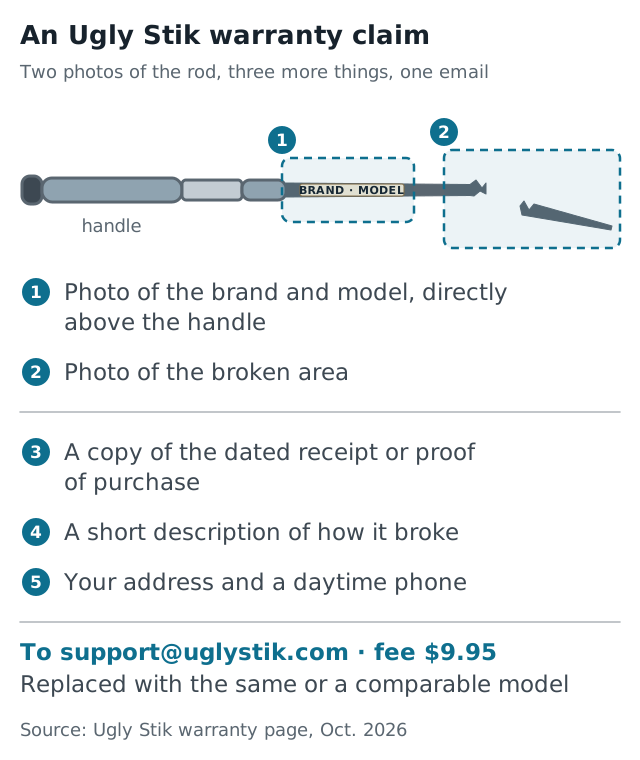
A rod under warranty is replaced for a $9.95 processing fee, with the same or a comparable model; Ugly Stik does not sell rod parts. A rod that does not qualify can still get a discounted replacement by phone at (800) 466-5643. That is the opposite of St. Croix’s warranty, which replaces an in-warranty rod broken for any reason for $60 and does not list a receipt among its photos. Ugly Stik’s is cheaper to claim and narrower in what it covers.
Why is it called an Ugly Stik, and how old is it?
- 1897: William Shakespeare Jr. founds his tackle company in Kalamazoo, Michigan; it takes the name Shakespeare in 1915.
- 1947: Shakespeare launches the Wonderod, the first rod built by Dr. Arthur Howald’s fiberglass process.
- 1970: Shakespeare moves its base to Columbia, South Carolina.
- 1976: The first Ugly Stik. The name came from the look: very large rods with metal handles, the graphite showing through the blank, black wraps with white pinstripes.
- 1990s: The Clear Tip, in Ugly Stik’s own timeline.
- 2013: The GX2, “modern performance to the rod anglers already trust”, in Ugly Stik’s words.
- 2026: The fiftieth year. “For 50 years, Ugly Stik has earned its place in the hands of anglers who fish harder,” the About page says, and a limited 50th Anniversary spinning combo sells at $50.
The dates before 1976 come from Wikipedia’s history; the later ones from Ugly Stik’s site.
Who makes Ugly Stik rods?
Shakespeare, which introduced the line in 1976. Today Ugly Stik runs its own site and warranty, and Shakespeare and Ugly Stik both belong to Pure Fishing, the tackle group behind Abu Garcia, Penn, Pflueger, Fenwick and Berkley. Pure Fishing has been owned by the private-equity firm Sycamore Partners since January 2019. Where the rods are built is not stated on any Ugly Stik page. The service center is in Philadelphia, which says nothing about the factory.
Ugly Stik or Shimano? They do different jobs here: Ugly Stik for the rod, Shimano for the reel on it. A GX2 rod with a Shimano Sedona or a Pflueger President reel is a sensible pairing; the Shimano reels page has the ladder.
The picks
GX2. The rod to buy when the rod has to survive: a child’s, a truck rod, a catfish rod for drifting. A 7 ft medium is the all-round size for bass and walleye. $59.95 in every size.
Elite. The GX2 made lighter, with cork. Take the 7 ft medium-light for slip floats and panfish, the 5 ft ultralight for a trout creek.
Carbon. For jigs and Texas rigs, where you feel for the bottom and the GX2’s glass mutes it. At $99.95 it competes with the $100 graphite rods from Daiwa and Lew’s on the best fishing rods page.
Bigwater. Sold for big game, used as the surf and pier family, up to 15 ft and 30–50 lb line, at $84.95–119.95.
Catfish Special. The bank catfish rod in 7 to 10 ft, at $74.95–84.95.
How we chose
The ladder comes from Ugly Stik’s own catalog on Oct. 17, 2026, rechecked Oct. 29: every rod series, its list price, model count and the construction in the maker’s words. The owner scores are Ugly Stik’s own, the verdicts are quoted from the reviewers named, and the history is Wikipedia’s and Ugly Stik’s. The picks follow what each series is built for, not a ranking; no rod was cast or tested for this page. For a whole first outfit, the rod and reel combo guide sets the GX2 combo against nine others.
Free PDF · 16 pages
Know what's biting before your first cast
The Water Temperature Fishing Chart. Take one water temperature reading, find it on the chart, and see which of 26 freshwater fish are spawning, feeding hard or slowing down. Six pages go deeper: bass, crappie, bluegill, walleye, catfish and trout. For your phone and the tackle box.
- Where they sit and what to throw at every band: bass, crappie, bluegill and walleye; catfish by species; trout: the 68 °F line where you stop, and where they hide
- A bass that drops 3 ft feels more pressure change than the biggest cold front: the front day by day, and what to throw on each
- The three thermometer mistakes that make a reading lie (the first one is the surface)
- The 26-fish chart: who's spawning, feeding hard or slowing down at your reading
The chart's numbers come from state fish and wildlife agencies and fisheries research: 61 sources, each listed on the site.
Enter your email, confirm it with one click, and the PDF is in your inbox. Plus one email a week on what's biting. Unsubscribe anytime. Privacy.
Related
Section guide
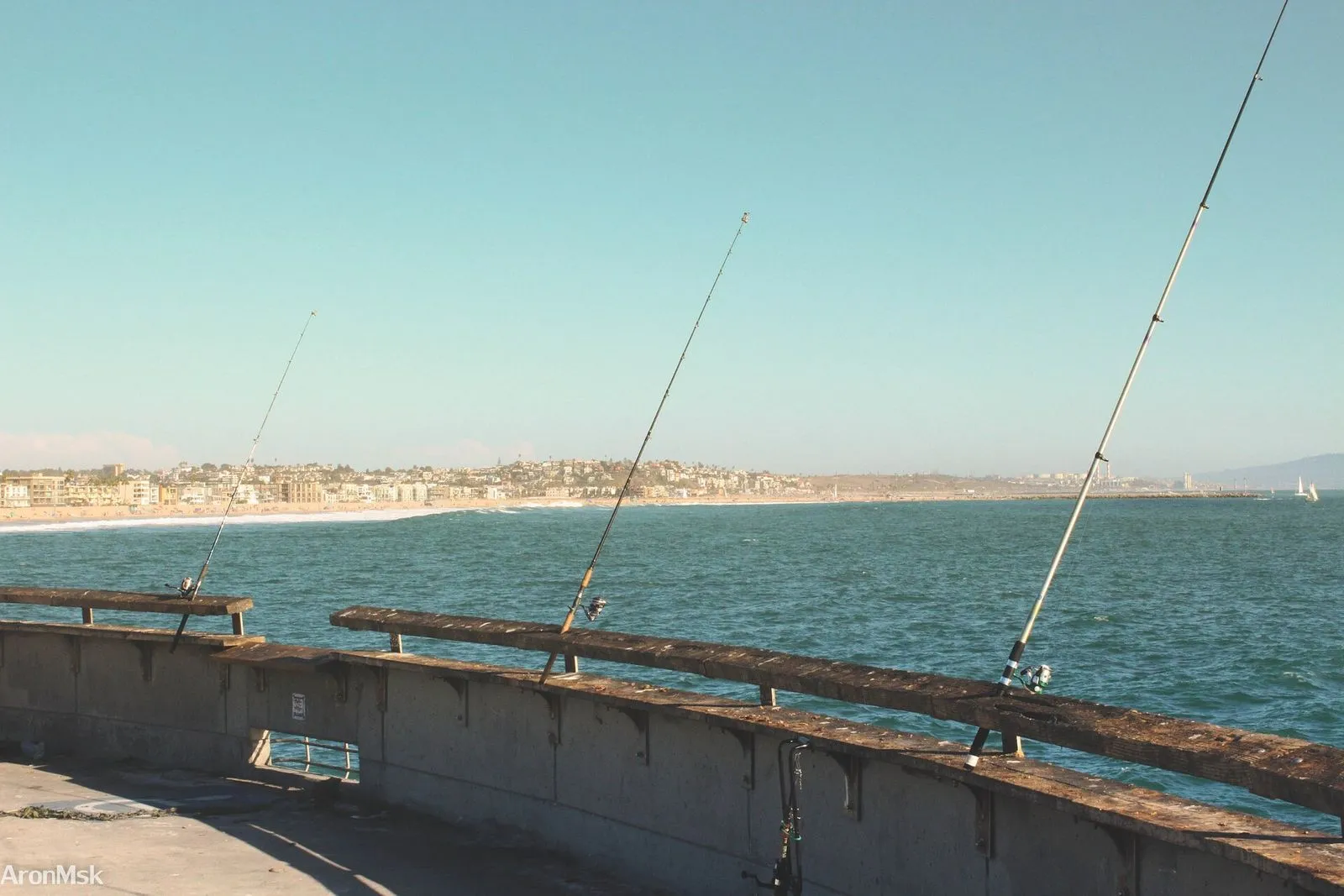
Fishing Rods: How to Choose Power, Action, Length and TypeHow to choose a fishing rod: power, action and length explained, 13 rod types, the right length for each kind of fishing, and what to pay.
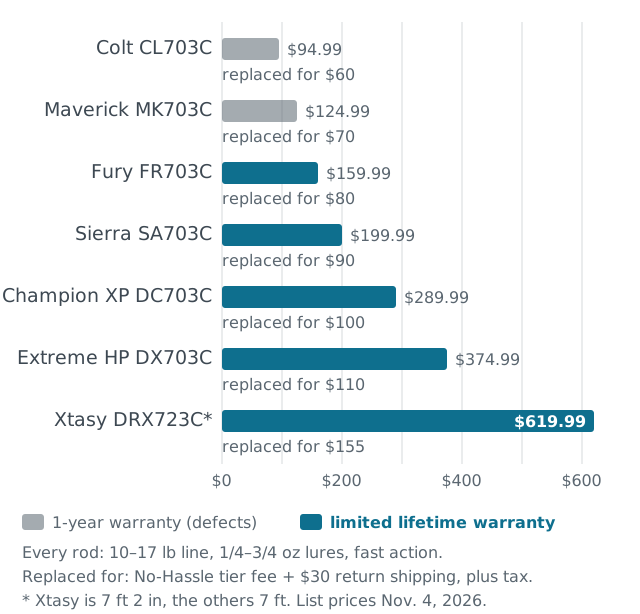 Dobyns Rods: Every Series From Colt to Xtasy, Prices and the Warranty
Dobyns rods from the $94.99 Colt to the $669.99 Xtasy: every series and price, the warranty and its replacement fees, and which rod to buy.
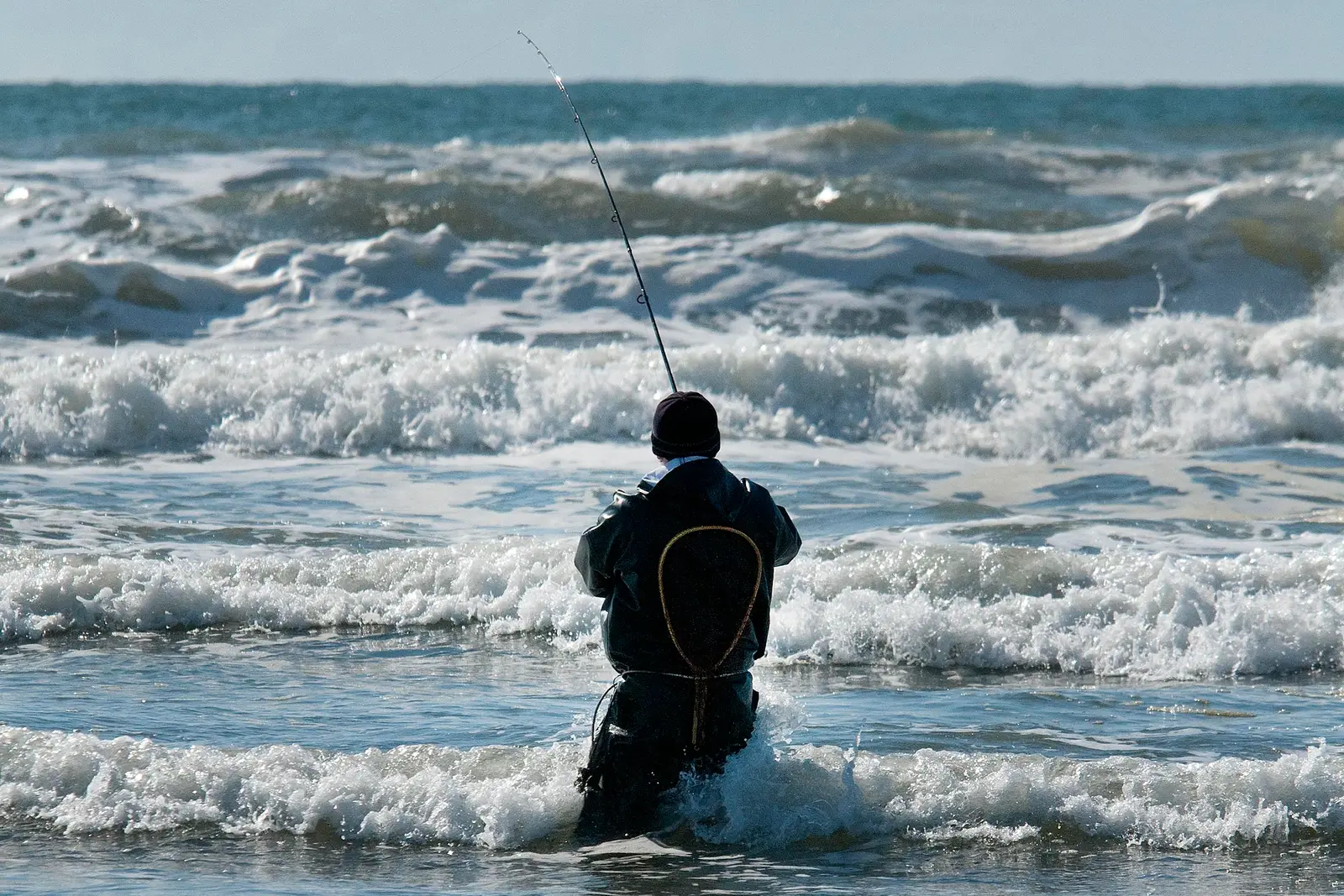 Surf Fishing Rods: Which Length for Which Beach, and Eight Rods Compared
Surf fishing rods by beach and bait: when 7 ft is enough and when you need 12, what the ratings mean, and eight rods from $55 to $430 compared.
 St. Croix Rods: Every Series From Triumph to Legend Xtreme, and the Warranty
St. Croix rods from the $115 Triumph to the $775 Legend Xtreme: every series with its blank, where it is built, its warranty, and which to buy.
 Telescopic Fishing Rod: How Good They Are, and Which to Buy
A 7 ft telescopic fishing rod packs to 21–30 in, about as short as a four-piece. Real collapsed lengths, the trade-offs and the reviewers' picks.
 Baitcaster Combo: Seven Picks From $85 to $230, and What to Look For
Seven baitcaster combos compared on rod, gear ratio, brake and price, what a first one needs, and how little the rod in the box really costs.
 Fishing Rod Holders: Bank, Boat, Kayak and Home, and How to Choose
Fishing rod holders for bank, surf, boat, kayak and home: which type fits, how to mount it, how to set it for the hook, and five picks.
Sources
- Ugly Stik, catalog and list prices (October 2026)
- Ugly Stik, GX2 spinning rod (models and features)
- Ugly Stik, Elite spinning rod (35% more graphite than GX2)
- Ugly Stik, Carbon spinning rod and Carbon Crappie (100% graphite, lab-test claims)
- Ugly Stik, Bigwater spinning rod
- Ugly Stik, Catfish Special spinning rod
- Ugly Stik, 50th Anniversary spinning combo
- Ugly Stik, Warranty and Service (dated May 26, 2026 in Ugly Stik's site feed)
- Ugly Stik, About (the timeline, 1976 to today)
- Wikipedia, Ugly Stik (Shakespeare history, the Howald process, the name)
- Wikipedia, Sycamore Partners (Pure Fishing and its brands)
- Wired2Fish (Kade Gewanter), best ultralight fishing rods (Ugly Stik Elite)
- Outdoor Life (Cory Schmidt), the best crappie rods (Ugly Stik Elite)
- Outdoor Life (Alan Clemons), the best catfish rods (Catfish Special, best value)
- St. Croix Rod, Service and Warranty (for the comparison)