 By
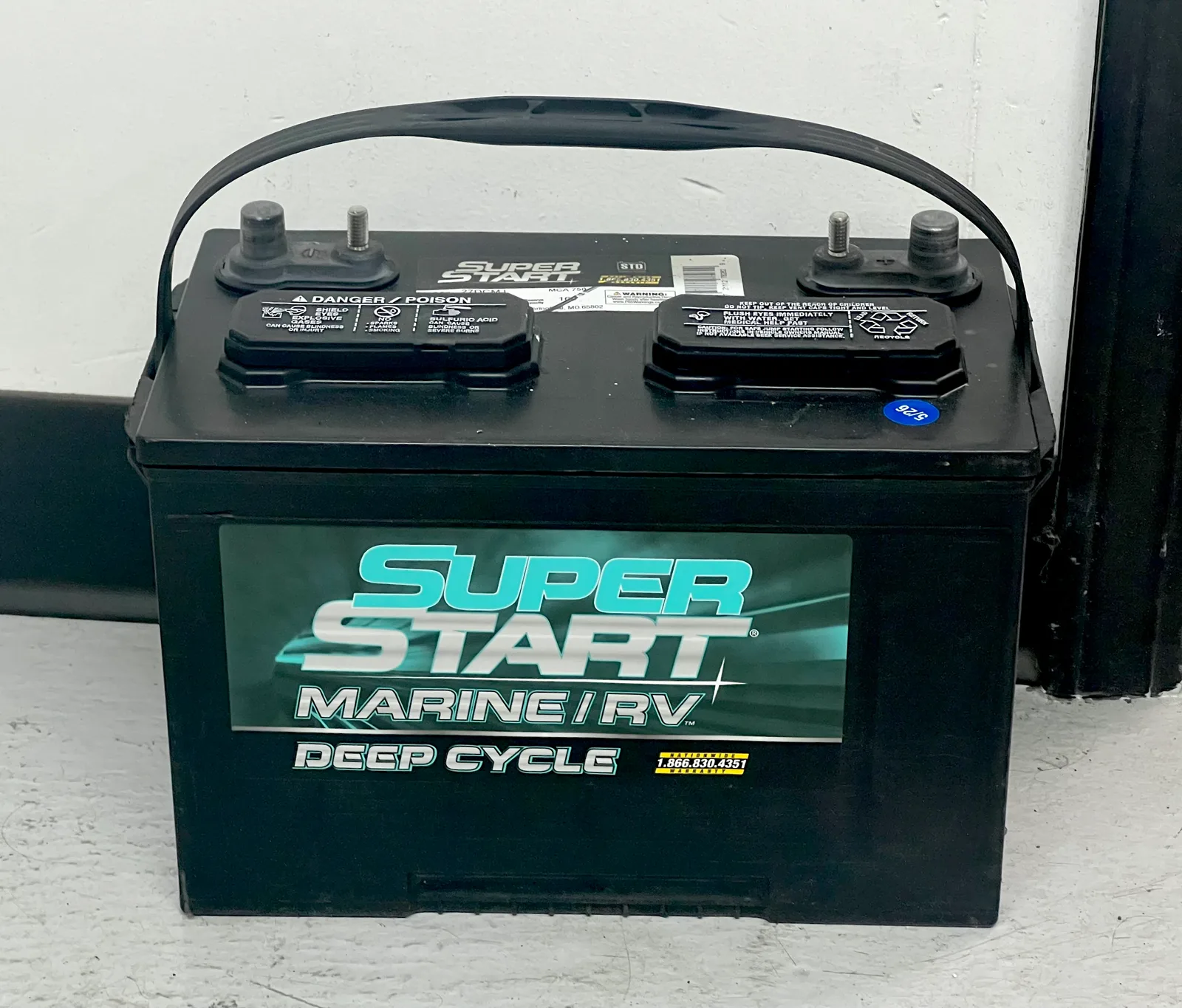
A trolling motor battery is a 12 volt deep-cycle marine battery, one for every 12 volts of motor. Minn Kota says it should hold at least 110 amp-hours. A 12 V motor runs on one battery, a 24 V motor on two and a 36 V motor on three. How long it runs is simple math: amp-hours divided by the amps the motor pulls. The catch is that a lead-acid battery only gives you about half its rating, and a fast speed setting eats it in hours.
Slow down and the battery lasts almost three times as long. At setting 15, Garmin’s Force Pro still makes half its full thrust on about a third of the current.
Which battery does a trolling motor need?
Use a deep-cycle battery, not a starting battery. A starting battery is built for a short burst to crank an engine. A deep-cycle battery is built to give power slowly for hours, then be drained and recharged hundreds of times. It’s the battery behind the trolling motor and the fish finder alike.
Can a car battery run a trolling motor? It’ll turn the prop, but not for long. A car battery is a starting battery, and Interstate says those handle only about 50 deep drains in their life. “Marine” on the label isn’t enough either: Interstate sells marine starting batteries too. Look for the words deep cycle.
Keep the trolling motor on its own batteries. If a cranking battery starts your outboard, Minn Kota says to give the trolling motor separate deep-cycle batteries.
The motor’s volts set how many batteries, each one 12 V:
- 12 V motor: one battery. On Minn Kota’s chart that covers motors up to 55 lb of thrust, the size for a jon boat or a small aluminum boat.
- 24 V motor: two batteries wired in series, for the 70 and 80 lb motors.
- 36 V motor: three batteries in series, for the 101 and 112 lb bow mounts on a bass boat.
Minn Kota’s chart says its motors run on “any lead acid, deep cycle marine 12-volt battery”. Lithium works too, with two catches.
Lead-acid, AGM or lithium trolling motor batteries?
Flooded lead-acid is the old wet-cell battery with caps on top. AGM is a sealed lead-acid battery with the acid soaked into glass mats. Lithium here means lithium iron phosphate, LiFePO4, sold in the same 12 V boxes.
| Flooded lead-acid | AGM | Lithium (LiFePO4) | |
|---|---|---|---|
| Cycles | 250 to 1,000, by how deep you drain it (Interstate) | 300 to 900 (Optima) | 3,000 to 5,000 (Battle Born) |
| Usable charge | about half | about half | all of it (Battle Born) |
| Weight | middle | heaviest | lightest: 27.6 to 31 lb for 100 Ah |
| Price | lowest | middle | highest: $599 to $949 for our two picks |
| Upkeep | check the water | sealed | sealed, own charge voltage |
Cycle counts are each maker’s own rating under its own test. Interstate’s are for its deep-cycle batteries, drained to empty or to half. Optima’s AGM range is a general figure, not a test of one model.
The row that matters most is usable charge. Interstate recommends that a deep-cycle lead-acid battery not be drained below 50%. Trojan goes further and recommends using 20 to 50% of the rating for best life, though its batteries can be cycled to 80%. Battle Born rates its 100 Ah lithium as the equal of a 200 Ah lead-acid battery, and lists 100% of its charge as usable.
So by Battle Born’s rating, a 100 Ah lithium does the work of about 200 Ah of lead-acid, and it weighs 31 pounds. That weight and that usable charge pay most on a 36 V boat that carries three batteries. For a jon boat that fishes a few hours on a 30 lb motor, one lead-acid battery is still the cheap and simple answer.
Lithium doesn’t have to cost $600, either. Brands that sell direct list 100 Ah for about half that: LiTime’s Group 24 was $309.99 on its own Black Friday sale. Check the same four lines on any spec sheet before you buy: the series limit, the continuous discharge amps, low-temperature charge protection and the warranty. On that LiTime, it’s four in series, 100 amps, no low-temperature protection on the base model, and 5 years.
Do lithium batteries damage a trolling motor?
Not if you mind two things. Minn Kota’s 2021 battery chart speaks of lead-acid only, but its help center now says lithium works with its motors.
First, on a brushed motor, keep the speed at 85% or less, “Speed 8.5 or lower” in Minn Kota’s words. Lithium holds a higher voltage for longer, and Minn Kota says full speed on it can damage a motor built for lead-acid. Its brushless Quest motors are made for lithium.
Second, check the battery’s continuous discharge rating against your motor’s maximum draw. If the motor pulls more, the battery’s electronics restrict power, and Minn Kota says the motor can shut off or Spot-Lock can act up. Dakota’s 100 Ah lists a 100 amp maximum discharge, well over the 56 amps of an 80 lb Minn Kota.

Free PDF · Water temperature chart Which fish are biting at today's water temperature?
One reading, and the 16-page chart shows which of 26 fish are spawning, feeding hard or slowing down; for bass, crappie, bluegill and walleye, where they sit and what to throw. Every number sourced.
No card, nothing to buy, and the PDF is yours to keep. It's in your inbox a minute later. Then a few short emails and one a week on what's biting. Unsubscribe anytime. Privacy.
What size battery for a trolling motor?
Marine batteries come in group sizes, a standard case size. The bigger the group, the more amp-hours fit inside. Minn Kota grades them for run-time like this:
| Group size | Amp-hours | Minn Kota’s run-time rating |
|---|---|---|
| Group 24 | 70 to 85 Ah | Good |
| Group 27 | 85 to 110 Ah | Better |
| Group 31 | 95 to 125 Ah | Best |
Minn Kota’s advice is at least 110 Ah for best results. On its chart, that’s the top end of a Group 27 or a Group 31. A Group 24 fits a tight battery box, but it runs out first.
Lithium breaks the link between box size and capacity. Dakota fits 100 Ah into a Group 24 footprint at 27.6 pounds. Battle Born’s 100 Ah drops into Group 27 and Group 31 trays at 31 pounds. Measure your battery box before you order. Group sizes are only a guide to the case, as Dakota’s own page warns.
Asked what size battery a 55 lb motor needs? Minn Kota’s table puts its maximum draw at 50 amps. A 110 Ah lead-acid battery, used to half, gives you about an hour flat out and much longer at lower speeds. The next section has the numbers.
How long will a trolling motor battery last?
Divide amp-hours by amps. Bass Pro’s example: a 100 Ah battery at a 20 amp draw runs about 5 hours. Then correct for the battery type: lithium gives you its full rating, lead-acid about half if you want it to last.
The hard part is knowing the amps. Most makers print only the maximum draw. Garmin prints the draw at every speed setting of its Force Pro, measured at 25.6 and 38.4 V to the ISO 13342 standard in calm water. Here is what that does to a bank of three 12 V 100 Ah batteries:
| Setting | Thrust | Current | Lithium, 100 Ah | Lead-acid, 100 Ah |
|---|---|---|---|---|
| 20 (full) | 114.7 lb | 55.9 A | 1.8 h | 0.9 h |
| 15 | 59.3 lb | 19.7 A | 5.1 h | 2.5 h |
| 10 | 30.7 lb | 7.5 A | 13.3 h | 6.7 h |
| 5 | 11.7 lb | 1.9 A | 52.6 h | 26.3 h |
Garmin’s figures at 38.4 V, tolerance ±5 lb and ±5 A. Hours are our arithmetic: amp-hours ÷ current, lead-acid at 50% usable and at the same draw.
Three batteries in series give 36 V but still 100 Ah, which is why the hours above use 100, not 300. Look at setting 15: about half the thrust for about a third of the current. That’s the case for buying a bigger motor and running it slow.
For a 12 V motor, use Minn Kota’s maximum draw as the worst case. A 30 lb motor can pull up to 30 amps, so a 100 Ah lithium lasts at least 3.3 hours flat out. A 100 Ah lead-acid, used to half, gives you about 1.7 hours. Minn Kota says the maximum only happens now and then, so real days run longer. And on lithium, a brushed Minn Kota shouldn’t run flat out at all: hold it at 85%.
How many amp-hours for a day on the water?
Add up the day the way you’ll fish it. Take a 36 V bow mount like the Force Pro on a bass boat:
- Four hours of slow work along a bank at setting 10: 4 × 7.5 A = 30 Ah.
- One hour at setting 15 to fight a breeze or cross a flat: 19.7 Ah.
- A quarter hour flat out, moving between spots: 55.9 A × 0.25 = about 14 Ah.
- The total: about 64 Ah from each battery in the bank.
A 100 Ah lithium bank covers that with about a third left. A lead-acid bank has to be rated about 128 Ah to give 64 without going below half. That’s more than even the 125 Ah top of Minn Kota’s Group 31 range. Garmin’s numbers are from calm water, so a windy day costs more.
Two more things cut a lead-acid battery’s hours. A fast draw gets fewer amp-hours out of it: Interstate’s SRM-27 runs 19.4 hours at 5 amps but 3.0 hours at 25 amps. And cold hurts. A fully charged battery works at 100% efficiency at 80 °F (27 °C), Interstate says. At 32 °F (0 °C) it’s 65%, and at 0 °F (−18 °C) it’s 40%.
Drain it less, it lasts longer
How deep you drain a lead-acid battery each trip decides how many trips it lasts. Interstate’s booklet shows it plainly.
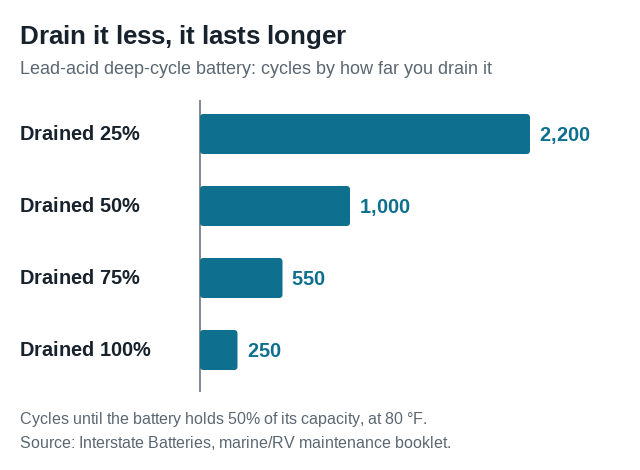
Drain it to empty every time and you get 250 cycles. Stop at half and you get 1,000, four times as many. That’s where the “count lead-acid at half” rule comes from. Interstate’s own sizing tip is to divide the amp-hours you need by 0.50.
Heat costs cycles too. Interstate says a battery kept consistently above 90 °F (32 °C) can give far fewer of them. A new battery doesn’t need a full drain to break it in, and lead-acid has no memory. Interstate recommends shallow or moderate drains for the first 5 to 20 cycles.
To know where you are, read the voltage at rest. Interstate’s numbers for its lead-acid batteries:
- 12.75 V: full.
- 12.45 V: 75% left.
- 12.25 V: 50% left. Time to head in or switch to the paddle.
- 12.05 V: 25% left.
- 11.90 V: empty.
Right after charging, the reading runs high. Interstate’s fix is a load of 10 to 15 amps for two to three minutes, then a minute’s rest before you read it. Built-in battery meters can mislead with lithium too: Garmin says its motor’s meter is set up for lead-acid and may be wrong on lithium.
Wiring two or three batteries
For a 24 or 36 V motor the batteries go in series. Run a jumper from the positive of one battery to the negative of the next. The motor’s leads go on the two free posts at the ends. Minn Kota wants the jumper wire one size larger than the motor’s lead wire.
Two batteries in parallel do something else. They stay at 12 V and add amp-hours, for a 12 V motor that needs a longer day.
Minn Kota’s rule for any bank: the batteries “must be the same manufacture, type, size, and age.” Don’t add one new battery to two old ones, and don’t mix lithium with lead-acid.
Lithium adds a limit of its own. Dakota’s 100 Ah Group 24 lists “Max in Series: 2”, so it can run a 24 V motor but not a 36 V one. Battle Born lists a maximum series voltage of 48 V, which covers 36 V. There are also 36 V lithium batteries in one case, such as MillerTech’s 36 V 50 Ah, built to replace a 36 V lead-acid bank. One case means no jumpers, but check its amp-hours against the day you plan.
Watch out: Read the series limit on a lithium spec sheet before you buy three. Dakota’s 100 Ah Group 24 allows two.
Two safety notes from Minn Kota. Wrong wiring on a 24 or 36 V system “could cause battery explosion”, and batteries belong in a ventilated compartment. Fit the breaker from the trolling motor wiring table too.
How to charge a trolling motor battery
Charge it the day you get home. Minn Kota calls a lead-acid battery left flat for more than 12 to 24 hours the leading cause of early failure. Interstate’s advice is the same: recharge as soon as you can after use.
Match the charger to the battery: flooded and sealed batteries often use different chargers, Interstate says. Use one that refills the bank in 8 to 12 hours, at no more than 20 amps for each 100 Ah (Interstate’s numbers). For a 24 or 36 V bank, the charger has to match the voltage too.
A lithium battery carries its own battery management electronics, which Battle Born says protect the battery and the systems it powers. It also wants its own charging voltage. Battle Born lists 14.2 to 14.6 V. Dakota lists 14.2 V at a recommended 20 amps, 50 at most. A charger with a lithium setting is the safe buy. In the cold, check the battery has low-temperature charge protection. Dakota’s has it with internal heating, and Battle Born sells a heated version.
Unplug the motor while you charge. Minn Kota says to disconnect it when it’s not in use or while the batteries charge. Over the winter, keep the batteries full: Minn Kota says to store them at full charge.
The picks in detail
| Battery | Capacity and weight | Fits |
|---|---|---|
| Interstate SRM-27 | 88 Ah, flooded lead-acid | 12 V motor, Group 27 box |
| Dakota Lithium 12V 100Ah | 100 Ah, 27.6 lb | 12 or 24 V motor, Group 24 box |
| Battle Born 100Ah 12V | 100 Ah, 31 lb | 12, 24 or 36 V, Group 27 or 31 box |
The Interstate SRM-27 is the budget pick for a 12 V motor on a jon boat or small boat. It’s a flooded Group 27 rated 88 Ah and 160 minutes of reserve capacity, the time it holds a 25 amp load. Interstate’s suggested retail price was $169.95 in November 2026, and its booklet gives the battery 8.5 hours at 10 amps. It needs its water checked, and you should stop at half charge.
The Dakota Lithium 12V 100Ah Group 24 suits a 12 V motor, or a 24 V motor with two of them. It weighs 27.6 pounds, has low-temperature charge protection and an internal heater, and carries an 11-year limited warranty. Its two-in-series limit rules it out of a 36 V bank. In late November 2026 Dakota listed it on preorder, shipping in early January 2027.
The Battle Born 100Ah 12V is the pick for a 36 V bow mount. Three of them make a 36 V, 100 Ah bank, inside its 48 V series limit. It fits Group 27 and 31 trays at 31 pounds each and carries a 10-year warranty. At $655 each on sale, a bank of three costs about $1,965, before the charger.
If your boat is the bigger question, the fishing boats guide starts there.
How we chose
The specs come from the makers’ own pages and manuals. That means Minn Kota’s battery charts, Interstate’s booklet and spec sheet, Trojan’s FAQ and Optima’s comparison. For lithium, Battle Born’s and Dakota’s product pages, and for the current draw, Garmin’s Force Pro manual. Prices are the makers’ own on November 27, 2026. We did not test these batteries.

Free PDF · 16 pages
Stop guessing. Know what's biting before your first cast
A whole Saturday on the water with nothing to show for it. One reading tells you who's feeding.
The Water Temperature Fishing Chart. Take one water temperature reading, find it on the chart, and see which of 26 freshwater fish are spawning, feeding hard or slowing down.
- Where bass, crappie, bluegill and walleye sit, and what to throw. Trout: the reading where you stop.
- Why a 3 ft drop beats a cold front, and what to throw each day of the front
- The three thermometer mistakes that make a reading lie
The chart's numbers come from state fish and wildlife agencies and fisheries research: 64 sources, each listed on the site.
No card, nothing to buy. The PDF is in your inbox a minute later, one version for your phone and one to print, yours to keep. Then a few short emails and one a week on what's biting, with an unsubscribe link in every one. Privacy.
Related

Section guide
Fishing Boats: The Types, What They Cost, and How to Pick Your FirstFishing boats compared: jon, bass, aluminum deep-V, flats skiff, bay boat and center console, with real maker specs, draft and prices from $1,495.
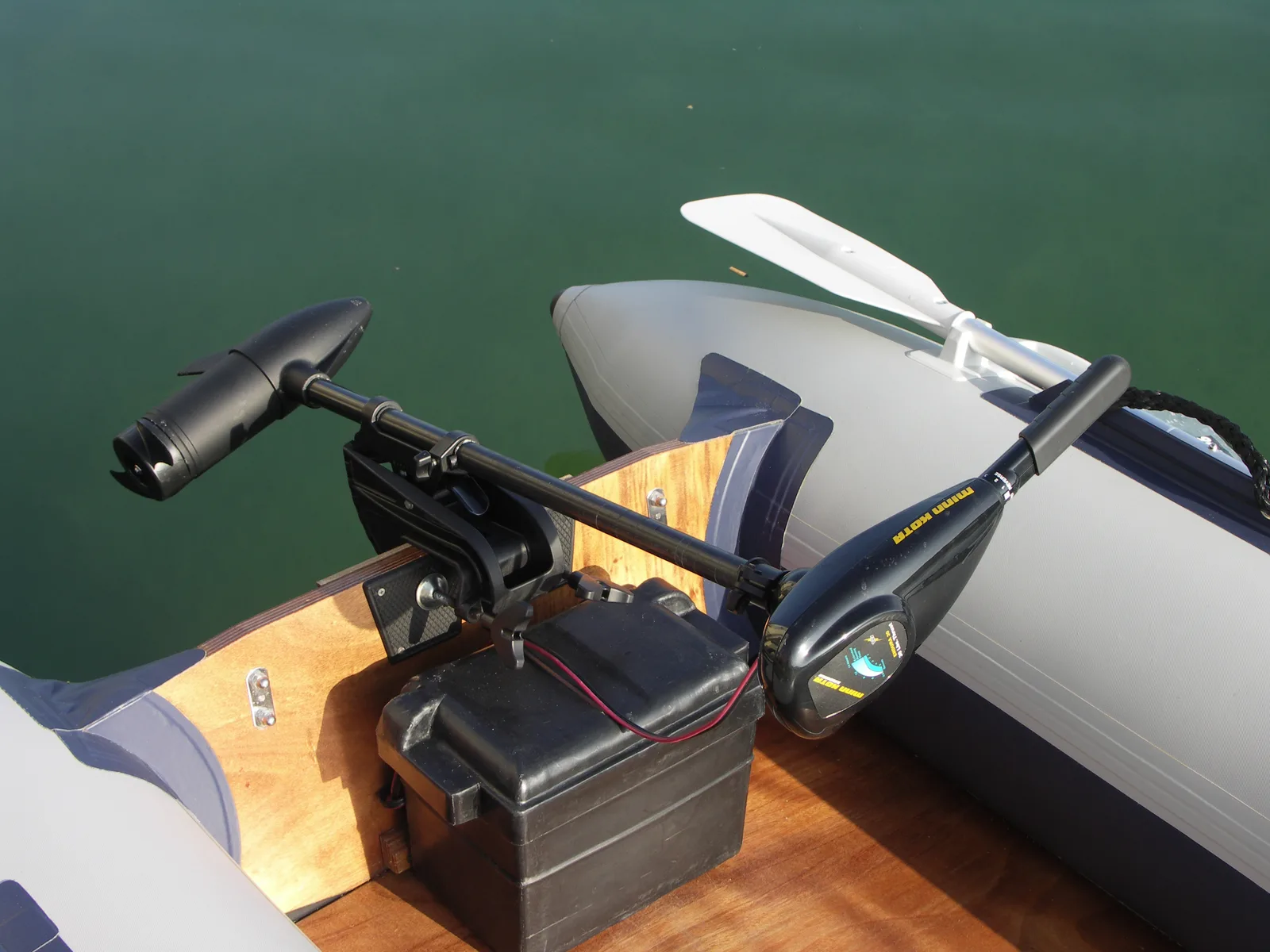 Trolling Motor: How Much Thrust, Which Shaft, Bow or Transom
Trolling motor guide: 2 lb of thrust per 100 lb of loaded boat, 12, 24 or 36 volts, the shaft length chart, bow or transom, and prices from $169.99.
 Bass Boat: What It Is, What It Costs and How Fast It Goes
A bass boat is a low, fast lake boat for two anglers. What a new one costs with motor and trailer, aluminum vs fiberglass, top speed and the rules.
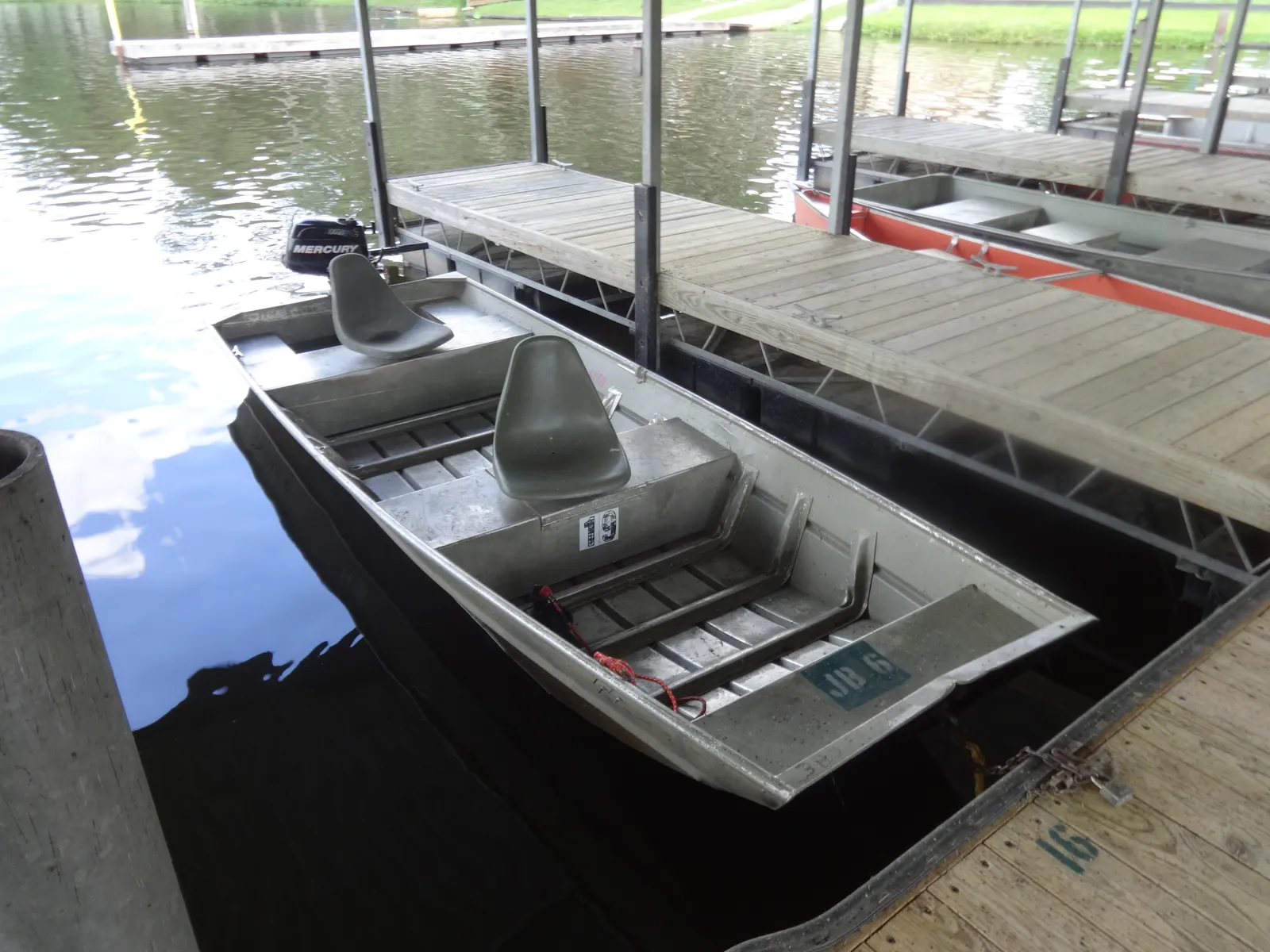 Jon Boat: Sizes, Prices, and How Much Motor Each One Can Take
A jon boat is a flat-bottomed aluminum fishing boat for calm, shallow water. Sizes from 10 to 17 ft, prices from $1,495, and the federal horsepower math.
Sources (12)
- Minn Kota, 2021 Battery Charts: battery selection, series and parallel wiring, breaker sizing (PDF, Rev. 8.17.2021)
- Interstate Batteries, Marine/RV Battery Maintenance: Maximizing Cycling Performance (PDF booklet)
- Interstate Batteries, SRM-27 marine deep-cycle battery specifications and suggested retail price (Nov 27, 2026)
- Trojan Battery, frequently asked questions (depth of discharge)
- OPTIMA Batteries (Jim McIlvaine), Flooded vs AGM vs Lithium Batteries (Jan 14, 2026)
Show all 12 sourcesShow fewer sources
- Battle Born Batteries, 100Ah 12V LiFePO4 Deep Cycle Battery (specifications and price, Nov 27, 2026)
- Dakota Lithium, 12V 100Ah LiFePO4 Deep Cycle Battery, Group 24 (specifications and price, Nov 27, 2026)
- Minn Kota help center, Lithium Battery Selection and Recommendations (brushed motors, continuous discharge)
- LiTime, 12V 100Ah Group 24 Deep Cycle Lithium Battery (specifications and price, Nov 27, 2026)
- Garmin, Force Pro Trolling Motor Owner's Manual (thrust and current-draw table, ISO 13342)
- Bass Pro Shops 1Source, How to Choose the Right Trolling Motor (Mar 9, 2026): the runtime formula
- Wired2Fish (Sam Hudson), Best Marine Lithium and Trolling Motor Batteries (updated Apr 9, 2026): the MillerTech 36V 50Ah