 By
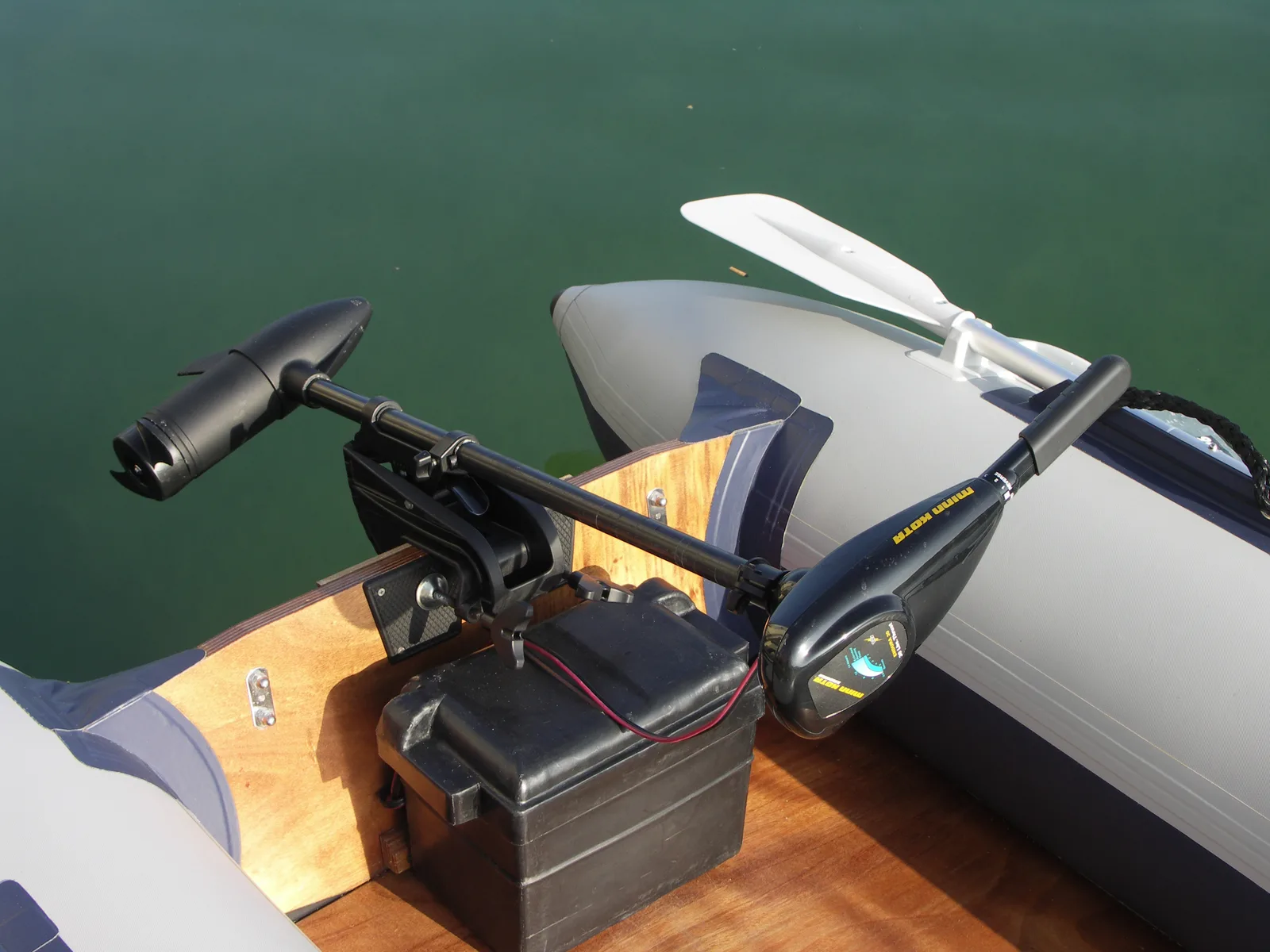
A trolling motor is a quiet electric motor that moves your boat slowly while you fish, and steers it. Size it by weight: at least 2 lb of thrust for every 100 lb of loaded boat, Minn Kota and MotorGuide both say. A small boat that weighs 1,500 lb with you and your gear in it needs a 30 lb, 12 volt motor. A loaded boat of 4,500 lb or more needs 101 to 112 lb on 36 volts. Get the thrust right, pick the right shaft length and mount, and the rest is features and money.
Flat out in reverse, Garmin’s Force Pro pushes 62 lb. Flat out forward, on about the same 55 amps, it pushes 115 lb.
Which trolling motor for your boat?
Start with the boat you have. These are the picks by kind of boat, worked out from the makers’ charts further down.
| Your boat | Mount | Thrust and volts |
|---|---|---|
| Jon boat, small aluminum boat, inflatable | transom, hand tiller | 30 to 55 lb, 12 V |
| 16 to 18 ft aluminum boat | bow, foot pedal or remote | 45 to 70 lb, 12 or 24 V |
| Kayak or canoe | the smallest that matches the craft | 30 lb is the chart’s floor |
| Fiberglass bass boat | bow, with a GPS anchor | 80 lb on 24 V or 101 to 112 lb on 36 V |
A jon boat, a small aluminum boat or an inflatable
Get a 12 volt transom mount with a hand tiller, 30 to 55 lb of thrust. Bass Pro calls transom motors “common on small boats and jon boats” and easier to install. A Minn Kota Endura C2 with 30 lb of thrust costs $169.99, and that’s all a jon boat of 1,500 lb loaded needs on Minn Kota’s chart. Skip a bow mount on a small tiller boat unless you cast from the front all day.
A 16 to 18 ft aluminum fishing boat
Go bow mount, 12 or 24 volt, 45 to 70 lb of thrust. A bow mount pulls the boat instead of pushing it, so it steers better, and a foot pedal leaves your hands for the rod. Bass Pro suggests 24 volts for long days or boats of 16 ft and up. For a GPS anchor on this boat, Minn Kota’s PowerDrive with a remote puts Spot-Lock on a 12 V motor.
A kayak or canoe
Go small. Minn Kota’s chart starts at 30 lb of thrust for any boat of 1,500 lb or less. A loaded kayak is a fraction of that. Bass Pro’s advice is a lighter motor with a lower thrust rating that matches the craft.
A fiberglass bass boat
Run a 24 or 36 volt bow mount with a GPS anchor. Minn Kota’s chart asks for 80 lb on 24 V at 4,000 lb loaded, and 101 to 112 lb on 36 V at 4,500 lb or more. Weigh your bass boat the way the chart means it: boat, outboard, fuel, batteries, people and gear. Under 4,500 lb, a 36 V motor is a step up, not a must, and the spare thrust helps in wind. This is where the $3,000 to $4,100 motors live.
Bow mount or transom mount?
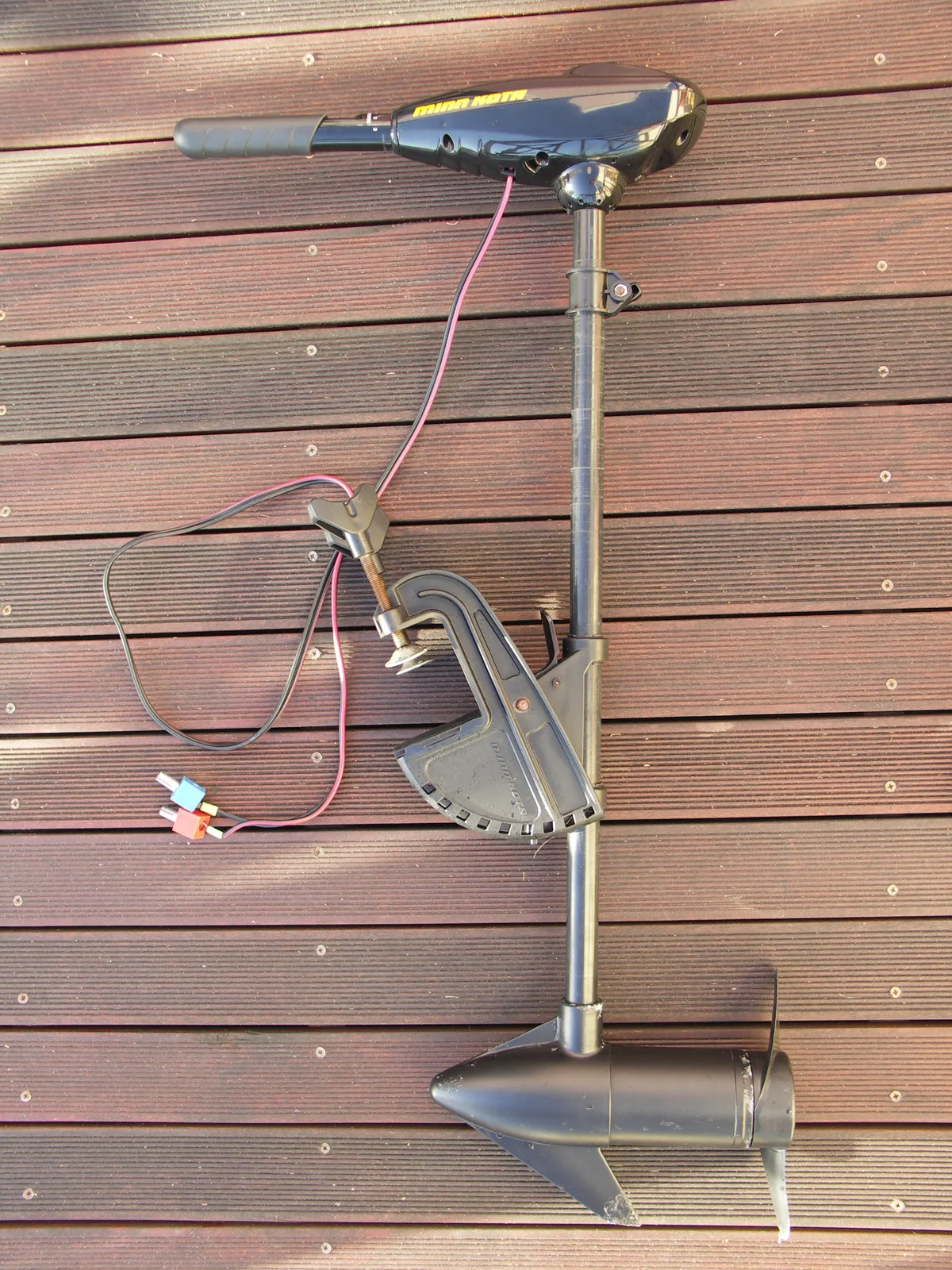 A 30 lb transom motor, top to bottom: tiller and head, shaft and clamp bracket, motor and prop. Photo: NJR ZA, Wikimedia Commons (public domain)
The mount decides how you fish more than any spec does: where you sit, and how you steer.
A transom mount clamps to the flat back wall of the boat, the transom, next to or instead of the outboard. You steer it with a tiller handle and turn the speed with a twist. It’s cheap, it holds on with a clamp, and it comes off for storage. The catch is that you sit at the back to drive it.
A bow mount bolts to the front deck and pulls the boat. Bass Pro lists it as “ideal for bass boats and open bow boats” with “better steering control” and often a foot pedal. You stand up front, cast, and steer with your foot or a remote. It’s the standard on bass boats.
Minn Kota also sells an engine mount that bolts to the outboard’s cavitation plate, the flat fin above the prop. The plate has to sit at least 13 in below the waterline and measure at least 4.5 in long and 6 in wide.
A bow mount is also the crappie angler’s tool for spider rigging: the motor creeps the boat along while the rods fan off the front.
Free PDF · Water temperature chart Which fish are biting at today's water temperature?
One reading, and the 16-page chart shows which of 26 fish are spawning, feeding hard or slowing down; for bass, crappie, bluegill and walleye, where they sit and what to throw. Every number sourced.
No card, nothing to buy, and the PDF is yours to keep. It's in your inbox a minute later. Then a few short emails and one a week on what's biting. Unsubscribe anytime. Privacy.
How much thrust do you need?
Thrust is the pull of the motor, rated in pounds. The rule from both big makers is the same: 2 lb of thrust for every 100 lb of fully loaded boat. Loaded means the boat plus the outboard, fuel, batteries, people and gear, the things Bass Pro lists. MotorGuide says to add 10 lb if you often fish strong current or wind.
| Loaded boat weight | Boat length up to | Minimum thrust and volts |
|---|---|---|
| 1,500 lb (680 kg) or less | 14 ft (4.3 m) | 30 lb, 12 V (1 battery) |
| 2,000 lb (907 kg) | 17 to 18 ft (5.2 to 5.5 m) | 40 to 45 lb, 12 V (1 battery) |
| 2,500 lb (1,134 kg) | 20 to 21 ft (6.1 to 6.4 m) | 50 to 55 lb, 12 V (1 battery) |
| 3,000 to 3,500 lb (1,361 to 1,588 kg) | 23 ft (7.0 m) | 70 lb, 24 V (2 batteries) |
| 4,000 lb (1,814 kg) | 25 ft (7.6 m) | 80 lb, 24 V (2 batteries) |
| 4,500 lb (2,041 kg) or more | over 25 ft (7.6 m) | 101 to 112 lb, 36 V (3 batteries) |
Minn Kota’s chart. The thrust figures are minimums.
Bass Pro’s own rule is a bit stronger: 5 lb of thrust for every 200 lb, which works out to 2.5 lb per 100. Use it if you fish big, windy water. The makers’ 2 lb is the floor, not the target.
Here’s how the rule plays out. A boat, motor and gear at 2,000 lb loaded needs 40 lb, and 50 lb if it’s windy where you fish. At 3,000 lb you’re at 60 lb by the rule, but Minn Kota’s chart already sends you to 70 lb on 24 V. When you land between two sizes, buy the bigger motor. More thrust doesn’t cost you battery when you don’t use it. “A larger motor does not need to run at full power all the time,” Bass Pro says. A higher-thrust motor runs more efficiently at lower speeds and handles wind and waves better, in Bass Pro’s words.
More thrust doesn’t make the boat faster, though. Speed comes from the prop’s pitch and the motor’s RPM, and Minn Kota says higher thrust “does not necessarily mean greater speed.” Its own worked example, a 4 in pitch prop at 1,540 RPM, pushes a small boat at about 5 mph.
12, 24 or 36 volts?
Volts set how many batteries you carry: one 12 volt battery for every 12 volts of motor. A 12 V motor runs on one battery, 24 V on two, 36 V on three, wired in series. Each step up adds one more battery to carry, charge and pay for.
The payoff of more volts is more thrust for fewer amps. Minn Kota’s own wiring table shows it. A 55 lb motor on 12 V can draw 50 amps. A 70 lb motor on 24 V draws 42, and a 112 lb motor on 36 V draws 52. Higher voltage systems “produce more thrust and often run more efficiently,” Bass Pro says.
| Motor | Max amp draw | Breaker |
|---|---|---|
| 30 lb, 12 V | 30 A | 50 A |
| 40 or 45 lb, 12 V | 42 A | 50 A |
| 50 or 55 lb, 12 V | 50 A | 60 A |
| 70 lb, 24 V | 42 A | 50 A |
| 80 lb, 24 V | 56 A | 60 A |
| 101 lb, 36 V | 46 A | 50 A |
| 112 lb, 36 V | 52 A | 60 A |
Minn Kota’s sizing table. The maximum draw only happens now and then, Minn Kota says, so don’t read it as the motor’s steady draw.
Wire the motor with a breaker. Coast Guard rules, as Minn Kota prints them, require a manually reset, trip-free breaker or fuse on every ungrounded wire, sized for the motor. Minn Kota’s 60 amp breaker sold for $44.99 in November 2026. For a run longer than 25 ft from the batteries, Minn Kota says to call a marine technician.
Which trolling motor battery to carry is a choice of its own: lead-acid or lithium, the group size, and how long a charge lasts at each speed. As a floor: a 30 lb motor at its 30 amp maximum empties a 100 Ah lithium battery in about 3.3 hours.
What shaft length do you need?
The shaft has to put the motor deep enough to bite. Minn Kota wants the center of the motor at least 12 in (30 cm) under the surface. Too short and, as Bass Pro puts it, “the prop comes out of the water and causes cavitation,” which costs thrust and makes noise. Too long and the motor may not stow.
Measure from the spot where the motor mounts straight down to the waterline. On a bow mount that’s the top of the front deck. On a transom mount it’s the top of the transom where the clamp sits.
| Mount to waterline | Bow mount shaft | Transom mount shaft |
|---|---|---|
| 0 to 10 in (0 to 25 cm) | 36 in | 30 in |
| 10 to 16 in (25 to 41 cm) | not listed | 36 in |
| 16 to 22 in (41 to 56 cm) | 42 to 45 in | 42 in |
| 22 to 28 in (56 to 71 cm) | 48 to 52 in | 55 in (Bass Pro) |
| 28 to 44 in (71 to 112 cm) | 54 to 72 in | ask the maker |
| 45 in (114 cm) or more | 87 in | ask the maker |
Minn Kota’s guide, with Bass Pro’s 55 in row for tall transoms. Minn Kota says to consult the factory over 22 in on a transom.
Two adjustments from Minn Kota. Add 5 in to your measurement if you fish rough water. Add 9 in for a bow mount with a hand tiller instead of a pedal. MotorGuide gives a quicker rule for bow mounts: your bow-to-waterline height plus 20 in is the shortest shaft that works.
Between two shaft sizes, take the longer one, Bass Pro says. A prop that comes out of the water in a chop cavitates, loses thrust and gets noisy.
Tiller, foot pedal or remote?
How you steer is the other half of the choice, and it follows the mount.
A hand tiller is a handle on the motor head. You steer by swinging it and set the speed with a twist grip or a knob. Transom motors work this way, and so do some bow mounts. Minn Kota adds 9 in of shaft for those.
A foot pedal puts on and off, speed and steering under your foot, so both hands stay on the rod and the net. That’s the big plus. The minus is that working your feet and hands at once gets hard in waves and wind.
A wireless remote steers the motor from a key fob or from a wireless pedal. It comes on high-end motors, and it lets you fish from anywhere in the boat.
| Control | You steer with | Best for |
|---|---|---|
| Hand tiller | your hand on the handle, from the back | jon boats, small boats, transom mounts |
| Foot pedal | your foot, standing up front | casting all day from the bow |
| Wireless remote | a fob or a wireless pedal | moving around the boat, GPS motors |
If you fish alone from the front deck, a pedal or remote earns its price. If you sit in the back of a jon boat, a tiller is all you need.
Is a GPS anchor worth it?
A GPS anchor holds the boat on one spot with no rope. Minn Kota calls it Spot-Lock, Garmin calls it anchor mode, and anglers use Spot-Lock for any brand. Garmin’s manual says it plainly: “The motor uses your GPS location to hold your position.” You nudge the held spot with the arrow keys on the remote.
It pays when you fish one spot over and over: a brush pile, a rock pile, an offshore point you found on your fish finder. On a pond or a small creek, a rope anchor does the job. The GPS anchor is the biggest jump on the price ladder. At Tackle Warehouse in November 2026, a plain Edge started at $549.99 and an Ultrex with Spot-Lock at $2,999.99.
You don’t need an Ultrex to get it. Minn Kota’s PowerDrive has Spot-Lock on its remote models, from $1,399.99 for a 12 V motor in Minn Kota’s own shop. The foot-pedal PowerDrive, from $829.99, doesn’t have it.
Two other features ride along on GPS motors. Heading hold keeps the boat pointed one way, and Garmin’s default setting can correct for drift from wind and current. Some top motors also carry sonar in the motor itself, the CHIRP and MEGA in the Ultrex names. Planning to run forward-facing sonar off the bow? Check that the motor works with your screen’s brand before you buy.
One setup step first: Garmin’s manual says you must calibrate the motor’s compass before any of the autopilot features work.
Tip: Calibrate the compass before you try the GPS anchor. Garmin’s anchor and heading hold won’t run without it.
Reverse, brushless, salt and weeds
Reverse is weak. Garmin’s manual says that in reverse the motor “runs louder, produces less thrust, and is less efficient”. Its own table shows how much: 62 lb backward against 115 lb forward, on about the same 55 amps. Garmin rates the motor at 100 lb on 36 V. Its table was run at 38.4 V, which is why full forward reads 115. The prop is built to push forward, so use reverse to back out of a tight spot, not to fight the wind. Garmin also says to use it sparingly, to spare the prop and the motor that drives it.
Brushless motors last longer on a charge. Bass Pro puts the runtime gain over brushed motors at “up to 20 to 50 percent”. They’re quieter too, and they cost more. That’s a retailer’s figure, not a maker’s test, so treat it as a range, not a promise.
Freshwater or saltwater: salt needs a salt motor. Saltwater motors have corrosion-resistant parts and better electrical sealing, Bass Pro says. “Using a freshwater motor in saltwater is not recommended.” If it ends up in salt anyway, rinse it well after every trip.
Weeds stop props. Some motors come with a weedless prop. Check the prop for wrapped weeds often, Bass Pro says, because a choked motor overheats.
What does a trolling motor cost?
Prices at Tackle Warehouse on November 27, 2026, and the PowerDrive at Minn Kota’s own shop the same day. They move with every sale, so check the day you buy.
| Kind | Example and thrust | Price |
|---|---|---|
| Transom, hand tiller | Minn Kota Endura C2, 30 to 50 lb, 12 V | $169.99 to $289.99 |
| Bow, foot pedal, no GPS | Minn Kota Edge, 45 to 70 lb, 12 or 24 V | $549.99 to $799.99 |
| Bow, remote, Spot-Lock | Minn Kota PowerDrive, 45 to 70 lb, 12 or 24 V | $1,399.99 to $1,849.99 |
| Bow, pedal, Spot-Lock | Minn Kota Ultrex CHIRP, 80 to 112 lb, 24 or 36 V | $2,999.99 to $3,199.99 |
| Bow, GPS, wireless pedal and remote | Garmin Force Pro, 80 lb (24 V) or 100 lb (36 V) | $3,799.99 to $3,899.99 |
| Bow, pedal, Spot-Lock, brushless | Minn Kota Ultrex Quest MEGA DI/SI | $3,899.99 to $4,099.99 |
Batteries come on top. For a 36 V bow mount that’s three batteries and a charger, so budget for them before you pick the motor.
The picks in detail
The Minn Kota Endura C2 is the jon-boat motor. It has a tiller, five speeds forward and three back, and 30 to 50 lb of thrust on one 12 V battery. The 30 lb with a 30 in shaft fits a low transom and a boat up to 1,500 lb loaded. Skip it on anything you want to drive from the front.
The Minn Kota Edge is the cheapest way to a bow mount with a foot pedal. The 45 and 55 lb run on 12 V, the 70 lb on 24 V, with 45 or 52 in shafts. It has no GPS anchor, so wind moves you off the spot. It suits a 16 to 18 ft aluminum boat on a budget.
The Minn Kota Ultrex CHIRP is the bass-boat motor with Spot-Lock. Pick the 36 V 112 lb for a fiberglass bass boat over 4,500 lb loaded, and the 24 V 80 lb for a lighter rig. The 52 in shaft fits a bow 22 to 28 in above the water on Minn Kota’s chart. It’s a foot-pedal motor, so it suits anglers who steer with their feet.
The number: A plain pedal bow mount starts at $549.99. The cheapest Ultrex with Spot-Lock is $2,999.99.
The Garmin Force Pro is a bow mount rated 100 lb on 36 V, with anchor mode and heading hold. You steer it with a wireless foot pedal or a remote. Its manual is the only one we found that prints thrust and current at every speed setting. The motor, mount and cables weigh 66.7 lb with the 50 in shaft, so check your bow can take it. Tackle Warehouse lists a 3-year warranty with a limited lifetime warranty on the shaft.
Before the first trip
Six things to do once the motor is on the boat, from the makers’ manuals.
- Put a breaker in the power line, sized from the table above. It’s a Coast Guard rule, not a suggestion.
- Give the motor its own deep-cycle battery. If a cranking battery starts your outboard, Minn Kota says to run the trolling motor off separate deep-cycle batteries.
- Don’t switch it on until the prop is in the water, Minn Kota says.
- Calibrate the compass on a GPS motor before you try the anchor or heading hold. Garmin’s autopilot features won’t run without it.
- Check the prop after every weedy stretch. Tangled weeds make the motor overheat, Bass Pro says.
- On lithium, keep a brushed Minn Kota at 85% speed or less. Minn Kota says full speed on lithium can damage motors built for lead-acid. Its brushless Quest motors are made for lithium.
How we chose
This page compares the makers’ own charts and manuals: Minn Kota’s thrust, shaft and wiring guides, MotorGuide’s catalog and Garmin’s Force Pro manual. Bass Pro’s buying guide fills in where it adds a row. Prices are Tackle Warehouse listings on November 27, 2026, and Minn Kota’s own shop for the PowerDrive. We did not test these motors on the water.
Minn Kota dates the first electric trolling motor for anglers to 1934, and its first flexible cable motor to 1935. O.G. Schmidt built the first one in Fargo, North Dakota, around the starter motor of a Ford Model A. He named his company after the Minnesota and North Dakota line: Minn Kota. For the boat that carries it, start at the fishing boats guide.

Free PDF · 16 pages
Stop guessing. Know what's biting before your first cast
A whole Saturday on the water with nothing to show for it. One reading tells you who's feeding.
The Water Temperature Fishing Chart. Take one water temperature reading, find it on the chart, and see which of 26 freshwater fish are spawning, feeding hard or slowing down.
- Where bass, crappie, bluegill and walleye sit, and what to throw. Trout: the reading where you stop.
- Why a 3 ft drop beats a cold front, and what to throw each day of the front
- The three thermometer mistakes that make a reading lie
The chart's numbers come from state fish and wildlife agencies and fisheries research: 64 sources, each listed on the site.
No card, nothing to buy. The PDF is in your inbox a minute later, one version for your phone and one to print, yours to keep. Then a few short emails and one a week on what's biting, with an unsubscribe link in every one. Privacy.
Related

Section guide
Fishing Boats: The Types, What They Cost, and How to Pick Your FirstFishing boats compared: jon, bass, aluminum deep-V, flats skiff, bay boat and center console, with real maker specs, draft and prices from $1,495.
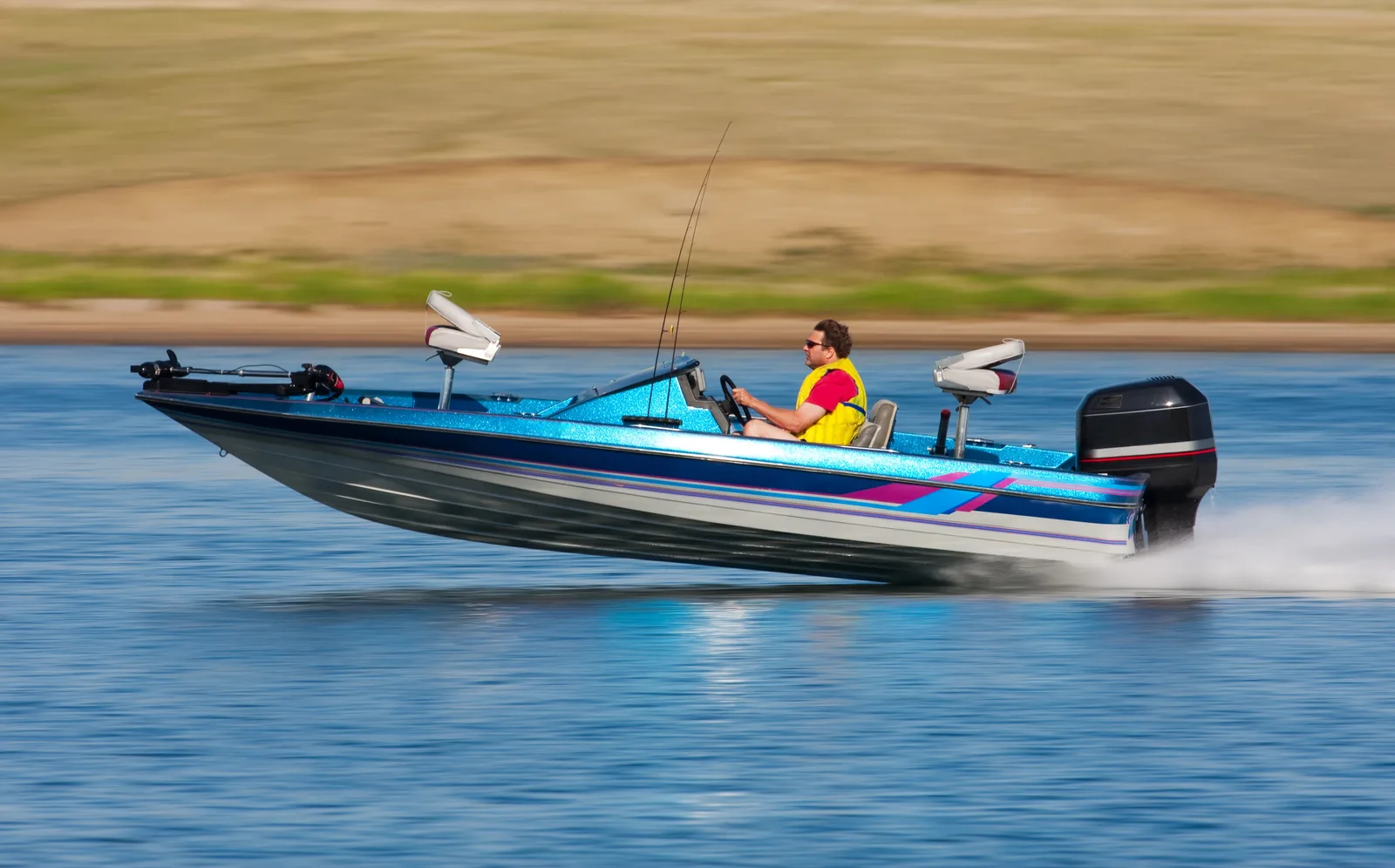 Bass Boat: What It Is, What It Costs and How Fast It Goes
A bass boat is a low, fast lake boat for two anglers. What a new one costs with motor and trailer, aluminum vs fiberglass, top speed and the rules.
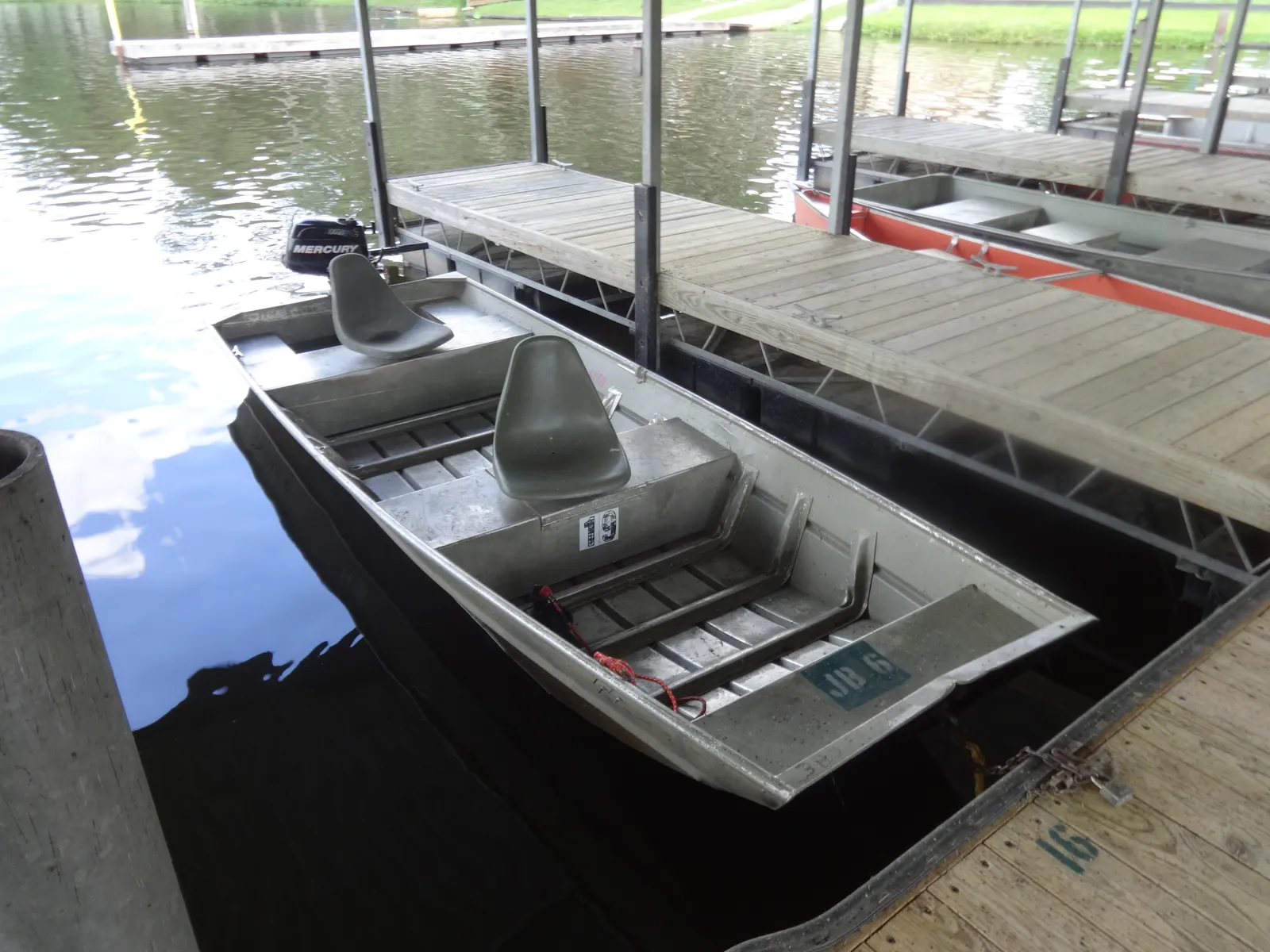 Jon Boat: Sizes, Prices, and How Much Motor Each One Can Take
A jon boat is a flat-bottomed aluminum fishing boat for calm, shallow water. Sizes from 10 to 17 ft, prices from $1,495, and the federal horsepower math.
Sources (15)
- Minn Kota, Motor Size: thrust, voltage and shaft length selection guide (PDF, Rev. 8.21.2020)
- Minn Kota, Battery and wiring installation: conductor gauge and circuit breaker sizing table (PDF, Rev. 8.17.2021)
- MotorGuide 2023 catalog, pages 6 and 7: thrust and shaft length guidance
- Garmin, Force Pro Trolling Motor Owner's Manual (anchor mode, heading hold, reverse thrust, thrust and current-draw table)
- Bass Pro Shops 1Source, How to Choose the Right Trolling Motor (Mar 9, 2026)
Show all 15 sourcesShow fewer sources
- Tackle Warehouse, Minn Kota Endura C2 transom mount trolling motors (prices, Nov 27, 2026)
- Tackle Warehouse, Minn Kota Edge bow mount trolling motor (prices, Nov 27, 2026)
- Tackle Warehouse, Minn Kota Ultrex CHIRP bow mount trolling motors (prices, Nov 27, 2026)
- Tackle Warehouse, Garmin Force Pro trolling motor (prices and rated thrust, Nov 27, 2026)
- Tackle Warehouse, trolling motors category (Ultrex Quest and MKR-19 breaker prices, Nov 27, 2026)
- Minn Kota, PowerDrive bow mount trolling motor (Spot-Lock on remote models, prices, Nov 27, 2026)
- Minn Kota help center, Calculate Speed and Determine Required Thrust
- Minn Kota help center, Lithium Battery Selection and Recommendations (brushed motors at 85% speed)
- Minn Kota, Minn Kota's Innovation Timeline (1934 and 1935)
- Wikipedia, Trolling motor (history: O.G. Schmidt, Fargo, the Ford Model A starter)