 By
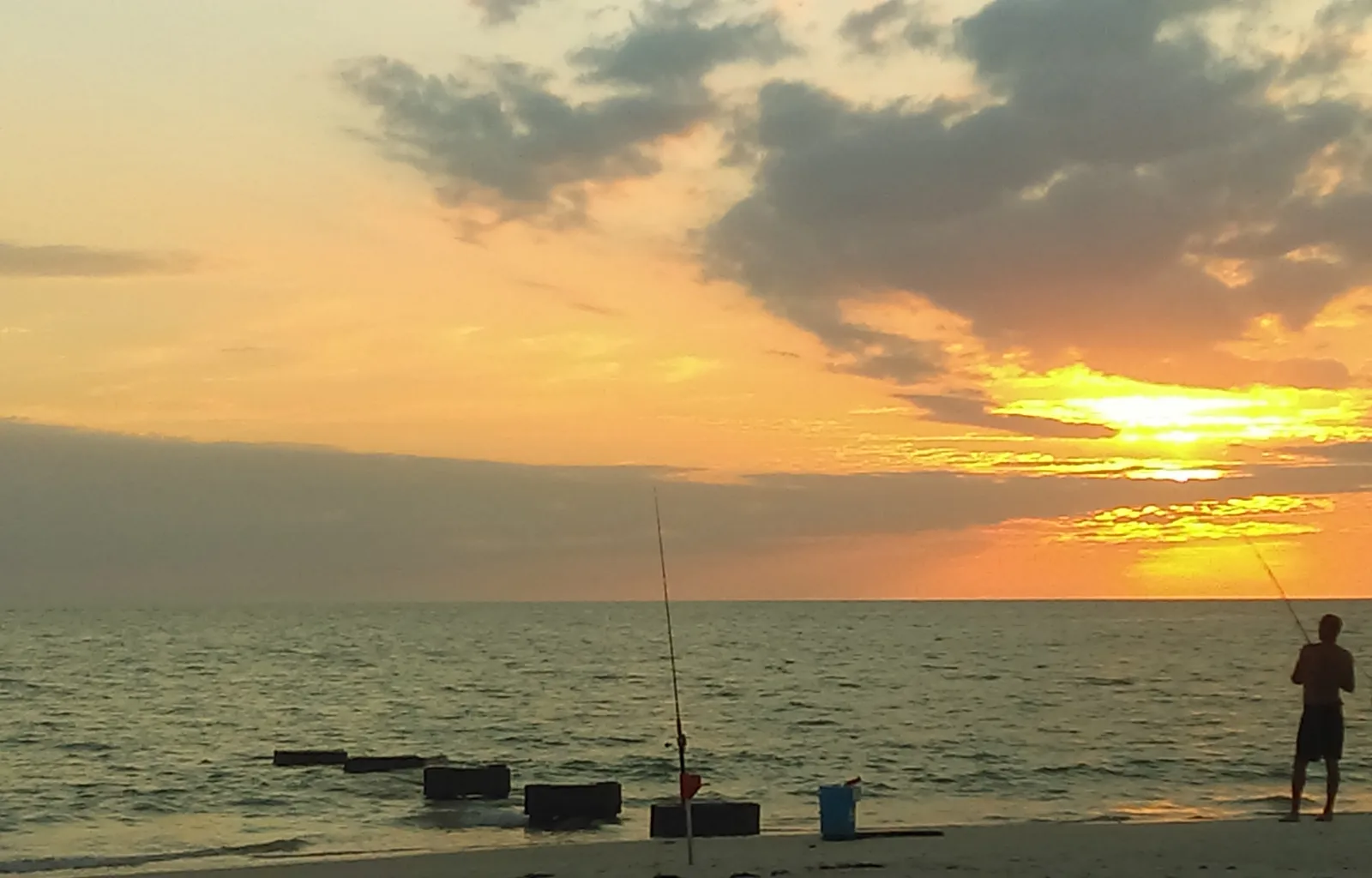
A Florida fishing license costs $17 a year for a resident and $47 for a nonresident. Saltwater and freshwater are separate licenses at that price each, so check which water you’ll fish before you buy. You need one from age 16, and you can buy it online, in the FWC’s app, by phone or at a tax collector’s office.
A Florida resident who only fishes salt water from the beach, a pier or a bridge can get a shoreline license that costs nothing.
That shoreline license is the best deal in Florida fishing. Snook, lobster and a kept tarpon each need something extra. For the lakes, the seasons and the rules by species, start at the Florida fishing page.
How much is a Florida fishing license in 2026?
Here is every fishing license the Florida Fish and Wildlife Conservation Commission (FWC) sells, from its own license pages as they stood on Nov. 27, 2026. Saltwater and freshwater cost the same. Florida has no fixed license year, and the Legislature sets the fees, so check the price at checkout.
| License | Resident | Nonresident |
|---|---|---|
| Saltwater, 1 year | $17 | $47 |
| Freshwater, 1 year | $17 | $47 |
| Saltwater or freshwater, 7 days | — | $30 |
| Saltwater or freshwater, 3 days | — | $17 |
| Saltwater or freshwater, 5 years | $79 | — |
| Saltwater shoreline only, 1 year | no cost | — |
| Saltwater + freshwater combo, 1 year | $32.50 | — |
| Saltwater + freshwater + hunting, 1 year | $48 | — |
| Gold Sportsman’s, 1 year (5 years) | $100 ($494) | — |
| Military Gold Sportsman’s, 1 year | $20 | — |
| Youth 8–15, saltwater or freshwater (optional) | $17 | — |
A dash means there’s no such license. Visitors can’t buy the 5-year license, the combos or the free shoreline license.
These prices already include the issuance fee the law allows. The shop that sells it may add 50 cents. Buy online and a handling fee of $2.25, or $1.75 plus 2.95 percent, comes on top. By phone it’s $6.25 plus 2.95 percent per person.
The Gold Sportsman’s is the everything license. It covers saltwater, freshwater and hunting, plus the snook and lobster permits and the hunting permits. Residents on active duty or retired from the military get it for $20.
Saltwater or freshwater fishing license: which do you need?
Pick by the fish, not by the water. FWC’s rule is that the license follows the species you’re after, wherever you catch it. Fishing a brackish river mouth for snook? That’s a saltwater license. Throwing for Florida bass in the same canal system? Freshwater.
One exception helps residents: a Florida resident with a freshwater license can fish for mullet in fresh water without a saltwater license.
The saltwater license covers more than fish. You need it for crabs, clams, lobster, scallops and marine plants too. It’s also needed to bring saltwater fish ashore in Florida, even when you caught them in federal water offshore.
If you fish both, a resident should buy the combo. It’s $32.50 against $34 for the two licenses apart.
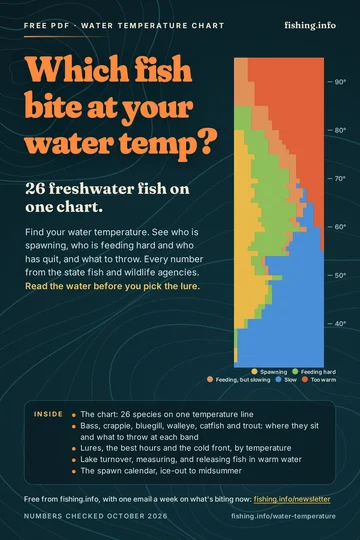
Free PDF · Water temperature chart Which fish are biting at today's water temperature?
One reading, and the 16-page chart shows which of 26 fish are spawning, feeding hard or slowing down; for bass, crappie, bluegill and walleye, where they sit and what to throw. Every number sourced.
No card, nothing to buy, and the PDF is yours to keep. It's in your inbox a minute later. Then a few short emails and one a week on what's biting. Unsubscribe anytime. Privacy.
Which license should you buy?
Start with where you’ll fish, then how long. This uses only FWC’s prices from the table above.
| Your trip | Buy this | Why |
|---|---|---|
| Resident, salt water from shore only | Shoreline license, no cost | covers beach, pier, bridge and jetty fishing |
| Resident, salt water from a boat | Saltwater, $17 | the shoreline license stops at the shore |
| Resident, both fresh and salt | Combo, $32.50 | $1.50 less than two licenses |
| Resident, sure to fish five straight years | 5-year, $79 | $6 less than five yearly licenses |
| Visitor, a long weekend | 3 days, $17 | the cheapest legal option |
| Visitor, a week | 7 days, $30 | $4 less than two 3-day licenses |
| Visitor, two trips or more | 1 year, $47 | two 7-day licenses cost $60 |
| Anyone, on a licensed charter | nothing | the charter’s license covers you |
The shoreline license has hard edges. It’s good from the shore or anything fixed to it, and wading counts as long as you can stand on the bottom. It’s not good on a boat, on a beach you reached by boat, or when you swim or dive. Want to hop on a friend’s boat? FWC itself says the regular $17 license “may be the best option for most anglers unless they feel certain they will fish only from shore.”
Visitors can’t get the shoreline license. A nonresident on a beach or pier needs a 3-day, 7-day or yearly saltwater license, unless a charter or a licensed pier covers them.
What do you need on top of the license?
Most anglers need nothing more. Some fish and some fishing need an add-on, and a few of these have no exemptions at all.
| Add-on | Cost | You need it for |
|---|---|---|
| Snook permit | $10 a year; residents can buy 5 years for $50 | keeping or trying to keep snook, from shore too |
| Spiny lobster permit | $5 a year; residents can buy 5 years for $25 | taking lobster |
| Tarpon tag | $51.50 a year | keeping a tarpon for a record, no exemptions |
| State Reef Fish Angler | no cost | certain reef fish from a private boat, 16 and up |
| Shore-based shark permit | no cost, after a free online course | sharks from shore, piers and bridges, 16 and up |
| Blue crab or stone crab trap registration | no cost | crabbing with traps, 16 and up |
The snook permit is the one people miss. It’s required even when you fish from shore on the free shoreline license. Check the season in your area before you buy it, because FWC gives no refund if snook are closed. The snook page has the regional seasons and the slot.
The tarpon tag isn’t for catching tarpon. Tarpon are catch and release, and any fish over 40 in (102 cm) must stay in the water. You can buy one tag a year, and only when you’re chasing a Florida or world record. It lets you keep that one fish. You buy it only at a county tax collector’s office.
The State Reef Fish Angler designation is free. You need it on a private boat to keep certain reef fish, the snappers among them. That goes for anglers 16 and older who are exempt from the license, too. The grouper page has the reef fish rules by coast.
The shore-based shark permit is free too, but you get it only after FWC’s online shark-fishing course. From 16, you need it to fish for sharks from the beach, a jetty, a bridge or a pier. Being exempt from the license doesn’t help here.
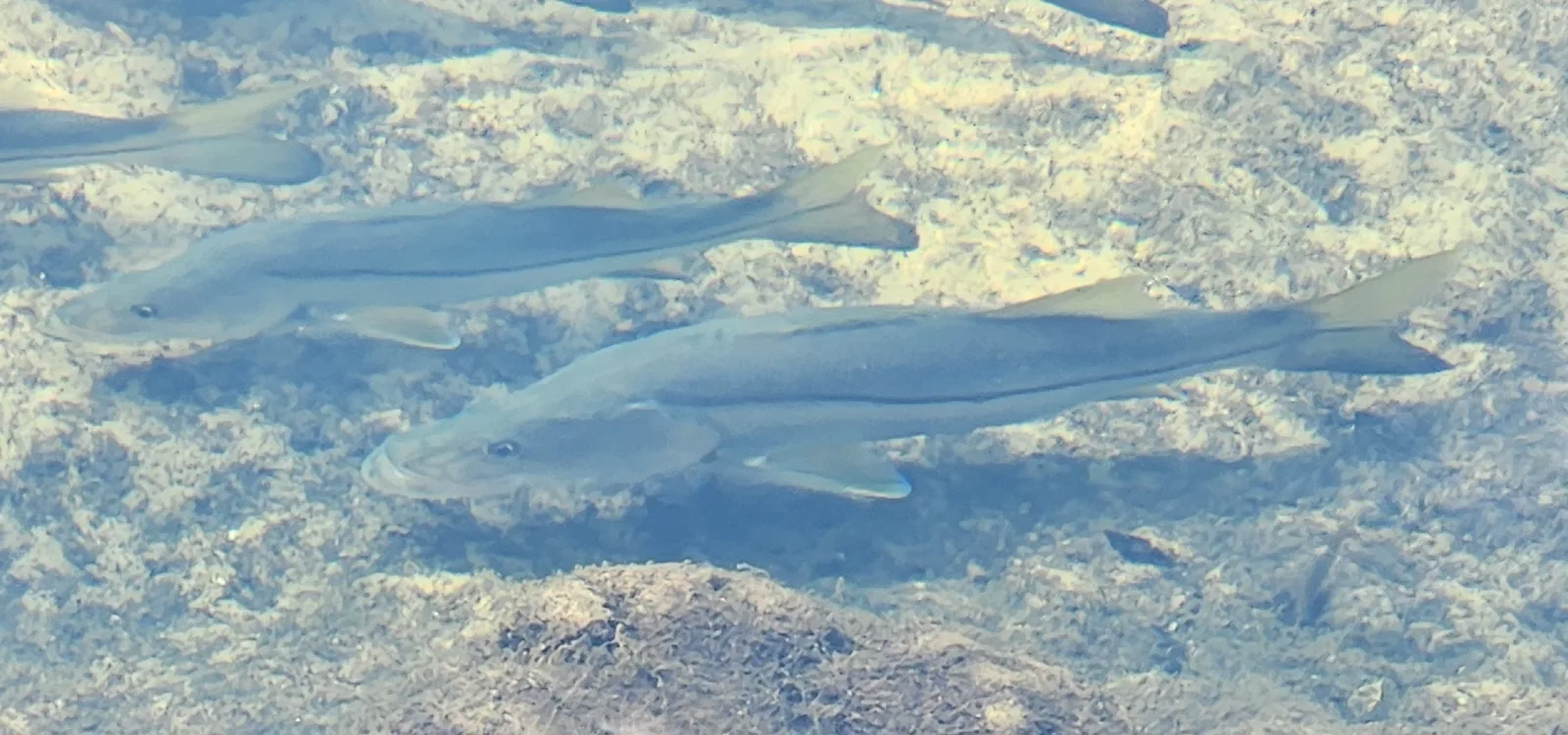 Snook in the shallows at Homosassa. Taking one needs a snook permit on top of the saltwater license. Photo: dande, iNaturalist (CC0)
Who needs a Florida fishing license?
Anyone 16 or older who fishes, unless an exemption below covers them. Casting a line counts, even if you release every fish. So does helping: baiting hooks for someone who’s fishing means you need a license too.
A rider on the boat who isn’t fishing needs nothing. That rider shouldn’t help either, so no netting fish, tying on lures or unhooking. And only licensed or exempt anglers count toward the boat’s bag. A non-fishing passenger doesn’t add a limit. The bag limit and possession limit are per person who’s legally fishing.
Signed up for the National Saltwater Angler Registry back home? That doesn’t replace a Florida license.
Who counts as a resident?
You’re a resident if you’ve declared Florida your only state of residence. You show that with a Florida driver license or ID card with a Florida address, and residency verified by the state’s highway safety department (DHSMV).
Active-duty military stationed in Florida count as residents, and so do their spouses and kids living with them, with orders. A resident without a Florida license or ID can use a current Florida voter registration card or a declaration of domicile. Under 18? A student ID from a Florida school works, or a parent’s proof with the parent there at the counter.
Who can fish without a license?
The list is long, and it’s different for salt and fresh water. These fish free in both:
- Kids under 16. They still follow every bag, size and gear rule, and may be asked for proof of age.
- Florida residents 65 and older, with proof of age and residency such as a Florida driver license.
- Florida residents certified totally and permanently disabled who hold the Resident Disabled Person’s Hunting and Fishing License.
- Florida residents who are clients of the Agency for Persons with Disabilities for developmental disabilities services. The agency gives you the proof to carry.
- Florida residents in the U.S. armed forces, stationed outside Florida and home on leave for 30 days or less, with orders.
- Someone watching or filming an angler without helping in any way.
Watch out: Being exempt from the license doesn’t exempt you from everything. The tarpon tag applies to everyone. From age 16, so do the State Reef Fish Angler designation, the shore-based shark permit and the crab trap registrations.
Who fishes free on fresh water only?
These anglers need no freshwater license:
- Residents fishing in their home county with live or natural bait on a pole or line with no reel. That’s the cane-pole rule, and it doesn’t apply in fish management areas.
- Anyone fishing a private fish pond of 20 acres or less, entirely on the owner’s land.
- Residents fishing on their own homestead in their county of residence, or on a spouse’s or minor child’s homestead.
- Georgia license holders on the St. Marys River or Lake Seminole, but not on the Florida creeks that feed them.
Who fishes free on salt water only?
These anglers need no saltwater license, and no snook or lobster permit either:
- Anglers on a for-hire boat (guide, charter, party boat) with a valid charter license.
- Anglers on a boat whose operator holds a recreational saltwater vessel license.
- Anglers on a pier that holds a saltwater pier license.
- Residents with a cane pole or hand line and natural bait in their home county. Nets, traps and spears don’t count.
- Residents eligible for food stamps, temporary cash assistance or Medicaid, fishing from land or a structure fixed to land. Carry ID and the benefit card. This one doesn’t cover boats or diving.
When are Florida’s free fishing days?
On license-free days, nobody needs a fishing license, resident or visitor. Every season, size and bag limit still applies. FWC sets them by a fixed rule, so here’s how they fall in 2027:
| Water | The rule | 2027, by that rule |
|---|---|---|
| Fresh | first full weekend in April | April 3–4 |
| Fresh | second full weekend in June | June 12–13 |
| Salt | first full weekend in June | June 5–6 |
| Salt | first Saturday in September | Sept. 4 |
| Salt | Saturday after Thanksgiving | Nov. 27 |
The saltwater days cover crabbing, lobstering and scalloping as well as fishing, from shore or a boat. You don’t need the snook or lobster permit on those days either.
FWC posts the rule, not the dates, so check its license-free days page before you go.
Is there a senior fishing license in Florida?
You don’t need one. A Florida resident 65 or older fishes free in salt and fresh water, and needs no snook or lobster permit either. Carry your Florida driver license or ID as proof. If you’d rather carry a license, the Resident 65+ Hunt/Fish Certificate is free online or at a tax collector’s office.
The exemption has one gap: the tarpon tag. A senior who wants to keep a tarpon for a record still buys the $51.50 tag.
At 64, there’s a bridge year. The Silver Sportsman’s 64+ license costs $13.50 a year, or $61.50 for five, and covers freshwater fishing and hunting. It doesn’t include saltwater.
What does a lifetime license cost?
Florida residents can buy a lifetime saltwater or freshwater license. The saltwater lifetime license also covers the snook and lobster permits. The price depends on age when you buy:
| Lifetime license | Age 4 or younger | Ages 5–12 | 13 and older |
|---|---|---|---|
| Saltwater or freshwater | $126.50 | $226.50 | $301.50 |
| Gold Sportsman’s | $401.50 | $701.50 | $1,001.50 |
For an adult, the $301.50 saltwater lifetime license costs the same as about 18 years of $17 licenses. Every lifetime license comes with a plastic card.
Where do you buy a Florida fishing license?
You have four ways to buy:
- Online at GoOutdoorsFlorida.com, FWC’s authorized online seller.
- In the Fish|Hunt FL app for Apple and Android. It buys, renews and stores your licenses and permits.
- In person at a license agent (Walmart, sporting goods stores and bait shops sell them, FOX 13 reported) or a county tax collector’s office. Tax collectors are the only place to buy a tarpon tag.
- By phone at 888-FISH-FLORIDA (888-347-4356).
Have your Social Security number ready. Florida law asks every applicant for a recreational license for it.
Visitors can buy the 3-day and 7-day licenses online again. FWC pulled them from online sales in November 2025 and brought them back on May 21, 2026, FOX 13 reported. If the site won’t sell you one, any license agent or tax collector will.
How do you carry it?
A license synced to the Fish|Hunt FL app counts as having it on you. You can also print it from GoOutdoorsFlorida.com, and reprints there cost nothing. An agent or tax collector reprints one for a fee. A plastic hard card costs extra and holds up to seven licenses or permits.
Good to know: All sales are final. Check the start date and the license type before you pay, because FWC doesn’t refund license or permit fees.
How long is a Florida fishing license good for?
A yearly license is good for one year from the start date you pick. For most licenses you can set that start date up to 90 days after you buy. So you can buy in December for a trip in February and not lose two months.
The 5-year license runs five years from its start date, and the visitor licenses three or seven days. A lifetime license stays good for life, even if you move out of Florida. There’s no single renewal day, so check the app or your GoOutdoorsFlorida account before a trip.
Where the money goes
State law sends fishing license money to the FWC, and it can’t be diverted. Only the tax collector’s $1 fee, the agent’s 50 cents and the processing surcharges go elsewhere. That’s why FWC asks even exempt anglers to buy one.
Once you’re legal, check the water you’ll fish: Florida’s bass lakes and saltwater seasons change by region. The fishing license by state page lines up Florida’s fee against other states’.
Quick answers
How much is a Florida fishing license for a nonresident? $47 for a year, $30 for 7 days or $17 for 3 days. Saltwater and freshwater are separate licenses at those prices each.
Do I need a fishing license to fish from a pier in Florida? Not on a pier that holds a saltwater pier license. On any other pier, a resident needs at least the free shoreline license and a visitor a saltwater license.
Do kids need a fishing license in Florida? No, not under 16. Resident kids 8 to 15 can buy an optional $17 youth license that stays good until their 17th birthday.
Do I need a license on a fishing charter in Florida? No. A for-hire boat with a valid charter license covers everyone fishing on it, snook and lobster permits included.
Can tourists fish in Florida without a license? Yes, on a licensed charter or pier, or on a boat whose operator holds a vessel license. Also on a free fishing day, or under 16. Otherwise buy a nonresident license.
Does one Florida license cover salt and fresh water? No. They’re two licenses. A resident who fishes both saves with the $32.50 combo. A visitor buys each one separately.
Does a Georgia license work in Florida? Only on the St. Marys River and Lake Seminole, not on the Florida creeks that run into them.

Free PDF · 16 pages
Stop guessing. Know what's biting before your first cast
A whole Saturday on the water with nothing to show for it. One reading tells you who's feeding.
The Water Temperature Fishing Chart. Take one water temperature reading, find it on the chart, and see which of 26 freshwater fish are spawning, feeding hard or slowing down.
- Where bass, crappie, bluegill and walleye sit, and what to throw. Trout: the reading where you stop.
- Why a 3 ft drop beats a cold front, and what to throw each day of the front
- The three thermometer mistakes that make a reading lie
The chart's numbers come from state fish and wildlife agencies and fisheries research: 64 sources, each listed on the site.
No card, nothing to buy. The PDF is in your inbox a minute later, one version for your phone and one to print, yours to keep. Then a few short emails and one a week on what's biting, with an unsubscribe link in every one. Privacy.
Related
Section guide
Florida Fishing: Licenses, Regulations and Where to FishFlorida fishing in one place: the $17 licenses, the freshwater limits, FWC's top bass lakes for 2026, and the snook, lobster and snapper rules.
Sources (12)
- FWC, Recreational Saltwater Licenses & Permits
- FWC, Recreational Freshwater Licenses & Permits
- FWC, What Exemptions May Apply?
- FWC, License-Free Fishing Days
- FWC, Lifetime Licenses
Show all 12 sourcesShow fewer sources
- FWC, How to Order
- FWC, FAQs: Recreational Licenses
- FWC, Saltwater Shoreline Fishing Information
- FWC, What qualifies as Florida residency?
- FWC, Tarpon
- FWC, Freshwater Fishing Regulations
- FOX 13 Tampa Bay, FWC brings back online sales for non-resident, short-term fishing licenses ahead of holiday weekend (May 20, 2026)