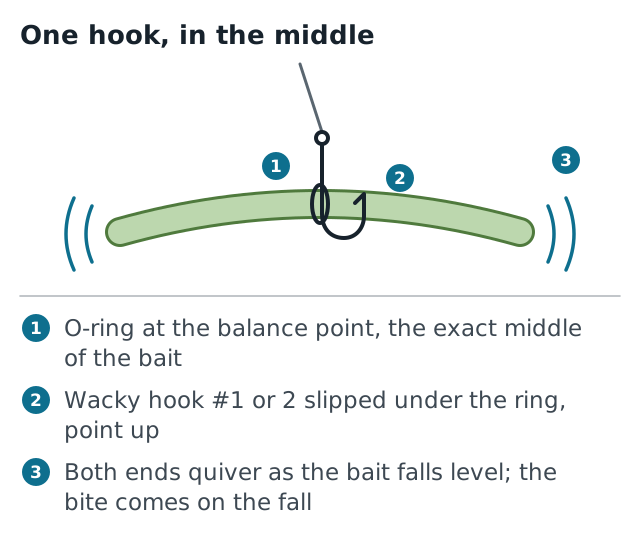
A wacky rig is a soft plastic stick bait hooked once, straight through its middle, so it hangs from the hook like a seesaw and both ends quiver as it falls. That fall is the whole reason it works. A 5 in Senko rigged wacky sinks slowly and level with a shimmy at each end, and bass that will not touch a moving bait eat it on the drop. Jason Sealock of Wired2Fish rigs the modern version: a No. 2 Neko hook slipped under an O-ring at the bait’s middle, weightless for shallow spawning bass and weighted for depth.
Hook the worm in the middle and do nothing. The fall is the retrieve, and the bite is on the fall.
When does a wacky rig work best?
The wacky rig is a shallow, clear-water target rig. Its season runs from the first bed to the end of the post-spawn. On the water-temperature table for bass, that is the spawn band from about 60 °F (16 °C), when largemouth sit on beds in 2–8 ft (0.6–2.4 m) and will not chase. Then comes the prime band after it, when they hang on dock edges, laydowns and grass edges in the shade.
It was built for a bass that can see it from a distance, which makes it the rig for pressured lakes and for the bank angler. The largemouth bass page has the bed behavior, and the when do bass spawn page the calendar.
What do you need?
- A soft stick bait, 4–5 in (10–13 cm): the Gary Yamamoto Senko is the original, and every maker sells a version (the bait table below). Green pumpkin and watermelon in clear water, black-blue in stained.
- A wacky hook: a No. 1 to 1/0 short-shank, wide-gap hook on light wire, sold as a wacky, Neko or finesse wide-gap hook. Field & Stream calls 1/0 “a good all-around size”; Sealock fishes a No. 2. A weed guard for docks and brush.
- O-rings sized for the bait, and the tube tool or spreader pliers that stretch them over it.
- For weight: 1/32–3/32 oz (0.9–2.7 g) nail weights, or a wacky jig head with the hook molded in, 1/32–3/16 oz (0.9–5.3 g) in Owner’s range.
- A 7 ft (2.1 m) light or medium-light spinning rod, a 2500 reel and 10–15 lb braid to a fluorocarbon leader.
Free card: what 26 species do at your water temperature
Plus one email a week on what's biting now. No sales pitches. Privacy.
How do you rig it, step by step?
- Slide an O-ring onto the tube tool, push the bait into the tube to its middle, and roll the ring off onto the bait. Spreader pliers open the ring instead.
- Find the balance point. The ring goes at the exact middle, or a fraction toward the head on a Senko, so the bait hangs level.
- Slip the hook under the ring, point up. Sealock goes “into the plastic just a small bit” to lock it in place. The ring takes the strain, and the bait survives fish after fish.
- Or hook through the plastic if you have no rings: straight through the middle, point exposed. A jumping bass flings the worm off the hook, so expect to lose a bait a fish.
- Add weight if needed: a nail weight in one end for a nose-down fall, a small wacky weight clipped to the hook bend to keep the fall level, or a wacky jig head in place of the plain hook.
- Check it falls flat on a short cast. A crooked bait spins and twists the line.
How do you fish it?
Cast or pitch past the target, let the bait fall on a semi-slack line, and watch the line where it enters the water. A tick, a twitch or the line moving sideways is a fish. A bait that stops falling too early has been eaten. Nothing pulls on the bait during the fall; in Bassmaster’s dock method the reel is not even engaged.
Only when the bait reaches bottom untouched does the rod come in. Sealock gives it “3 short pops on semi-slack line”, then lets it settle. His reason is the crawfish: startled, it leaps off the bottom with its claws folded back, as the two ends of a stick worm fold behind the hook, then flares and floats back down. Lift, fall, lift, fall, two or three times, then reel in and cast again.
How do you set the hook?
The hookset is a lean, not a snap. Reel down until the line comes tight and pull into the fish, since “half the time you can just start reeling”, in Sealock’s words. Set too late and the fish has the Senko deep. Set once, and bass rarely throw a wacky rig: the worm slides up the line and leaves only a small weightless hook to lever against.
How do you skip it under docks?
The darkest corner of a dock is where the bass is, and the weightless wacky rig is the easiest bait to skip there. Bassmaster tells beginners to learn skipping with it.
- Set up for it. Spinning tackle with a fast tip and the backbone to pull a fish out from under the dock: the dock setup in the tackle table below.
- Aim at the front edge. The ideal skip “first touches the water at the front edge of your target”, so it still has momentum to carry far under the cover.
- Keep the backcast low and quick, sidearm, and come forward with a snap that ends with the rod tip pointed at the target. A lazy cast will not skip; this is throwing a flat stone.
- Keep the whole trajectory low and hard. The first casts will miss.
- Let it fall on a slack line with the bail open, lift and drop it a few times under the dock, then reel in and skip the next corner.
Which hook?
Seth Feider, the 2021 Elite Series Angler of the Year, names three things a wacky hook needs. The point must be sharp enough to set on a lean rather than a snap. The shank must be long enough to pin the fish. And the wire must be strong enough for “the fish of a lifetime” on light line. The early short, round wacky hooks lost fish, and Sealock finds they rotate and “skin hook”. The current ranges, from the maker pages:
| Hook | Sizes made | Weed guard | Pick it for |
|---|---|---|---|
| Gamakatsu Finesse Wide Gap | 4 to 6/0, 6 or 25 per pack | None; a weedless version has a nylon guard | The plain wacky hook, from $4.99; the maker’s own pick for wacky-rigging bass |
| Owner Wacky Hook (5172) | 4 to 2/0 | With or without | The sharp-angled bend seats the worm in a saddle so it cannot slide; the all-round choice |
| VMC Neko Hook | 4 to 1/0, 6 or 25 per pack | Optional | Sealock’s No. 2: the offset bend gives a straight pull and sticks fish |
| VMC WK Wacky | 4 to 4/0, 6 or 25 per pack | None | Round shape, turned-down closed eye; 25 for $12.49 |
| Gamakatsu G-Finesse Weedless Wacky | 2 to 4/0, 4 per pack | Thin titanium wire molded into the shank | Docks, laydowns and brush; from $14.49 |
| Owner Wacky Jig Head (5154) | 1/32, 1/16, 1/8, 3/16 oz heads | Yes | The weighted version with a V-bend saddle; 4 for $7.50 |
Feider fishes the plain hook most of the time and switches to the weedless one “around brush or wood”. In grass he keeps the plain hook and rips it free. Burying the point of a plain hook in the plastic to make it weedless costs hook-ups, Sealock warns: buy the guard, not the buried point. The hooks hub covers the shapes and wire gauges.
Weightless or weighted?
| Weightless | Nail weight (1/32–3/32 oz) | Wacky jig head (1/32–3/16 oz) | |
|---|---|---|---|
| Depth | 1–6 ft (0.3–2 m) | 6–15 ft (2–5 m) | 6–15 ft (2–5 m) |
| Fall | Slow, level, maximum shimmy | Faster, nose down; stands on the bottom | Fast, level, hook rides up |
| When | Spawn, post-spawn, docks, calm water, pressured fish | Wind, points, fish on the bottom | Deep docks, bluffs, current, summer |
| Where | Beds, dock edges, laydowns, grass edges | Rock, ledges, main-lake points | Deep structure, rock |
| Skipping | Best | Good | Poor |
Weightless is the rig most anglers mean by wacky: pitched to a bed, skipped under a dock, dropped beside a laydown, and left to fall on a slack line. Weight is for fish the weightless bait cannot reach, and for wind. Sealock adds that the extra speed makes the ends “flap and shimmy more on the fall”, so a weighted wacky is not just deeper but louder. A nail weight in the nose makes a different rig with its own name.
What is a Neko rig?
Sealock’s definition is the shortest: “a Neko rig is simply nose weighted wacky rig.” Push a 1/32–3/32 oz (0.9–2.7 g) nail weight into one end of the same bait on the same O-ring and hook. It falls nose-first, stands on the bottom and quivers upright when you shake the rod tip. Gamakatsu’s tungsten nail weights come in 1/16, 3/32 and 1/8 oz with a wire keeper that grips the plastic.
Feider chooses between the two by depth. The wacky rig is for a specific target or water 5 ft (1.5 m) or shallower, where “the initial fall is what I am looking for”. The Neko rig is for a main-lake point or anything deeper than 7 ft (2.1 m).
Its finesse cousin on a jig head is the Ned rig, which swims a shorter, buoyant bait just off the bottom instead of standing a worm on it. The drop shot suspends a bait where the Neko stands it, and the shaky head drags a finesse worm.
Which baits besides the Senko?
The Senko is the softest and saltiest stick bait and shimmies hardest; it also tears soonest. The copies trade a little action for price and durability, and all of them fish the same way on the same O-ring. The soft plastics hub covers the wider family.
| Bait | Sizes | Pack and price | What it brings |
|---|---|---|---|
| Yamamoto Senko | 4 and 5 in (10 and 13 cm) the wacky sizes; 3–7 in made | 10 for $7.99 | The most salt and the fastest shimmy; the 4 in is Yamamoto’s pick for gin-clear water |
| YUM Dinger | 3–6 in (8–15 cm) | 4 in: 10 for $3.99; 5 in: 8 for $3.99 | Tougher plastic at half the price; the bait to learn on |
| Strike King Ocho | 4–7 in (10–18 cm) | 10, 8, 6 or 6 by size, $4.89 | Eight flat sides, coffee-scented bag; skips and pitches well |
| Zoom Trick Worm | 6.5 in (16.5 cm) | Sold by the maker | A slim floating worm; a longer, thinner profile for fish that have seen every Senko |
The 4 in (10 cm) is the size for smallmouth and for gin-clear water. There the smaller, slower profile draws the follower that turns away from a 5 in. Yamamoto hands it to beginners because it is easier to cast. Smallmouth take the 4 in on gravel beds and the Neko rig on the rock after.
The Trick Worm is Zoom’s “original floating worm” (the Zoom baits page covers that line). The Senko page has the six rigs, the colors by water clarity and the comparison with the copies.
Which rod, reel and line?
| Setup | Rod and reel | Line | Best for |
|---|---|---|---|
| Spinning, the default (Yamamoto) | 7 ft (2.1 m) light or medium-light, 2500 reel | 10–15 lb braid to a 6–14 lb fluorocarbon leader, lighter in clearer water | Open water, the slow weightless fall, long casts |
| Casting (Sealock) | 6 ft 10 in to 7 ft (2.1 m) medium | 12 lb fluorocarbon straight through | Pitching to targets, a natural fall, fish around wood |
| Skipping docks (Bassmaster) | 7 ft 1 in (2.2 m) medium-heavy spinning, fast tip | 15 lb braid to a 5.5 ft (1.7 m) 15 lb fluorocarbon leader | Under docks and pontoons, pulling fish out |
The middle of the road for bass is the spinning setup with 10–15 lb braid and an 8–10 lb fluorocarbon leader. Sealock also fishes straight 8 lb fluorocarbon on spinning gear, which skips better than a braid-to-leader knot. The rods and line hubs cover the choices.
Wacky rig or Texas rig?
| Situation | Wacky | Texas | Why |
|---|---|---|---|
| Beds, docks, calm shallow water | Wacky | The slow, level fall in front of a fish that is not feeding | |
| Pressured, clear water | Wacky | Nothing looks more natural falling | |
| Grass, wood, brush | Texas | The exposed wacky hook snags; the buried Texas point does not | |
| Deeper than 8 ft (2.4 m) | Texas | The weight gets it there and keeps contact; or go Neko | |
| Wind and current | Texas | A weightless bait never reaches the bottom | |
| Covering water | Texas | The wacky rig is a target rig, one cast per spot | |
| Beginners | Wacky | Nothing to get wrong, and the bite is obvious |
Gary Yamamoto designed the Senko in the mid-1990s to fall level with a vibration on a weightless Texas rig, his own rig for it. The wacky rig is the other way to get the same fall, with both ends free. The two rigs share the bait and split the water between them. The Texas rig page has the weights and hooks for the cover side of the table, and the rigs hub sets the wacky rig beside the Carolina, Ned and drop-shot rigs.
Mistakes to avoid
- Hooking it off-center. The bait spins on the fall and twists the line. Find the balance point.
- Working it. Twitches, hops and swims take away the fall that gets the bite. Cast, fall, lift, fall, reel in.
- A heavy hook. Thick wire kills the shimmy; light wire, No. 1 to 1/0.
- No O-ring. A Senko costs 80 cents; hooked through the plastic it lasts one fish.
- Slack too slack, or set too hard. A bite on a pile of slack is never felt, and a jig hookset on 8 lb line is a lost fish. Watch the line, reel down and lean.
Free download
The water temperature card
Read your water temperature and the card tells you who is spawning, who is feeding and what to throw. 26 species, 16 pages, for your phone and the tackle box.
Plus one email a week on what's biting now. No sales pitches. Privacy.
Related
Section guide
Fishing Rigs: Texas, Carolina, Drop Shot, Ned and WackyFishing rigs explained: the Texas, Carolina, drop shot, Ned and wacky rigs, the weight for each depth, and which rig fits which cover and fish.
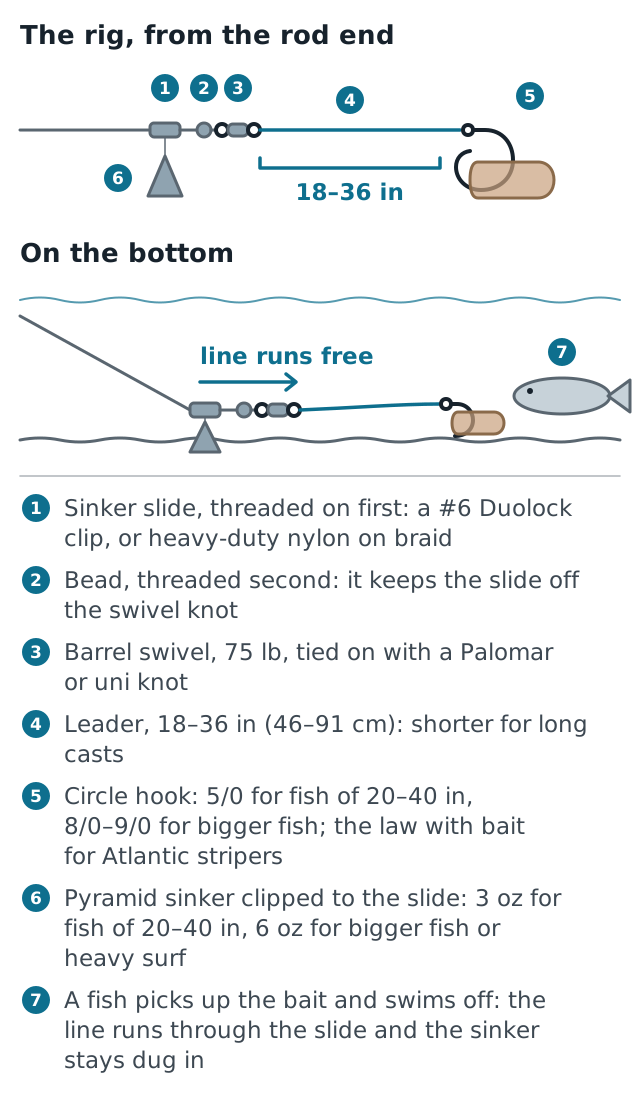 Fish Finder Rig: How to Tie It, Sinker Weights and Leader Length
How to tie a fish finder rig for the surf in seven steps, a size for every part, sinker weight by surf, leader length, and when a circle hook is the law.
 Drop Shot Rig: How to Tie It, Hook and Weight Sizes, How to Fish It
The drop shot rig step by step: a small hook tied 12–18 in above a 1/8–1/4 oz weight, the Palomar trick that stands the hook out, baits, tackle and retrieve.
 Ned Rig: How to Fish It, the Right Jig Head and Where It Came From
The Ned rig: a 2–4 in buoyant bait on a 1/20–1/5 oz mushroom head, the heads and baits in tables, six retrieves, the tackle, and the 2006 day it began.
- Carolina Rig: How to Tie It, Leader Length and When to Use It
How to tie a Carolina rig, every part with its size, the leader by season and clarity, five baits, the drag-and-sweep retrieve, and when a Texas rig is better.
 Texas Rig: How to Rig It, Which Weight and Hook, and How to Fish It
How to tie a Texas rig, which bullet weight and hook to use by depth and cover, how to fish it slowly on the bottom, and where the rig came from.
Sources
- Wired2Fish (Jason Sealock), the wacky rig: how to rig and fish guide
- Wired2Fish (Jason Sealock), wacky rig vs Neko rig: when to fish each
- Bassmaster, Gary Yamamoto on the Senko
- Bassmaster, How do you skip a dock?
- Omnia Fishing, Seth Feider on choosing the perfect hook for your Neko and wacky rigs
- Field & Stream, How to fish a wacky rig: a beginner's guide
- Gamakatsu, Finesse Wide Gap hook (sizes and price)
- Gamakatsu, G-Finesse Weedless Wacky hook (sizes and price)
- Gamakatsu, TG Trigger Nail Weight (sizes)
- VMC, WK Wacky hook (sizes and pack counts)
- Omnia Fishing, VMC Neko Hook (sizes and pack counts)
- Owner, Wacky Hook 5172 (sizes, weed guard options)
- Owner, Wacky Jig Head 5154 (weights and price)
- Yamamoto Baits, 4 in Senko 10pk (price and pack count)
- Discount Tackle, YUM Dinger (sizes, pack counts and price)
- TackleTour, Strike King Ocho review (sizes, pack counts and price)
- Zoom Bait Company, Trick Worm
- Wired2Fish (Jason Sealock), the Texas rig
- Bassmaster, Best of 2025 Elite Series top lures