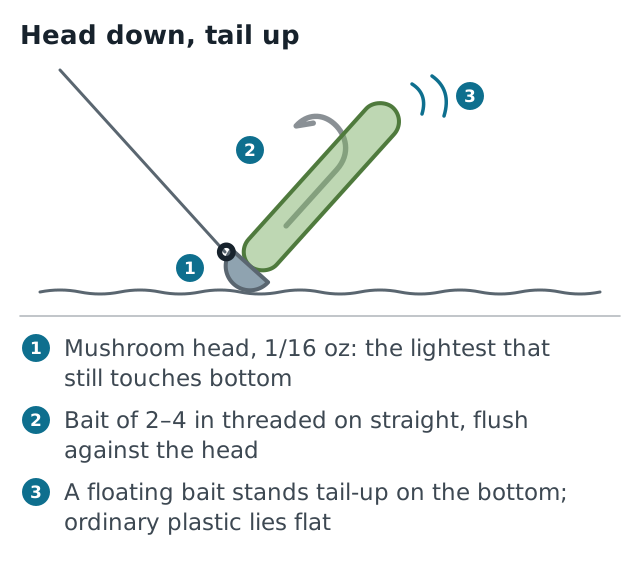
The Ned rig is a soft-plastic bait of two to four inches, threaded onto a light mushroom-shaped jig head and fished slowly along the bottom on spinning tackle. It catches bass when the water is cold, clear or pressured and the reaction baits are ignored, and it catches them in numbers. Its inventor, the Kansas outdoor writer Ned Kehde, calls the whole approach Midwest finesse. The name “Ned rig” came from a magazine editor, not from him.
It looks like nothing, and that is the point: a two-inch stub of plastic on a jig head the weight of a paperclip, fished slower than you think possible.
What it does, and when to throw it
All year, and best when other things do not. Clear water, high pressure, cold fronts, tournament Sundays: the conditions that empty the livewell are the Ned rig’s conditions.
In Kevin VanDam’s six seasons, as the bass hub sets them out, the Ned rig fills winter and early pre-spawn, under 55 °F (13 °C). Bass then sit on deep rock and want a small meal presented slowly. The bass water temperature table puts a light Ned rig in the coldest row, below 45 °F (7 °C), with ten-second pauses.
Smallmouth are the rig’s best customer. Crayfish are their first food, and a 2½ in craw or a green-pumpkin TRD on a 1/10 oz head, dragged over rock, is the closest imitation in the box. The smallmouth bass page has the depths by season, down to the 15–25 ft (5–8 m) summer humps where the Ned rig and the drop shot take over.
Spotted bass under docks eat it as readily, and so does anything that eats a small bait. Wired2Fish’s Jason Sealock lists walleye, crappie, sauger, bluegill, catfish, striped and white bass.
What you need
- A mushroom-head jig with a light-wire hook: 1/15 or 1/16 oz (1.8–1.9 g) is the standard, 1/10 oz (2.8 g) for wind and depth, 1/20 oz (1.4 g) for shallow calm water. Z-Man’s Finesse ShroomZ or any maker’s finesse mushroom head; the flat back lets the bait stand up.
- A bait of 2–4 in (5–10 cm): Z-Man’s Finesse TRD, the bait designed for the rig, a TRD CrawZ or Hula StickZ, or half a 5 in stick worm. ElaZtech floats, so the tail stands up; plastisol works but lies flat.
- A 6 ft 10 in to 7 ft 1 in (2.1–2.2 m) medium-light, extra-fast spinning rod, a 2500 reel, and 10 lb braid to a 6–8 lb fluorocarbon leader; the rods and line hubs explain the choices.
- Restraint. The rig fails when it is fished fast.
Free card: what 26 species do at your water temperature
Plus one email a week on what's biting now. No sales pitches. Privacy.
How do you rig it?
Thread the bait straight onto the hook so it sits flush against the mushroom head with no bend; a crooked bait spins. Z-Man’s welded wire keeper holds ElaZtech without glue. On a plain molded collar, a drop of superglue holds the bait for dozens of fish. Sealock adds one rule: match the hook wire to the line, light for light, stronger for heavier so it does not bend open.
The weight follows depth and wind, and the rule is the lightest head that still touches bottom.
| Conditions | Head | Bait | Why |
|---|---|---|---|
| Shallow (under 6 ft / 2 m), calm | 1/20–1/16 oz (1.4–1.8 g) | 2½ in TRD or half a stick worm | The slowest fall; the bait glides |
| 6–12 ft (2–4 m), light wind | 1/15–1/10 oz (1.8–2.8 g) | 2¾ in Finesse TRD | The standard |
| 12–20 ft (4–6 m), or wind, or current | 1/6–1/4 oz (4.7–7 g) | 3–4 in TRD, TRD CrawZ | Bottom contact, less bow in the line |
| Grass and wood | Weedless mushroom head with a wire guard | TRD, Hula StickZ | Comes through cover |
| Smallmouth on rock | 1/10 oz (2.8 g) | 2½–3 in, green pumpkin or craw colors | Crayfish imitation; heavier for the hop |
| Very clear, pressured | 1/20–1/15 oz (1.4–1.8 g) | 2 in, natural colors | Minimal presentation |
Kehde’s own choice has stayed the same for years: a 1/15 or 1/16 oz head with a green-pumpkin ZinkerZ cut to 2½ in, or a single 2¾ in Finesse TRD.
How do you fish it?
Kehde’s Finesse News Network, 478 anglers from San Diego to Charleston, fishes six retrieves, all slow, switching until one draws bites. The first has a date. On April 1, 2006, at Beaver Lake, Arkansas, the Japanese pro Shin Fukae showed Kehde a swim-glide-and-shake that kept the bait “swimming from six to 12 inches above the bottom”. Then Fukae won the tournament.
- Swim-glide-shake. Shake the rod tip as the rig sinks; reel slowly so the bait swims 6–12 in off the bottom; stop and let it pendulum down (the glide); resume. The standard, for bass up off the bottom in spring and fall.
- Drag. Rod low, a slow pull of a foot or two, reel up the slack, pause. For cold water, deep water and smallmouth on rock.
- Hop. Short lifts of the tip that jump the bait a few inches; it stands up on each landing. For fish on the bottom in shallow water.
- Straight swim. A slow steady retrieve just off the bottom, for bass that follow. Sealock’s dock trick: skip it under a dock, let it fall 10 ft, then reel it out briskly for the spotted bass there.
- Deadstick. Let it lie, ten seconds, twenty, more, tail up. For the coldest water and the most pressured fish.
- Stroll. Let the drift or the trolling motor move the bait along a drop-off while you shake the rod; covers deep structure.
What does a bite feel like?
Rarely a thump. Most bites, Sealock says, are a change in pressure: the bait feels heavier, or lighter when a fish swims toward you. The line ticks, moves sideways or goes slack. Reel until the rod loads and sweep; the light-wire hook needs no hookset.
Which jig head?
Z-Man makes the heads most anglers mean by “Ned head”; the numbers are from its product pages. Owner, VMC, Gamakatsu and TroKar make the same shapes.
| Head | Weights | Hook | Keeper | When |
|---|---|---|---|---|
| Finesse ShroomZ | 1/20, 1/15, 1/10, 1/6, 1/5 oz (1.4–5.7 g) | Light wire, size 1 and 2 | Welded wire | The standard, open bottom, 6 lb leader |
| Finesse ShroomZ Weedless | 1/10, 1/6, 1/5 oz (2.8–5.7 g) | Light wire | Welded wire, double wire guard | Brush, laydowns, dock cables |
| NedlockZ EWG | 1/15, 1/10, 1/6, 1/5 oz (1.9–5.7 g) | Heavy-duty No. 1 VMC extra-wide-gap | Molded | Texas-style weedless; skipping docks, grass edges |
| Power Finesse ShroomZ | 1/10, 1/6, 1/5 oz (2.8–5.7 g) | Medium wire, forged 3/0 | Welded wire | The 4 in Big TRD, heavier line, bigger fish |
| OG Mushroom | 1/32, 1/16, 3/32 oz (0.9–2.7 g) | Needle-point VMC, No. 4 and No. 2 | Molded double | The original Gopher shape; shallow, calm, panfish-light |
Sealock prefers the double wire guard around snags. The offset-hook head misses fish when a thick, spongy bait fills its small gap. For deep rock there is a sixth shape. Johnathan Dietz of Wired2Fish fishes a 1/10 oz mushroom head shallow, and a 1/4 oz (7 g) Z-Man Football NedZ when Lake Erie’s smallmouth sit in 40–50 ft (12–15 m). The jig heads page covers the other shapes.
Which bait?
All are ElaZtech, lengths from the maker. The TRD is the stick; the rest add legs, claws or a tail for fish that want movement at rest.
| Bait | Length | Shape | Use |
|---|---|---|---|
| Finesse TRD | 2¾ in (7 cm) | Plain stick, “The Real Deal” | The default; Z-Man calls it the best-selling softbait of the decade |
| TRD TicklerZ | 2¾ in (7 cm) | Dimpled body, four spread tentacles | When a plain stick draws followers, not bites |
| TRD BugZ | 2¾ in (7 cm) | Ribbed creature, oversized appendages | Open water on a ShroomZ, rock on a football head |
| TRD CrawZ | 2½ in (6.4 cm) | Crayfish with buoyant claws | Smallmouth and spotted bass on rock; the claws stand up at rest |
| Hula StickZ | 4 in (10 cm) | Stick with four tube-style tentacles | Bigger profile; Drew Reese’s design, shown at ICAST 2012 |
| Finesse ShadZ | 4 in (10 cm) | Slim shad body, thin worm tail | Baitfish imitation; also the drop shot and Damiki rig |
| Big TRD | 4 in (10 cm) | Upsized TRD | On the Power Finesse ShroomZ for heavier line and larger fish |
Half a 5 in Senko, YUM Dinger or ZinkerZ remains the cheapest Ned bait and the original. For color, use green pumpkin or a natural shad or craw pattern unless the water is badly stained. Wired2Fish’s 2026 pick is the Fuzzy TRD, the same body with silicone legs.
Why does ElaZtech float, and why does it matter?
Standard soft plastics are plastisol, a PVC compound that sinks and tears. ElaZtech is a different polymer, naturally buoyant and, in Z-Man’s words, good for “weeks or months of casting”. The company’s stated record is 255 fish on one TRD TicklerZ. Kehde found the Strike King Zeros that Kevin VanDam gave him in 2006 “extremely durable and buoyant”.
The buoyancy is the whole trick. The head sits flat and the bait rises from it like a crawfish in its defensive pose. It tips forward on a drag, stands again at each pause, and stays up and quivers on a deadstick. A plastisol bait on the same head lies on its side. The cost is a material so soft that a thick lead collar does not hold it, which is why Sealock fishes thin-wire heads with wire keepers.
What tackle does it need?
The rig weighs under a tenth of an ounce and the bites are pressure changes, so the tackle is built around feel. The numbers are the ones Wired2Fish and Discount Tackle agree on.
| Part | Spec | Why |
|---|---|---|
| Rod | 6 ft 10 in to 7 ft 1 in (2.1–2.2 m), medium-light, extra-fast | Loads a 1/15 oz head on the cast; the soft tip shows a pressure bite; the butt sets the hook on a sweep. Medium power for the 1/5 oz heads and the Big TRD |
| Reel | 2500 size spinning, 3000 for the heavier heads | Holds 10 lb braid; light enough to feel a 1/16 oz head through the handle |
| Main line | 10 lb braid (some use 12 lb) | No stretch, so the slack-line bite registers; thin, so the light head reaches the bottom; the braided line page covers diameters |
| Leader | 6–8 lb fluorocarbon, 6 lb for the lightest heads | Invisible in clear water, sinks, and still breaks before the hook straightens; see the leader page |
| Alternative | Straight 8 lb fluorocarbon | Sealock’s second choice where the braid-to-leader knot bothers you |
Wired2Fish’s rod shortlist is almost all one rod, the one in the table, from four makers. Dietz’s 7 ft 1 in medium with a 3000 reel and a 10 lb leader is the heavy end, for smallmouth in 40–50 ft.
Mistakes to avoid
- Too much weight. A 1/4 oz head turns it into a shaky head and loses the glide. Go lighter until you lose the bottom, then one step up.
- A stiff rod or heavy line. Both kill the action and the bite detection, and a medium-heavy rod straightens the light-wire hook on the sweep; medium-light, 6–8 lb leader.
- Fishing it fast. Every retrieve above is slower than feels natural.
- Plastisol baits on a stand-up head. They lie down. Use ElaZtech or accept the bait on its side.
- A thick lead collar with ElaZtech. The soft material will not stay on it; use a wire keeper or glue.
- Setting the hook hard. Light wire straightens; sweep and reel.
When something else wins
The drop shot suspends a bait above the bottom, where a Ned rig sits on it. The shaky head carries a bigger 4–7 in worm for the same slow bottom work. The wacky rig is the choice for spawning bass in shallow water, where a weightless stick worm falls slower than any jig head.
The Texas rig goes through cover a Ned rig cannot, but it is not the same bait. On a jig head the plastic glides, spirals and darts on the fall. Behind a bullet weight it falls straight, and it needs heavier tackle to drive the hook. All are on the rigs page. When bass are chasing, the chatterbait and crankbait hubs cover the moving baits.
Where did the Ned rig come from?
Midwest finesse is older than the name. Chuck Woods of Kansas City built the Beetle and Texas-rigged the first jig worms in the 1960s. Bill Ward tied the first marabou jig in 1957, and his family’s Bass Buster Lure Company sold them by the thousand. Guido Hibdon fished tubes when nobody else did, and critics called it “sissy fishing”. Ned Kehde has written about all of them since 1981. He took the mushroom head from Ron Lindner in the early 1980s because it “can drag over rock terrain and rarely get hung up”.
On October 12, 2006, he and Dick Bessey fished a northeastern Kansas reservoir for four hours. Their bait was a 5 in Strike King Zero cut to 2½ in, on a red 1/16 oz Gopher Mushroom Head Jig. They caught 109 largemouth bass, two wipers, a walleye and a channel catfish, on the same two baits from first cast to last.
Steve Quinn named the rig after Kehde in In-Fisherman in 2010. Before that, anglers called the stub of plastic “The Turd”; Table Rock Lake guides in 2014 called it “The Little Varmint”. Kehde cut Z-Man’s 5 in ZinkerZ in half. His friend Drew Reese, who fished the first Bassmaster Classic in 1971, persuaded Z-Man to mold a bait of that size: the Finesse TRD, “The Real Deal”, shown at ICAST in 2014. The Fuzzy TRD, with silicone legs, is its latest descendant.
Free download
The water temperature card
Read your water temperature and the card tells you who is spawning, who is feeding and what to throw. 26 species, 16 pages, for your phone and the tackle box.
Plus one email a week on what's biting now. No sales pitches. Privacy.
Related
Section guide
Fishing Rigs: Texas, Carolina, Drop Shot, Ned and WackyFishing rigs explained: the Texas, Carolina, drop shot, Ned and wacky rigs, the weight for each depth, and which rig fits which cover and fish.
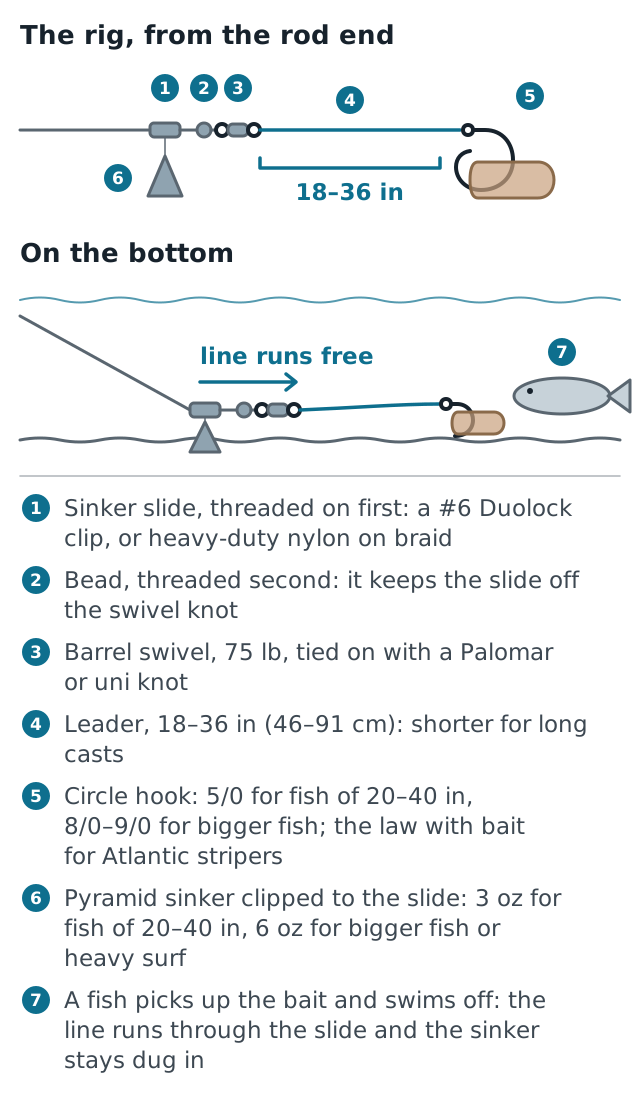 Fish Finder Rig: How to Tie It, Sinker Weights and Leader Length
How to tie a fish finder rig for the surf in seven steps, a size for every part, sinker weight by surf, leader length, and when a circle hook is the law.
 Wacky Rig: How to Rig It, and When It Beats a Texas Rig
The wacky rig hooks a stick bait through its middle so both ends quiver on the fall. The O-ring method, hook and line, weightless or weighted, when to use it.
 Drop Shot Rig: How to Tie It, Hook and Weight Sizes, How to Fish It
The drop shot rig step by step: a small hook tied 12–18 in above a 1/8–1/4 oz weight, the Palomar trick that stands the hook out, baits, tackle and retrieve.
- Carolina Rig: How to Tie It, Leader Length and When to Use It
How to tie a Carolina rig, every part with its size, the leader by season and clarity, five baits, the drag-and-sweep retrieve, and when a Texas rig is better.
 Texas Rig: How to Rig It, Which Weight and Hook, and How to Fish It
How to tie a Texas rig, which bullet weight and hook to use by depth and cover, how to fish it slowly on the bottom, and where the rig came from.
Sources
- In-Fisherman (Ned Kehde), A history of Midwest finesse fishing and the so-called Ned rig
- Discount Tackle, The Ned rig: a brief history and buyer's guide
- Wired2Fish (Jason Sealock), Ned rigs: the complete guide to Ned rig fishing
- Wired2Fish (Johnathan Dietz), 2 proven Ned rig jig heads and when to use them
- Wired2Fish (Sam Hudson), The best bass fishing lures for 2026 (Ned rig pick)
- Z-Man Fishing, The Z-Man difference (ElaZtech)
- Z-Man Fishing, Finesse ShroomZ jighead
- Z-Man Fishing, Finesse ShroomZ Weedless jighead
- Z-Man Fishing, TT Lures NedlockZ EWG jighead
- Z-Man Fishing, Power Finesse ShroomZ jighead
- Z-Man Fishing, OG Mushroom jigheads
- Z-Man Fishing, Finesse TRD
- Z-Man Fishing, TRD TicklerZ
- Z-Man Fishing, Hula StickZ
- Z-Man Fishing, TRD CrawZ
- Z-Man Fishing, TRD BugZ
- Z-Man Fishing, Finesse ShadZ
- Z-Man Fishing, Big TRD
- Bassmaster, KVD's 6-season bass guide