The Carolina rig separates the weight from the bait. An egg sinker and a bead ride on the main line above a swivel, and a leader of a foot to a yard runs from the swivel to a worm hook and a soft plastic, so that when the rig is dragged across the bottom the weight plows and the bait swims along behind it, free to rise and wander. That makes it the rig for covering water on points, flats, humps and ledges, and a fish-finder you work by hand: Wired2Fish’s guide calls it “the ultimate bass fishing search tool since the early 1980s”.
Shaw Grigsby calls the Carolina rig “the old ball and chain”: a heavy sinker that stays on the bottom and stirs up the muck and shells, and a bait that comes floating along behind it. The bass turns to the noise and finds the meal.
What you need
Six parts, each with a job; the sizes are the bass standards from Wired2Fish and the Bassmaster pros. The catfish version, the slip-sinker rig, uses the same pieces at twice the weight.
| Part | Size | Why that size |
|---|---|---|
| Weight | 1/2–3/4 oz (14–21 g) egg or barrel sinker; 1 oz (28 g) past 15 ft (4.6 m) or in wind; 1/4 oz (7 g) in 2 ft (0.6 m) of water | Heavy enough to stay on the bottom and report it; the egg shape pops over obstructions |
| Weight material | Lead is the standard; tungsten is about 25% smaller and louder on rock; brass is louder than lead | Tungsten transmits the bottom better but costs more and shatters glass beads |
| Bead | Glass or plastic with lead or brass; rubber, a metal disk or a magnetic bead with tungsten | Protects the knot from the sinker and clicks against it |
| Swivel | Barrel or rolling swivel, No. 10 to No. 6; Jacob Wheeler fishes a No. 4 | Large enough not to jam in the weight or the bead; stops line twist |
| Leader | 18–36 in (46–91 cm) of 12–15 lb fluorocarbon, one size under the main line | Lighter than the main line, so a snag costs a hook and not the rig |
| Hook | 3/0–5/0 offset or extra-wide-gap worm hook for creature baits and lizards; 1/0–2/0 for finesse worms | Offset holds a thin worm straight; the wide gap leaves room for a thick body to collapse on the set |
| Main line | 15–20 lb fluorocarbon, or 30 lb braid | Abrasion resistance for a rig that is dragged over rock all day |
Two details in that table decide whether the rig lasts the day. The bead: Jason Sealock’s Wired2Fish guide says tungsten weights “break the glass beads protecting your knot”, so a tungsten sinker gets a rubber or magnetic bead or a metal disk. The swivel: a tiny one wedges inside the sinker or the bead, hence Sealock’s No. 10 to No. 6. The hooks hub covers offset versus wide gap, and the soft plastics hub lists the bait families.
Weight follows depth and wind: Field & Stream runs from 1/4 oz in 2 ft of water to a full ounce in 25 ft (7.6 m) and more. If you cannot feel the bottom, go heavier; if you snag on every cast, go lighter. Feider pairs two 3/8 oz tungsten sinkers back to back so they clack on every drag; Kelly Jordon does the same, and his reason is blunt: “Noise is a huge factor in the amount of fish you catch.”
How to tie a Carolina rig, step by step
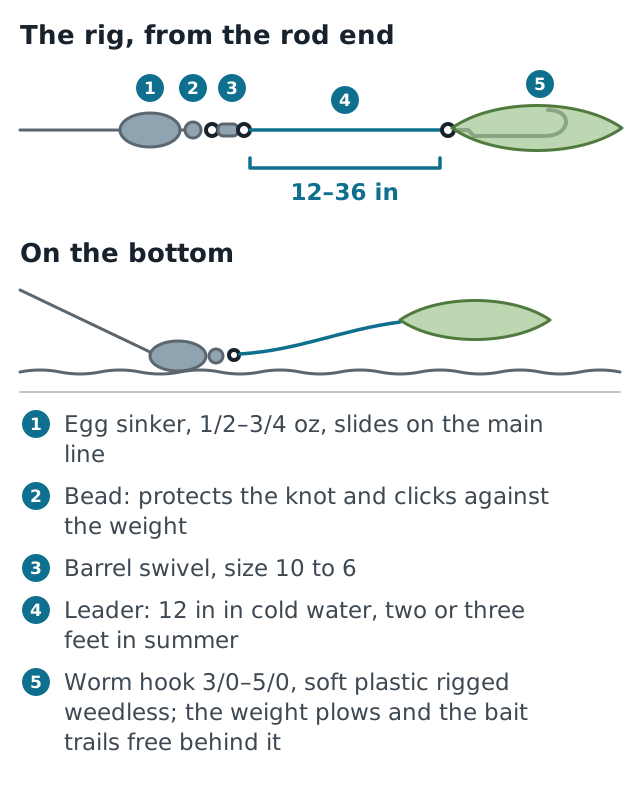
The parts in order from the rod end, and the rig on the bottom. Drawing: fishing.info.
- Thread the weight onto the main line first, then the bead, so the bead sits between the weight and the knot and takes the sinker’s hammering.
- Tie the main line to one eye of the swivel with a Palomar knot, wetted before it is pulled tight.
- Cut the leader to the length the water calls for, from the table below; 2 ft 6 in to 3 ft (76–91 cm) is the pros’ starting point, 18–24 in (46–61 cm) for a beginner.
- Tie the leader to the other eye of the swivel with the same knot.
- Tie the hook to the leader with a Palomar.
- Rig the plastic Texas-style: point into the nose, out 1/4 in (6 mm) down the side, bait slid up to the hook’s elbow, point buried back into the body so it hangs straight and weedless.
- Cast with a side-arm lob, the weight about 2 ft from the rod tip and the bait 4 or 5 ft behind you; a three-foot leader on a hard overhead cast wraps the main line.
Leader length and the seasons
The leader is the one setting that changes with the fish. Clark Reehm, second at the 2008 Elite Series event on Lake Amistad on a Carolina rig, calls 2 ft 6 in to 3 ft ideal: 3 ft in grass and clearer water, shorter as the cover gets heavier. Cody Bird uses 2 ft or less in deep lakes and timber, where a short leader hangs up less, and 3 to 4 ft in grass. Greg Vinson shortens to 12 in on a very shallow flat. Scott Rook’s rule for fussy fish: “the longest leader I can cast.”
| Condition | Leader | Weight | Bait |
|---|---|---|---|
| Cold water, under 55 °F (13 °C), fish tight to bottom | 12–18 in (30–46 cm) | 3/4 oz (21 g) | Finesse worm, small craw |
| Pre-spawn on points and staging flats, 48–60 °F (9–16 °C) | 18–24 in (46–61 cm) | 3/4 oz (21 g) | Lizard, creature bait |
| Post-spawn and summer, active fish, 65–85 °F (18–29 °C) | 24–36 in (61–91 cm) | 3/4–1 oz (21–28 g) | Fluke, floating worm, lizard |
| Deep ledges and humps, 15–25 ft (5–8 m) | 24 in (61 cm) | 1 oz (28 g) | Big worm, creature bait |
| Shallow flats, 3–8 ft (1–2.4 m) | 12–18 in (30–46 cm) | 1/2 oz (14 g) | Lizard, craw |
| Grass edges and clear water | 36–48 in (91–122 cm) | 3/4 oz (21 g) | Fluke, trick worm |
| Wind or current | Shorter, 12–18 in (30–46 cm) | One size heavier | Any |
Cold water is where the advice splits. The common rule, the first row above, is a short leader that keeps the bait right behind the sinker for fish that will not move far; Grigsby goes the other way, up to 4 ft in cold water and over submerged grass, so the bait hangs almost still above a lethargic fish. Try short first. A longer leader also sacrifices hook-setting power, Reehm says, which is why his rod is 7 ft 6 in. The temperature bands are Kevin VanDam’s, laid out on the bass water-temperature page, which puts the Carolina rig on deep breaks from 80 °F upward.
The baits
A creature bait is the natural Carolina-rig plastic: a big profile with appendages that wave as it glides behind the weight. Around grass and in clear water, straight baits do at least as well; Sealock writes that Senkos and Flukes have found him whole schools of bass in grass. Five that keep earning the spot, with the makers’ lengths:
| Bait | Length | When it earns the spot |
|---|---|---|
| Zoom Brush Hog | 6 in (15 cm) | The default creature bait; Wired2Fish’s first pick, flaps and arms move water behind the sinker |
| Zoom Lizard | 6 in (15 cm) | Pre-spawn on points and flats; Jay Yelas: “You can count on a lizard being the bait of choice during the pre-spawn” |
| Zoom Trick Worm | 6.5 in (16.5 cm) | The straight worm; Peter Thliveros’s one Carolina bait, which “will catch bass anywhere” |
| Zoom Super Fluke | 5.25 in (13 cm) | Clear water, grass edges and fall, when a swimming bait beats a crawling one |
| Strike King Rage Bug | 4 in (10 cm) | A compact creature with a slim body that slides through grass and brush; the downsize for pressured fish |
Yelas adds a 3 in “French fry” on a 1/0 hook for spotted bass in clear lakes. One fact changes how you fish all of them: most soft plastics sink, especially on a heavy hook, so the bait does not float a yard above the bottom the way the drawings suggest. Only air-injected worms and floating lizards and tubes genuinely hover; a Brush Hog glides low and settles when you pause.
How to fish it
Cast long, side-arm, in a fan across the point or flat, and let the weight pull the rig to the bottom. Then drag it: rod low and to the side, a slow sweep of two or three feet, pause, reel up the slack, sweep again. The reel never moves the bait; the rod does. The weight reports what it crosses, sand, gravel, rock, shell, the edge of grass, and soon a boulder and a stump feel different in your hand. When the weight wedges, lift the rod tip and give it a short, tight pop; Sealock says that frees it nine times out of ten.
Most bites are a heaviness or a slow pull rather than a thump, because the fish has the bait and not the weight. If you are unsure, hold the rig tight and feel for movement that is not yours. Grigsby’s rule for the next second is the one to remember: reel in slack until you feel the bass, because a fish often swims toward the boat with the bait. Then set with a long, hard, low sweep to the side, which takes up the slack and drives a hook that is a yard from the weight. In current, thin line holds the bait in place and heavy line sweeps it; shorten the leader and add weight.
Where it wins
The Carolina rig is a structure rig for the fish that have left the bank. Field & Stream puts its best work after the spawn, in more than 10 ft (3 m) of water, on flat points and ledges with clean bottoms, as largemouth bass move offshore in early summer. Strike King agrees: summer ledges and drop-offs, because the rig gets deep fast and stays deep. Bassmaster’s panel adds pre-spawn, when a lizard dragged across a staging point finds fish that are not yet aggressive, and fall, when the bass are on structure and not chasing bait on top. The grass edge is the overlooked spot: Rook threw to the bank at Guntersville and dragged a grass edge out to 7 ft (2 m). It also works colder than most anglers believe, Sealock writes, and Feider rates it for largemouth and smallmouth alike on new water.
Carolina rig or Texas rig?
| Question | Carolina rig | Texas rig |
|---|---|---|
| Cover | Open structure: points, flats, humps, ledges, scattered grass | Heavy cover: grass mats, brush, laydowns, docks |
| Speed | Faster; covers water on long casts and drags | Slower; one target at a time |
| Presentation | Bait glides and wanders behind a dragged weight | Bait falls with the weight, then hops or crawls |
| Depth | 5–25 ft (1.5–8 m) | Any, from 1 ft to punching 20 ft of grass |
| Bite | Heaviness, slow pull; long sweeping hookset | Tap or line jump; firm sweep |
| Finding fish | Yes, the weight reads the bottom | No, it is for fish you have found |
| Season | Pre-spawn, post-spawn, summer, fall | All year |
The honest summary: the Carolina rig finds and catches fish on open structure, and the Texas rig catches the fish you already know are in the cover. On a summer ledge the football jig covers the same bottom with a bigger, faster profile, and many anglers run one of each.
The rod, reel and line
The rod is long because the leader is. Sealock calls a 7 ft 6 in (2.29 m) medium-heavy with a fast tip the staple; Reehm wants 7 to 7 ft 6 in to move a lot of line on the set; Feider goes to 8 ft. Grigsby drops to a 7 ft 3 in heavy when the leader is 12 lb, so the set does not break it. The reel is fast, 7:1 or quicker (Vinson 7.1:1, Feider 8.1:1), because the job between the bite and the set is picking up slack; the rods hub explains why length and backbone matter more than price.
| Main line | Where | Leader |
|---|---|---|
| 15 lb fluorocarbon | Clean bottom, little or no cover | 12 lb fluorocarbon |
| 17–20 lb fluorocarbon | Normal cover: rock, shell, scattered grass | 14–15 lb fluorocarbon |
| 25 lb fluorocarbon | Nasty bottom, big fish | 20 lb fluorocarbon |
| 30 lb braid | Long casts, maximum feel, a cheap spool | 12–15 lb fluorocarbon, or mono for stretch |
The table is Reehm’s: 15, 20 or 25 lb fluorocarbon as the cover gets worse, and a leader one size down. He does not fish monofilament main line (“you just don’t feel as many bites”) and warns that braid transmits false bites from the bottom and can snap a leader on the set, so a braid main line gets a mono leader for stretch; Vinson avoids braid because it cuts on rock. Wheeler turns the order round, 17–20 lb fluorocarbon main to a 14 lb mono leader, and calls it a finesse system. Why a leader differs from the spool line is on the fishing leader page.
Mistakes to avoid
- A glass bead on a tungsten weight. The weight shatters the bead and the shards cut the line. Rubber, magnetic or a metal disk.
- A long leader on an overhead cast. It wraps the main line. Lob side-arm.
- Setting the hook with a jerk. The bait is a yard behind the weight; reel down to the fish, then sweep long, low and hard.
- A short, soft rod. A 7 ft 3 in medium-heavy is the minimum to move that much line and lead on the set.
- Reeling to move the rig. Drag with the rod; the reel alone moves the bait too fast and too straight.
- The same leader all year. A foot on a shallow flat, 2 ft or less in timber, 3 ft in grass and clear water.
- An offset hook in grass. The bend collects stalks; Rook switches to a straight shank.
- Heavy line in current. It sweeps the bait out of position; go thinner, shorter and heavier.
When to use something else
In heavy cover the Texas rig wins; in clear, pressured water a drop shot or a Ned rig gets the bites a dragged sinker spooks. All of them are on the jigs and rigs page. Inshore, the same rig with a circle hook and a shrimp is the standard bottom rig for flounder and redfish, and the catfish hub covers its freshwater cousin, the slip-sinker rig.
Sources
- Wired2Fish (Jason Sealock), The Carolina rig: how to rig and fish
- Wired2Fish (Kyle Peterson), How to rig and fish the Carolina rig with Seth Feider
- Wired2Fish (Kyle Peterson), Carolina rig 101: how to rig and fish with Jacob Wheeler
- Wired2Fish, The Texas rig: how to rig and fish
- Bassmaster (Louie Stout), Carolina rigging in-depth
- Bassmaster (Greg Vinson), How to build a Carolina rig
- Bassmaster (David Hunter-Jones), Breaking down the C-rig, part 1
- Bassmaster, A rig for all seasons (Peter Thliveros)
- Bassmaster, KVD's 6-season bass guide
- Strike King (Mark Hicks), How to fish a Carolina rig (Shaw Grigsby)
- Field & Stream (Shaye Baker), Carolina rig fishing for bass
- Tackle Warehouse, How to rig a Carolina rig for bass fishing
- knots.fish, How to rig a Carolina rig
- Zoom Bait, Brush Hog (6 in)
- Zoom Bait, 6-inch Lizard
- Zoom Bait, Trick Worm (6.5 in)
- Zoom Bait, Super Fluke (5.25 in)
- Discount Tackle, Strike King Rage Bug 4 in